Kate Isichei is a global collaboration and internal communications consultant and also host of the Engagement Express podcast. She has over 20 years experience working with multinationals on technology implementations, transformation projects and leadership visibility.
Global collaboration and internal communications consultant Kate Isichei gives her tips on how to improve leadership visibility at your organization.
Jess DeVore
Published:
September 6, 2023
Last updated:
September 17, 2023
What do the words leadership visibility mean to you?
Is it a lone wolf standing at the top of a hill raised up above the masses or is the usual visual that pops into your mind more nuanced?
Leadership usually conjures up thoughts of the very pinnacle of corporate hierarchies. The CEO, and his or her c-suite.
Those who run the company or who are tasked with running it.
Then there are leaders who are less symbolic and more down to earth leaders like team managers and supervisors. The everyday people managers.
What about their visibility? They also need to be seen and heard but also available to see and hear from their people that they’re tasked with looking after.
That, for me, is at the heart of leadership visibility.
What does leadership visibility equate to?
The accountability and responsibility for a group of people and their ability to have a positive experience during the time they are affiliated with your organization.
Visibility equates to being both visible so people can see leaders and also accessible so employees can gain access to interact with leaders in a meaningful way.
In a 2019 Salesforce research report it was found that when employees feel heard they are over four times more likely to feel empowered to perform to the best of their abilities.
To give it their all or exercise that discretionary effort that can make the difference between good and excellent. Of course, it matters how this is done and informality can create a more comfortable environment for both leaders and their people to interact.
What does leadership visibility look like?
For example, if you organize a breakfast session where a leader makes themselves available for 45 minutes and you provide breakfast treats and hot beverages, that could be deemed as a formal gathering.
I have organized a few such sessions and found, in some cases, that there was a level of reluctance to participate. Why should this be? I would say it was cultural as well as the event type.
A breakfast session cannot, in of itself, change a culture or create a welcoming one that provides a safe environment where employees want to be seen, listened to, and heard by their leaders.
That willingness to have conversations with leaders is key.
The role of culture
If an organisation’s culture doesn’t permit or encourage connections with leaders or where they are cordoned off, no amount of breakfast sessions, walk the floors or town hall Q&As will fix this.
In this instance, the toxicity would need to be addressed before any activities could successfully come to fruition. So, it’s less a case of visibility and more a case of authentic visibility.
An approach that aligns visibility programmes with an organisation’s culture. If your managers are having regular conversations with their teams as part of business-as-usual activities, then you’re halfway into the journey of engaging employees through visible leadership.
Managers are key to making unconcealed leadership a success.
The persona of a visible leader
What do accessible leaders look like?
They are personality-driven and offer a heady combination of charisma, capability, intelligence, and social skills that culminates in a person who makes others feel at ease, relaxed, empowered and emboldened to have their say.
Not to say that quiet leaders cannot elicit the same reaction.
It’s less about being extroverted and more about being confident in one’s own skin to give others the assurance that they can do the same without fear of retaliation in response to the sharing of candid views.
Mutual respect is crucial which again is largely driven by culture .
If everyone knows they are in an environment that actively promotes transparency, then leaders can be authentically visible and encourage employees to respond positively to this visibility without viewing this access with suspicion.
What we'll cover
Start your free trial today
See how Blink helps frontline teams stay connected, informed, and engaged.
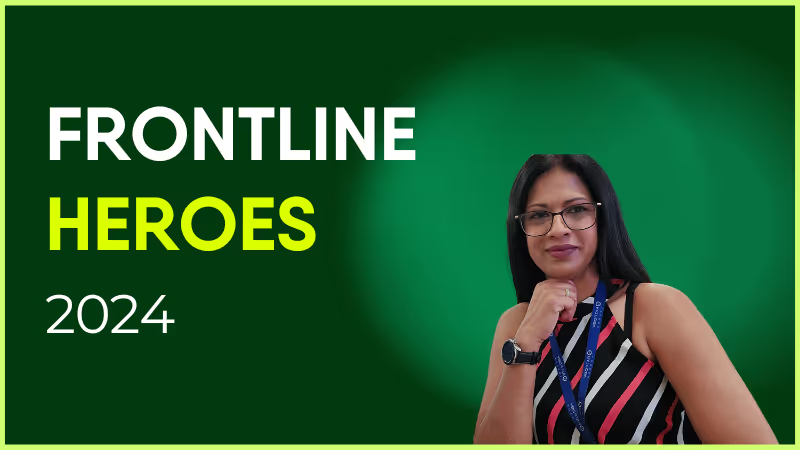
Chandi has been instrumental in representing the company and its bus drivers in cases related to traffic penalties. By thoroughly reviewing and addressing these cases, she has substantially reduced costs for both the business and individual drivers.
It is very common for bus drivers to face fines and prosecutions while doing their essential job for the communities of London. Chandi appears in Courts and Tribunals to represent the business and has successfully challenged almost 50% of the cases that come in. In years gone by the business was facing charges of up to £10k per month which have now been reduced by 70%. This is a massive saving both financially and reputationally to the business.
Most importantly, Chandi’s work provides crucial support to drivers, alleviating their stress and ensuring they feel valued. She is a quiet and meticulous professional who has created so much good in the department since her arrival in April 2024.
How has Blink helped in her role?
Blink has been used to advertise “money boxes” YBJ where fines are received. Chandi has also used the platform to share guidance and resources about observing traffic regulations, as well as demonstrating the team’s support for drivers.
What does she want to do next?
Continuing to reduce penalties, with the ultimate goal of eliminating them, would be a massive achievement, maybe seen as impossible — but what Chandi has achieved would have been seen as impossible six months ago. Chandi is keen to communicate with drivers using Blink as well as garage roadshows to raise awareness and help bus drivers avoid fines and better serve the communities of London.
Nominated by: Phil Thornton, General Manager Central Operations
Hey! I'm Theo Booth, I am originally from the UK but I have spent the majority of my life trying to travel as much as possible and I have lived in 5 countries.
Before becoming a software engineer I was in the shipping industry, initially as a broker before becoming a trader.
I did a Software Engineering bootcamp during lockdown before joining the Solutions Engineering team at Blink as a Full Stack Developer in September of last year.
The responsibilities of the role are twofold: Firstly, to scope out and build custom integrations that can service our clients needs; and secondly, to work with customers to find solutions to/tailor bespoke apps for the pain points in their current ways of working.
The culture at Blink is second to none and the diverse team is a mix of weird and wonderful people all driving towards the same goal. It’s a lovely place to work!
The last few years brought a storm of change to the HR industry. Artificial Intelligence. The gig economy. And more recently, a global pandemic has altered our reality and redefined workflows.
While Covid-19 has forced us to make many temporary adjustments to the way we live and work, not every new development is short-lived. There has been an influx of new trends that are here to stay.
These innovations have pushed us to view different areas of the HR function from a new perspective. And they have made us wonder: What’s in store for the future? What are the developments that will transform HR for good? Which trends will shape the new reality of work?
Read on for answers. In this post, we take a look at the top HR trends in 2021 for frontline business and HR leaders to take into account as they prepare for what’s to come.
Top HR trends for 2022
Designing work for frontline employees’ well-being
The line between work and home life has been blurring for some time, but the pandemic has all but erased it for many employees. In response, HR leaders have shifted from promoting work-life balance to pushing well-being into the work itself.
As per the 2020 Hartford’s Future of Benefits Study, workers are now demanding benefits like hospital indemnity insurance, additional paid time off, and employee assistance programs.
Companies, on their part, are focusing on online experiences that improve employees’ health. These include virtual team-building events, yoga and fitness sessions, and mindfulness classes, and so on.
So organizations that thrive beyond 2021 are going to be those that integrate health-related initiatives into the design of work. This will be done at the individual, team, and organizational levels to create an environment in which employees are at peak health.
Reskilling to unlock frontline worker potential
During Covid, many organizations struggled to retain employees because of financial problems, sick leave, or losing workers to the virus. So managers called on remaining employees to expand their roles and fill the gaps left by their coworkers. And like the Spartans, employees rose to the challenge.
Workers’ resourcefulness and agency in these hard times have shown that they can learn and contribute in unexpected ways. And in doing so, they have positioned their organizations to thrive in the long term.
So employee reskilling is another important trend to watch out for. According to a recent Udemy survey, the demand for building employee skills grew by 38% in 2020. The consulting company PricewaterhouseCoopers (PwC) illustrates this trend. It invested $3 billion in the learning and development of employees who have stayed with the business for at least 3 years. This suggests that reskilling is a lean and sustainable way to strengthen your workforce.
Building 'Superteams'
Organizations have been using ‘teaming’ (setting up a temporary team of people who aren’t familiar with each other) as a survival strategy to counter the impact of Covid-19. Many leaders have now begun to realize teaming as an opportunity to form “superteams.”
Coined by Thomas Malone, the term ‘superteam’ refers to the pairing of people with technology such as artificial intelligence (AI) and robotics, to rethink workflows and get faster outcomes.
The strategy of turning teams into superteams is still in its infancy, as many companies still see technology from a limited viewpoint — more as a tool than a team member.
According to Deloitte’s 2021 Global Human Capital Trends report, only 16% of executive-level leaders said that they plan to transform work by combining humans and machines.
But the trend is expected to accelerate, with organizations shifting to this new mindset and strategy in a strong position to realize the untapped potential it offers to drive growth and handle uncertainty. Making sure you have the right employee experience software, and the right tech stack is vital.
Rethinking governance of workforce strategies
Covid-19 has opened our eyes to the fact that using data on your workforce’s current state to determine employee strategies is not enough. Relying solely on the metrics showing the workforce’s present situation is risky because it limits a company’s potential to survive drastic changes. This applies to all strategies, from staffing levels to employee retention.
Some organizations are shifting their approach from strategizing for likely, minor events to planning for the unexpected. 17% of HR executives say that their companies plan to focus on the occurrence of unlikely, high-impact events, as opposed to 6% before the pandemic.
Companies that want to handle change with confidence must address questions that force them to look into the future. It’s forward-looking insights that will help businesses accomplish new milestones.
Shifting from managing employees to re-architecting work
Covid-19 has positioned HR as a prominent part of surviving a crisis. And the good news is that HR has lived up to this new standard, gaining more credibility as a result.
A survey by Deloitte has shown that both HR and business leaders are now more certain of HR’s ability to tackle future challenges.
This creates an opportunity for HR departments to leverage their new position and transform their role from that of managing employees to re-architecting work.
HR leaders can make the most of this by taking charge of reimagining both the workforce and the workplace to ensure future success.
The survey also found that 61% of business and HR executives are planning to reimagine work in the next one to three years. This would mean:
Prioritizing outcomes over outputs
Focusing on building superteams that combine human and technological capabilities
Managing the cultural and leadership changes that arise from the new approach to work
As a result, HR trends and goals will align better with business objectives. And HR will need to work closely with other departments to shape the new architecture of work.
Conclusion
These HR trends show the future holds both big opportunities and tough challenges for HR and business leaders. All this is pushing HR professionals to search for and leverage innovative technologies to improve employee productivity and engagement.
In the near future, AI-based predictive and automation technologies are likely to improve all the areas under the HR function, including talent acquisition, workforce analytics, and reskilling of employees. All these ultimately help HRs role in employee engagement.
So use these trends to anticipate new developments in the human resource field, and to inform your business processes moving forward. It will give you a solid foundation to not just survive but thrive in the face of upcoming changes.
Restaurant turnover isn't a mystery so much as an accepted cost of doing business. Limited-service restaurants saw hourly turnover of 110 percent in the third quarter of 2025, according to Black Box Intelligence, down from 133 percent in 2019 but still meaning the average crew turns over more than once a year.
The good news buried in that data: turnover isn't evenly distributed. Black Box's research also found that restaurants in the top quartile for retention, meaning the lowest turnover, see measurably better results, including a 2.6 percent comparable traffic advantage on the full-service front of house side alone. Retention isn't just a people problem. It shows up on the P&L, the same point EX=CX: the equation every restaurant operator needs to know makes about crew experience and guest experience.
Here are seven restaurant employee retention strategies grounded in what's actually driving people to leave, and stay.
Why restaurant retention starts with management
7shifts' 2025 Restaurant Employee Engagement report, surveying 1,500 active restaurant employees, found that nearly half of employees who left a restaurant job cited difficult management as the reason, and most of them went on to take another restaurant job rather than leaving the industry altogether. That's an important distinction: the people leaving aren't done with restaurant work. They're done with how they were managed.
7 restaurant employee retention strategies
1. Fix management, not just morale. If management quality is the single biggest reason people leave, retention strategy starts there, with training for shift leads and managers on how they communicate, recognize, and support their teams, not just how they run a shift.
2. Build a visible, even if short, career path. 75 percent of restaurant employees say career paths and growth opportunities are important or extremely important, per 7shifts' data, and 24 percent cite a lack of opportunity as a reason for leaving. That path doesn't need to be a corporate ladder. A shift lead role, a training certification, a clear next step is often enough.
3. Protect team relationships in scheduling. Coworker relationships rank as restaurant employees' top motivator, ahead of pay. Scheduling that breaks up teams constantly, rather than preserving some consistency in who works with whom, quietly undermines retention.
4. Take the first 90 days seriously. Most frontline turnover clusters around the three-month mark, after initial onboarding support has faded but before real engagement has taken hold. Extending structured check-ins and support past week one addresses this directly, and it's why onboarding software and retention strategy really are the same conversation.
5. Make recognition routine, not occasional. Over half of restaurant employees say more recognition from management would increase their engagement. Retention improves when recognition is built into the operating rhythm, not left to whichever manager happens to remember.
6. Close the loop on feedback. A quarter of restaurant employees say they rarely receive feedback of any kind. Retention strategies that include a real channel for employees to raise concerns, and evidence that something happens with what they raise, address a genuine and fixable gap.
7. Make the basics painless. Benefits access, schedule visibility, and payslip questions are small frictions on their own, but they add up. Self-serve access to this information removes a steady source of low-grade frustration that erodes retention over time.
Where technology fits
None of these strategies require expensive new programs, but most of them are hard to sustain consistently across multiple locations without a system behind them. A restaurant employee app that handles recognition, feedback, onboarding, and day-to-day communication in one place makes retention strategy something a franchise or multi-location group can actually execute at scale, rather than something that depends on one strong manager at one good location.
Blink brings these pieces together for restaurant brands including McDonald's, Domino's, and Shake Shack, with adoption rates in Blink's frontline customer base regularly landing above 90 percent within the first week.
At Blink, we’re constantly evolving our employee experience platform to meet the dynamic needs of organizations and their employees.
As part of our commitment to empowering great employee experiences from the frontline to the front office, we’re excited to announce our latest suite of product features designed to improve the way employees engage with their organization and with each other.
From fostering deeper social connections and real-time interactions, to improving platform security and content protection, discover 6 new features designed to help you create an engaging, reliable, and thriving workplace.
#1. Stories: Share snapshots of your company culture
In today’s fast-paced world, the need for real-time connection and engagement has never been more important — and that includes at work. That’s why we’re excited to bring Stories, a first-of-its-kind feature, to Blink. With Stories, teams can easily share moments, celebrate wins, and keep the workplace experience fun and dynamic.
Much like Stories on the social media platforms we know and love, employees and team leaders can share temporary posts that live at the top of the Feed, keeping internal content relevant and up to date.
{{mobile-stories="/image"}}
Why you’ll love it:
Instant sharing: Whether it’s celebrating team achievements, giving updates on project milestones, or sharing everyday moments, Stories offer a personal touch that helps foster a connected culture.
Boost engagement: With the ability to share everyday moments and add a personal touch using image-editing tools, Stories make it easier for employees to connect and engage beyond formal communications.
Keep content fresh: With a 72-hour shelf life, Stories are a great way to share timely messages and encourage frequent, social snapshots of your day.
With Stories, organizations can bring a fresh yet familiar approach to their internal communications strategy, engaging employees not just in critical communications but throughout their everyday work lives.
#2. Communities: Modernize your employee resource groups
As part of the reimagined Connect section, which brings Groups, Teams, and Contacts into one cohesive view, we’re excited to introduce Communities. This new feature allows employees to connect and collaborate over shared interests and hobbies.
With Communities, which are open for anyone to explore and join, employees have an intuitive and interactive digital space to foster deeper connections that go beyond day-to-day work tasks.
{{mobile-community="/image"}}
Key benefits:
Personalized experience: Employees can join Communities based on their interests, passions, or hobbies, creating a more inclusive and engaging workplace.
A dedicated space: Each Community comes with its own unique Feed, Channels, and Resources, creating a dynamic virtual hub for content and communication.
Cross-company connection: Communities provide an opportunity to engage with colleagues across the organization, helping to bridge the gap between teams, departments, and geographies.
From Parents at Work and Home Chefs, to Dog Lovers and LGBTQ+ Crew, Communities open up new opportunities for social connection, workplace collaboration, and community-building.
#3. Moderation: Enhance control over your digital spaces
In order to ensure organizations can create and maintain a positive digital environment, we’ve enhanced our platform moderation tools. Administrators can now better manage and control content in Blink through new reporting and moderation functionalities.
New capabilities:
Report a comment: Users can now report individual comments, in addition to posts, making moderation more precise.
Report reasons: Users can provide specific reasons for reporting content, enabling admins to make more informed decisions and take quick action.
Streamlined admin workflow: Moderation tasks are now part of the admin task list, ensuring that no report goes unnoticed.
These improvements give admins more transparency and control, allowing them to better maintain a respectful and focused communication environment.
#4. Mobile version control: Improve security for frontline teams
We’ve added mobile version control as an additional security measure to help organizations protect sensitive content on Blink’s platform. With this new feature, admins now have the option to require that devices meet a minimum OS version requirement, across iOS and Android, to access specific content and resources.
Why it matters:
Improved data security: By controlling OS versions, companies can add an additional layer of security to any sensitive resources housed in the Content Hub.
Tailored policies: Admins can customize their security settings to include OS version requirements, helping to meet BYOD (bring your own device) policies and ensuring compliance.
Prompted updates: As part of this feature, Blink will alert employees in-app whose devices don’t meet the minimum OS requirements and prompt them to update their device. Blink will let me know I need to update my device’s operating system.
This update is crucial for companies prioritizing security, especially those with frontline, hybrid, or remote workers who often use their personal devices.
#5. Custom profile fields: Tailor your employee inputs
In addition to our 15 out-of-the-box user profile fields like “Name” and “Location,” we’re excited to roll out customizable profile fields.
Admins can now set up custom profile fields to gather the data they need and expand Blink’s usability, paving the way for admins to design a truly tailored Blink experience for their organizations and employees alike.
A closer look:
Customization: Admins can now create custom fields to collect and manage unique user data, offering more tailored experiences for employees.
Scalability: Whether you’re managing teams in retail, healthcare, or any other industry, custom fields make it easy to track data points that matter most to your organization.
Extensibility: This is just the first step! Soon, custom fields will be integrated across more Blink features, making it easier to manage employee information in a way that works for you.
With these customized fields, you can gain deeper insights, streamline processes, and capture workforce data that aligns with your organization’s unique operational needs.
#6. ServiceNow notification integration: Stay on top of IT updates
Lastly, but certainly not least, we’ve expanded our integration capabilities. Our seamless notification integration with ServiceNow enables employees to receive real-time updates on their IT tickets directly within Blink.
How it works:
Real-time notifications: Whenever an IT ticket is updated or resolved in ServiceNow, employees receive instant notifications via the Feed.
Improved efficiency: This integration reduces the need for employees to switch between platforms, keeping everything in one place and ensuring they stay informed about their requests.
Enhanced integrations like these ensure that Blink can continue to be the central hub for all of your employee communications and task management needs.
Bring your consumer-grade employee experience to life.
As workplaces continue to evolve, our goal remains the same: to provide the tools that foster connection, enhance productivity, and create a seamless and exceptional experience for every employee — no matter what they do and where they work.
These product enhancements are our next step in empowering organizations to meet — and exceed — the expectations of a modern and digitally savvy workforce.
Managing frontline employees is an altogether different task than leading a desk-based team.
For one, you’re usually working in shift patterns and you might have insufficient tooling to keep you all connected. This connection gap makes it all the harder to navigate the “Great attrition” risks and widespread disengagement that most first-line/frontline managers are faced with.
But we don’t need to linger on the reasons why managing the frontline can be hard. Let’s focus instead on how to do it more effectively.
Because if we can empower first-line managers to better manage their teams, we can help reduce attrition, increase engagement, and improve the employee experience for everyone.
In this guide, we'll discussyour role as a frontline manager, the challenges faced by frontline teams and their managers, and the best practice approaches you can adopt when managing frontline employees.
Understanding the first-line manager role
Frontline managers play a pivotal role in any deskless organization and account for roughly 60% of a company’s management ranks. They are responsible for managing the day-to-day activities of their teams and ensuring that their organization's frontline remains strong and efficient.
Ultimately, the role of a first-line leader is to enable frontline workers to do their jobs effectively. This might include setting objectives, delegating tasks, providing feedback on frontline employee performance, and ultimately driving organizational success. But it also means giving positive and constructive feedback: celebrating a job well done and stepping in to rectify when things aren’t going right.
And yet, first-line managers are often “accidental managers”, too. They might have been promoted to a managerial role because of their subject matter expertise and hands-on experience in the business — but they’ve yet to receive any dedicated management or employee engagement training to prepare them for the job. A large proportion (around 40% based on recent Harvard Business Review research) are first-time managers as well, in the very first year of their leadership journey.
Maybe that’s a description that resonates? And if it is, you’ll also be able to appreciate how that makes the role more difficult.
First-line managers: overworked and under-invested in?
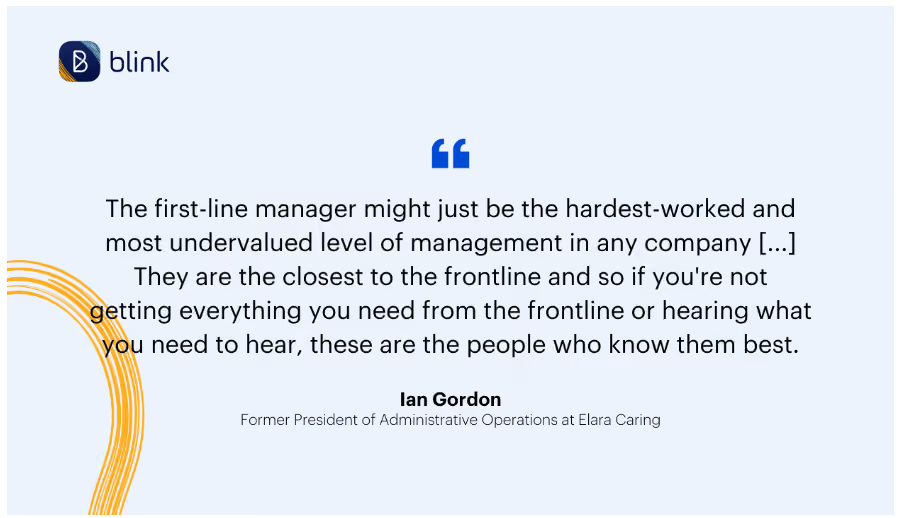
First-line managers can be the hardest working and most undervalued level of management — under pressure from all angles and expected to pick up the slack caused by frontline labor shortages.
When an organization propels someone into a leadership role with insufficient training and insufficient support, we can hardly be surprised if they struggle to perform. And many first-line managers do: 60% in fact, over their first two years.
Flipping that figure around and helping first-line managers to perform is relatively easy to achieve.
A frontline manager’s potential can be unlocked by:
Providing them with tools for proper team-wide communication and workforce management
Investing in employee engagement training to help manage and improve team morale
Alleviating the strain of manual, repetitive tasks to free up their time to better manage their teams
Doing so is in everyone’s best interests. Frontline employees will receive a better and more fulfilling workplace experience which helps them deliver a better quality of service to customers. The impact of this will be felt on the organization’s bottom line, making frontline manager empowerment a business-critical mission for the C-Suite and other leaders.
If you’re a first-line manager, it’s good to know your worth.
You are in a unique position within the organization — you’re frontline-facing and can act as a touchpoint between frontline workers and your desk-based peers. You can also be the catalyst for better frontline employee engagement and motivation.
Common challenges when managing frontline employees
If you’re facing challenges as a first-line manager, know that you’re not alone.
There are a number of common issues impacting frontline teams, including:
Poor communication and engagement
Attrition and turnover
Labor shortages
Unstable service levels and disappointed customers
Lack of useful tooling
Lack of training for frontline teams
Lack of training for first-line managers themselves
Attrition, turnover, and the unavoidable staff shortages that follow can seriously impact the quality of service provided by the frontline workforce. Frontline teams increasingly struggle to cover more tasks with fewer resources — and it’s often the first-line manager who is left racing to fill empty shifts, deliver on tasks, or explain the drop in productivity to other senior management.
High turnover rates can also have a detrimental effect on frontline team morale, as new employees come in and existing ones leave at a rapid rate. Open communication between you and your team — which also means providing fit-for-purpose employee engagement tools and solutions, and employee engagement activities — will be key in helping to build trust and loyalty within the organization.
Finally, frontline managers must effectively advocate for their teams when they are not getting adequate support from executives and training from the business. This may involve having difficult conversations with the C-Suite or presenting frontline engagement data that shows the value of investing in frontline teams.
7 best practices when managing frontline employees
1. Thorough onboarding
It’s important to provide all new team members with a detailed onboarding program. You want to create a sense of community for them and ensure that they know any responsibilities and KPI expectations for the role from the get-go.
All frontline employees should receive adequate training for their specific roles and ensure they understand the requirements of their job. This will be a compliance must-do in many frontline organizations, of course, but even if the role is light on health and safety or legal regulations, you’ll want to take the time to outline the responsibilities clearly.
Onboarding can be a time-consuming process but it's an early driver of employee engagement, so explore the tools you have available to help lighten the load.
Again, the business case for doing so is easy to sell to decision-makers: the faster you can onboard new joiners, the sooner they can help move the business forward (and the less time and focus you’ll lose on your other essential tasks).
2. Active listening
Listening — and we mean really listening — to your frontline teams is essential for successful frontline management.
It can be difficult for frontline employees to feel heard, as they are often more spread out than desk-based colleagues and have less access to resources and support. As a frontline manager, it is important to ask for, actively listen to, and then share the concerns of your team.
3. Communicate across the board
Frontline teams have a unique brief when it comes to internal communications, and there aren’t too many tools that are really fit for purpose.
Having access to a mobile-first frontline employee appcan help keep everyone in the organization connected. As a first-line manager, you can lead by example — posting and commenting on company updates, messaging frontline employees directly and within groups, as well as making sure that senior leaders are seeing what’s being shared.
By prioritizing communication with your frontline employees, you can ensure they always feel informed, appreciated, and engaged — no matter how infrequently you see them face to face.
4. Support and pastoral care
Management support is key for each team member to feel valued and to keep morale high knowing that their supervisor has their back. This can be done through regular check-ins, providing tailored resources for their development, and actively listening to — and actioning — their feedback for the business.
Empowering your frontline workforce with the support of intuitive scheduling solutions and the autonomy to manage their own workloads can also help them feel valued and give them a sense of responsibility.
Finally, providing instant access to mental health resources will enable employees to feel safer in the work environment, and more comfortable in approaching their manager with any issues they may have.
A TikTok video showing a restaurant manager comforting a tearful employee sparked a big conversation about pastoral care for frontline teams. You will find an approach that feels comfortable and beneficial for you and the people you work with every day.
5. Professional development
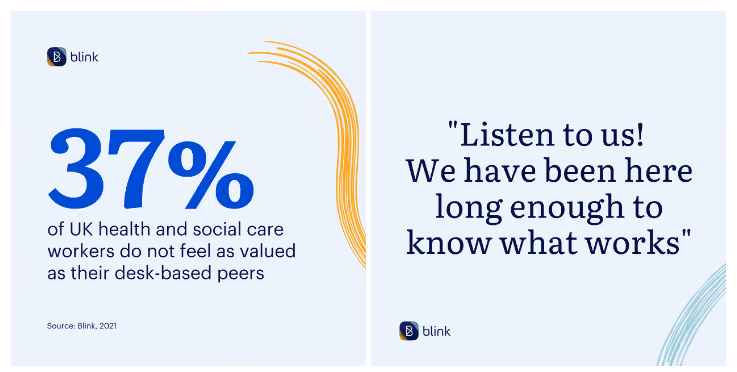
Many frontline workers feel that they do not receive the same access to career advancement opportunities as their desk-based colleagues. This can leave frontline staff feeling undervalued and, unsurprisingly, employee motivation starts to dwindle.
Professional development is key for frontline employees. Frontline managers know what is expected of them, and what it takes to be successful in the role. If you see those characteristics in someone else, develop them. This might mean connecting them with development opportunities, recommending them for promotion or training, as well as checking that your frontline staff are happy with their career development via ongoing employee surveys.
By investing in your frontline team’s growth, you can ensure that their skills are kept up to date, increasing their confidence and improving their job satisfaction.
6. Reward hard work and commitment
It’s essential to provide frontline employees with tangible rewards for their hard work and dedication, just as you would your desk-based staff. Not seeing your deskless employees every day doesn’t equal forgetting about their contributions to your company — that’s something you may need to remind desk-based senior leaders.
Rewarding your frontline can be done in a variety of ways: bonus pay, gift cards, lunch vouchers, or even just a public shoutout across the company. This helps to show appreciation for their efforts and encourages them to continue striving for excellence. It also allows you to boost employee morale and create a positive working environment.
While rewarding great work is important, in the current economic climate, businesses don't always have the funds to pay frontline workers more. That's why reward and recognition should always go hand-in-hand.
7. Recognize team and individual achievements
Employee recognition, small or large, is crucial for motivating and inspiring team members.
Showing appreciation is a great way to boost morale and create a positive working environment. Recognizing employees can come in various forms such as verbal praise, recognition in meetings, and virtual employee recognition or Kudos.
If someone has dealt with a difficult customer or situation well, recognize this. If someone has worked extra hard to ensure quality of service, recognize this. Acknowledging great work can help empower employees and make them feel appreciated for their efforts. It’ll also make them more likely to perform that way again.
To retain a frontline worker and enable them to become a valuable asset to your organization, you need to ensure their efforts are recognized. By following this advice, you can show them that their hard work is appreciated and foster an environment of engagement and success.
Expert tips from frontline managers
Healthcare ops expert and former President of Administrative Operations at Elara Caring, Ian Gordon, has some key insights for us on the topic of engaging with frontline employees.
Here are just a few of his expert tips for navigating frontline management and engaging your deskless workforce:
Create bi-directional communication: Communicating issues is a team effort. It starts with the CEO and runs the full way through to the frontline. Everybody has to own it
Redeploy resources to the frontline: Increasing investments into the skills and capabilities of your frontline can be a true differentiator in the marketplace. It is also a good reason for your frontline to feel appreciated and invested in. Wondering where this extra budget will come from? If you can help retain employees with training and development, then you won’t need to spend so much on continuous recruitment
The right tech: Being a frontline worker, you can’t spend a lot of time signing in and navigating complex tech. Having hub-based access to all-inclusive and easy-to-navigate information can really be a benefit to employees
Keeping frontline employees engaged is a key part of running a successful business.
Strategies for employee engagement and retention should cover the seven tips mentioned above. As well as providing accessible resources, frequent rewards and recognition, and implementing tailored technology solutions, you can foster an environment of engagement that will help to retain your frontline workers and enable them to become valuable assets for the organization.
Remember: investing in the growth of your frontline team is essential for success. With the right tools and support in place, you can create an environment of engagement in which everyone feels able to thrive.
Enable: Give your frontline the tools, information, and inspiration they need to go above and beyond.
Engage: Give your frontline instant access to the news, people, and information they need to feel part of the team.
Understand: Use data and insights you need to make the best decisions for your frontline team.
With our one-stop solution, you can get rid of complex and outdated processes that are blocking your frontline's satisfaction — and their success. With Blink, you can finally empower your frontline with the tools they need to succeed.