Best employee engagement tools in 2026
It's 7am and a store manager is trying to get forty people onto the same page before doors open. Half the team doesn't have a company email address. The policy update from head office went out on Monday and three people still haven't opened it. The engagement survey from last quarter is sitting in a spreadsheet nobody's looked at since. This is the daily reality an employee engagement tool is supposed to fix, and most of the lists ranking for this search were written by people who have never run a frontline team.
The best employee engagement tools go beyond measuring how people feel. They give every employee, whether they sit at a desk or stand on a sales floor, a way to be heard and a reason to care. This guide compares 10 of the leading options for 2026, with a specific lens on what actually works when a meaningful share of your workforce doesn't have a laptop. For a broader look at what drives engagement in the first place, see our guide to measuring employee engagement.
How we chose
We evaluated each tool against six criteria that matter most for organizations with any frontline, deskless, or multi-site population:
- Mobile reach without email. Can every employee get access without a corporate email address or company device?
- Two-way feedback. Can employees respond, not just receive?
- Recognition. Is peer-to-peer and manager recognition built in, or bolted on?
- Analytics. Can you see what's landing and what isn't, by location, team, or role?
- Integrations. Does it connect to the HR, scheduling, and payroll systems you already run?
- Ease of rollout. How fast can you realistically get this live across every site?
We pulled every competitor fact from the vendor's own website or public pricing page. No prices are listed below because most of these vendors quote custom pricing, and packaging changes more often than comparison articles get updated, so check current plans directly on the vendor's site before you shortlist.
Employee engagement tools compared
The "frontline fit" column below reflects how well each tool works for employees who don't sit at a desk. Legend: strong means built mobile-first with no email requirement, moderate means usable on mobile but designed primarily for desk-based teams, and limited means it assumes email access and a company device.
{{blink-table:table-1}}
The 10 best employee engagement tools in 2026
1. Blink
Best for: organizations with a frontline, shift-based, or distributed workforce that need one app for communication, recognition, and feedback.
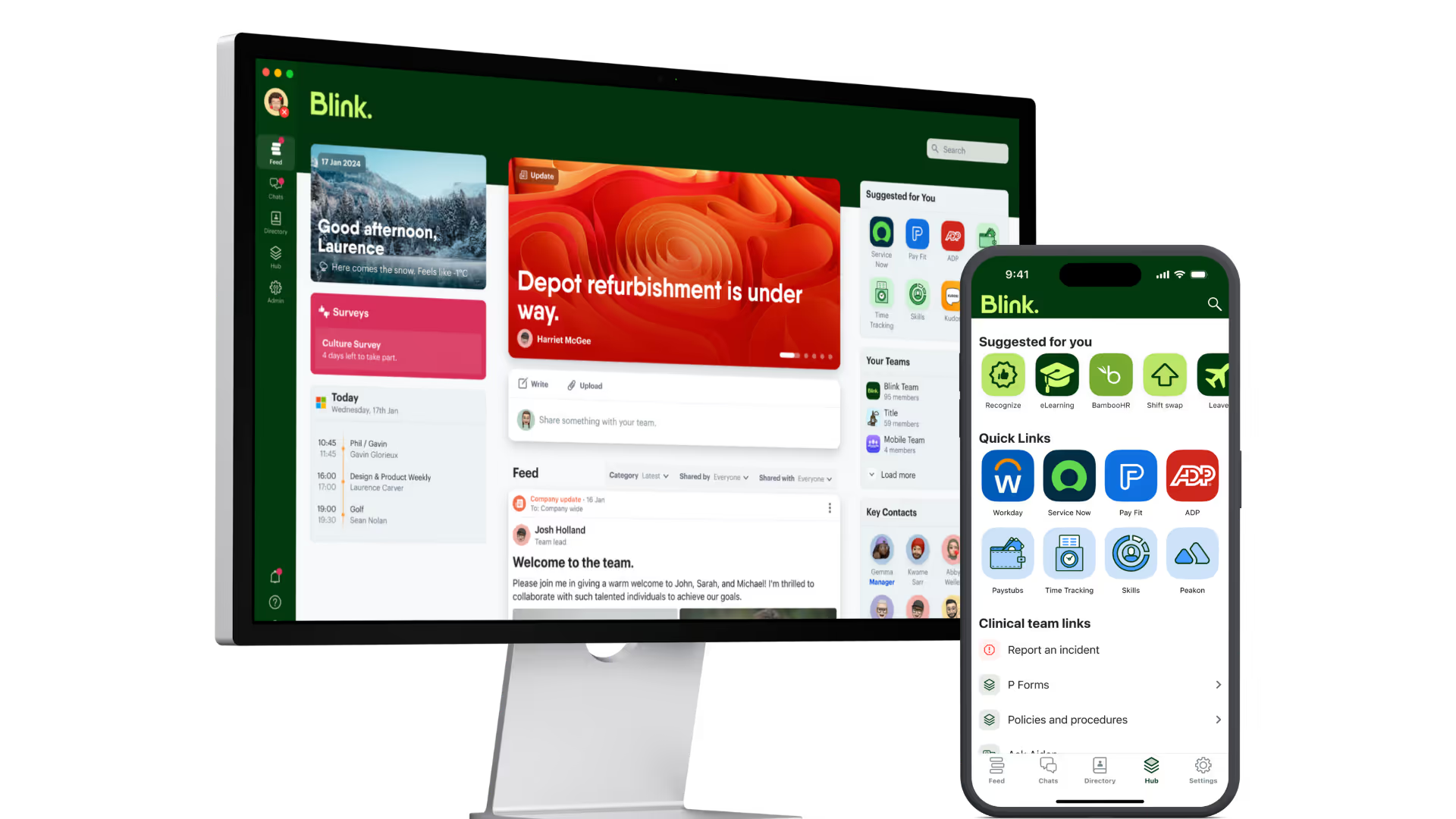
Blink is a mobile-first employee experience platform built for people who don't sit at a desk. Every employee gets access on their own phone, no corporate email required, and everything they need day to day lives in one place: a company feed, peer-to-peer and group chat, recognition, surveys, and a document hub. You can see current plans on Blink's pricing page, or start a 14-day free trial to try it with your own team.
Strengths:
- A single feed for company updates, with priority posts and mandatory reads that track who's seen what. That matters for compliance-heavy industries where "I didn't see the message" is a real risk.
- Built-in peer-to-peer recognition, so appreciation doesn't require a separate app.
- Pulse and multi-question surveys with AI-assisted survey building, so comms and HR teams can go from question to insight without a research team.
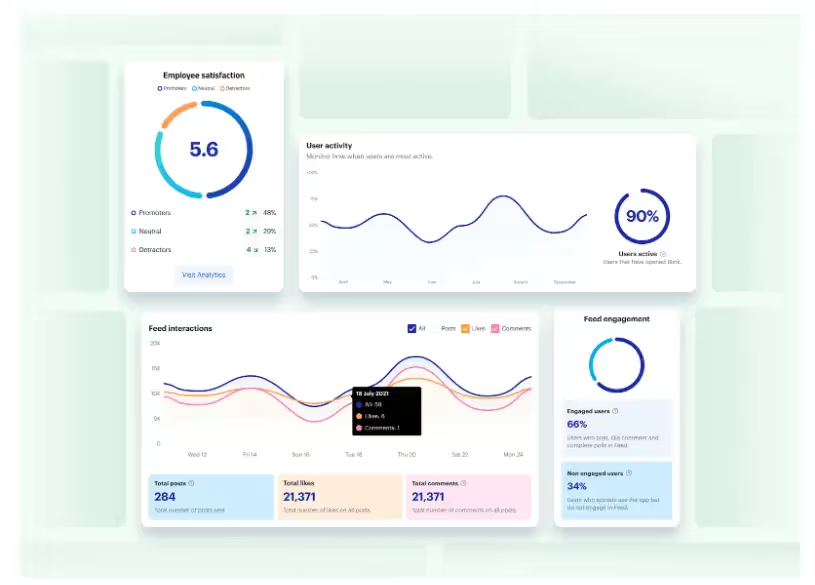
- Blink IQ, Blink's analytics layer, shows which content lands, which locations or teams are hardest to reach, and where engagement is dropping off, not just a single engagement score.
- Integrations with major HR and workforce systems, including Workday, for user sync, SSO, and nudges that bring HR tasks into the flow of work.
- Fast rollout: JD Sports reached 87% adoption within 10 days of launch.
Watch-outs: Blink is built frontline-first, so desk-based-only organizations with no distributed workforce may be better served by a desk-based, HRIS-native tool such as Lattice.
2. Workvivo
Best for: mid-market and enterprise organizations that want a social, culture-driven employee app.
Workvivo (a Zoom company) focuses on a social feed experience, with campaigns, shoutouts, and leadership video. It's well suited to organizations that want employee engagement to feel like an internal social network.
Strengths: strong social and culture features, employee-generated content, integrates with the Zoom suite.
Watch-outs: cost at your scale depends on headcount and the modules you need. See workvivo.com for current packaging.
3. Staffbase
Best for: large enterprises with a mature internal comms function and a need for a structured intranet.
Staffbase is one of the longest-standing players in enterprise internal communications, with multi-channel publishing, an employee app, and intranet capabilities.
Strengths: deep publishing and governance controls, established enterprise track record, broad channel support.
Watch-outs: implementation is typically a larger, longer project, which suits enterprises with dedicated IC resource but can be heavy for a leaner team. See staffbase.com for scope and implementation timelines.
4. Culture Amp
Best for: organizations that want to lead with engagement surveys and people analytics.
Culture Amp built its name on survey science. It offers a large library of validated survey templates and uses AI to summarize results.
Strengths: strong survey methodology, people analytics, performance and development tools.
Watch-outs: Culture Amp is primarily a listening and analytics tool rather than a day-to-day communication or recognition app. See cultureamp.com for current scope.
5. Qualtrics EmployeeXM
Best for: large enterprises that need advanced experience management across the full employee lifecycle.
Qualtrics EmployeeXM is part of the broader Qualtrics experience management suite, with deep survey customization and predictive analytics.
Strengths: enterprise-grade survey design, predictive and text analytics, strong integration with other Qualtrics products.
Watch-outs: the platform's depth comes with complexity. Smaller teams or those without a dedicated analyst often need support to get full value. See qualtrics.com for current packaging.
6. Lattice
Best for: organizations that want engagement tied closely to performance management and goal-setting.
Lattice combines performance reviews, OKRs, and engagement surveys in one platform, aimed primarily at office-based and knowledge-worker teams.
Strengths: strong performance and goals workflow, engagement surveys baked into the same system managers already use for reviews.
Watch-outs: Lattice is built around desk-based performance workflows, so it's a weaker fit for frontline teams without regular system access. See lattice.com for details.
7. Workhuman
Best for: large enterprises that want recognition and service awards as the center of their engagement strategy.
Workhuman is a dedicated social recognition platform, with peer-to-peer recognition, service anniversaries, and reward redemption.
Strengths: mature recognition and rewards catalog, strong analytics on recognition trends, enterprise scale.
Watch-outs: Workhuman is recognition-first rather than an all-in-one communication platform. See workhuman.com for scope and packaging.
8. Connecteam
Best for: small and mid-sized businesses that need operations and engagement in one lighter-weight app.
Connecteam combines scheduling, task checklists, chat, and basic recognition, aimed at SMB frontline teams.
Strengths: operational features alongside engagement, approachable for smaller teams, mobile-first.
Watch-outs: review which tier includes what before you compare cost against an all-in-one platform. See connecteam.com for current plans.
9. Beekeeper
Best for: frontline and operational teams that want communication tied closely to workflow automation.
Beekeeper offers chat, campaigns, and workflow automation aimed at frontline operations, with a focus on connecting comms to operational processes.
Strengths: workflow automation, campaign tools, frontline-oriented design.
Watch-outs: check which plan includes the analytics and recognition depth you need. See beekeeper.io for current scope.
10. SurveyMonkey
Best for: organizations that want a standalone, dedicated survey tool rather than a full engagement platform.
SurveyMonkey remains a widely used survey tool, with templates, reporting, and AI-assisted sentiment analysis.
Strengths: easy to deploy, flexible survey design, familiar to most HR teams.
Watch-outs: SurveyMonkey measures engagement. Driving it day to day, through recognition and ongoing communication, takes a separate tool. See surveymonkey.com for pricing and features.
Engagement tools by industry
Retail: retail teams are spread across stores with high turnover and little desk access. The priority is a mobile app that reaches every store employee directly, with recognition that works across shifts and locations. At Riviera Hardware Holdings, a competition to recognize the most-engaged team member drew a direct show of support from frontline staff, with the winner posting his own thanks on the platform for bringing some competitive fun back into a sales-target-driven role. For more sector detail, see our guide to employee engagement ideas.
Healthcare: healthcare organizations need mandatory read tracking and acknowledgment logs for policy and compliance communication, alongside recognition that reaches care staff who rarely sit at a desk. Reliable delivery and an audit trail matter as much as the comms itself. Our healthcare engagement guide covers this in more depth.
Manufacturing: manufacturing teams often have shift patterns, language diversity, and limited desktop access. The right tool needs to reach the plant floor directly, support plant-level targeting, and give comms teams visibility into which sites are engaged and which aren't. AG Barr let employees choose the app's own name as part of the launch, building momentum with peer-to-peer champions and a prize competition rather than treating it as a standard software rollout. See our guide to employee engagement in manufacturing for more.
How to choose for a frontline workforce
If a meaningful share of your workforce doesn't sit at a desk, start by ruling out anything that assumes a company email address or a laptop. From there, prioritize:
- Mobile-first by default, not as an add-on. Check how employees actually log in. Personal device access without MDM friction matters.
- Two-way, not broadcast-only. Surveys, chat, and recognition should let employees respond, not just receive.
- Visibility by location or team. You need to know which sites or shifts are engaged, not just a company-wide average.
- A rollout plan, not just a login link. The platforms with the strongest adoption stories involve champions, local launch moments, and comms teams from day one, not just a go-live email.
- Integration with what you already run. Check whether the tool connects to your HRIS, scheduling, or payroll system before you commit to manual user management, and weigh that against the overhead of running point solutions for comms, recognition, and feedback separately versus one platform like Blink.
Start a 14-day free trial to see how Blink works for your team: app.joinblink.com/#/start-trial/start. Prefer to talk it through first? Book a demo.
FAQ
What's the difference between an employee engagement tool and an internal communications tool?
There's a lot of overlap, but internal comms tools focus on broadcasting updates, while employee engagement tools add two-way feedback, recognition, and analytics on top of communication, giving teams visibility into what's landing. The line has blurred as comms-first platforms add feedback and recognition features and engagement-first platforms add broadcast tools. When comparing options, look at which capability each vendor built first, since that's usually where the product is strongest. For a frontline or shift-based workforce, the distinction matters less than mobile reach without a company email.
Do employee engagement tools work for frontline or deskless employees?
Only some do. Many were built for desk-based teams first, assuming a company email address and regular laptop access. Look for mobile-first access that doesn't require an email address, plus features like mandatory read tracking and acknowledgment logs that matter more for shift-based and compliance-heavy teams. Multi-site visibility, seeing which locations or shifts are engaged rather than a single company-wide number, is another sign a tool was designed with frontline teams in mind rather than added as an afterthought.
How much does an employee engagement platform cost?
Pricing varies widely by vendor, user count, and features, and most providers quote custom pricing rather than listing it publicly. Vendors also gate features like analytics depth, AI tools, or recognition budgets behind higher plan tiers, so two quotes for the same headcount can cover very different capability. Ask specifically what's included at your expected headcount before you compare total cost.
Can I use more than one employee engagement tool at once?
Many organizations do, for example a survey tool alongside a comms platform. But running separate tools for communication, recognition, and feedback often means lower adoption overall, since employees have to check multiple apps to get the full picture. An all-in-one platform like Blink tends to perform better for frontline teams who have limited time between tasks to engage with any one app, let alone several.
How do I measure whether an employee engagement tool is working?
Look past a single engagement score. Track adoption by location or team, response rates on surveys, recognition activity, and whether critical updates are actually being read and acknowledged, not just sent. According to Gallup's 2024 State of the Global Workplace report, only 23% of employees worldwide are engaged at work, so a tool that reports only a single headline score will miss most of the variation at site level. For frontline teams specifically, site-level and shift-level breakdowns matter more than a company-wide average, since engagement often varies sharply by location.