
The most common communication challenges in organizations from big enterprise businesses to small startups are so widespread that dealing with them can start
Communication challenges (and how they affect your bottom line)
The deep impact of communications challenges in organizations
Jess DeVore
Published:
September 6, 2023
Last updated:
June 13, 2024
What we'll cover
The most common communication challenges in organizations from big enterprise businesses to small startups are so widespread that dealing with them can start to feel normal.
It’s easy to forget that internal communications issues can have a big impact. Don’t make the mistake of thinking you can safely back burner internal comms because communication challenges and barriers are so widespread.
The fact is that poor internal communications can seriously harm your business. It’s a domino effect of frustrating communication, poor morale, lower productivity, higher absenteeism leading to higher employee turnover, and finally, higher costs and smaller profits.
Of course, when you’re in the thick of things, the relationship between poor internal comms and your bottom line might not be very clear. After all, it wasn’t that long ago that communication was thought of as a nice but not necessary soft skill.
We put together this article to lay out some of the ways communication challenges and barriers can sap a company’s resources along with strategies for making your internal comms more effective (also see the best way to improve internal communications).
The deep impact of communications challenges in organizations
The idea that internal communications problems can make a business less profitable can seem overblown.
The statistics, however, show that having a weak internal comms strategy (or having no strategy at all) can have a detrimental impact on everything from employee engagement to your business's bottom line.
Here’s how communications challenges in organizations affect success.
Communication challenges and barriers lead to increased employee turnover
Studies looking into the real cost of employee turnover often show different results.
Some studies show it costs employers 33% of a worker's annual salary to hire a replacement while other research suggests that it costs three times that salary.
What all of the data has in common is that employee turnover definitely costs companies big bucks.
Relationships suffer when communication is a problem
Two heads are better than one, but whole teams of heads are necessary for long-term success.
When people can’t communicate with one another effectively because of technical barriers or, worse, can communicate but feel uncomfortable doing so because there’s not a culture of openness at a company, collaboration may slow or even stop.
That means innovation can’t happen and problems languish with no solutions. Your employees just can’t be as productive when relationships with colleagues are strained and everyone feels like they’re working in isolation.
Less productivity means less profit.
Customer service suffers when there are communication challenges
Internal communications and external communications are inexorably linked.
Employees need access to information to answer customer queries, respond to sales inquiries, or help customers get what they need.
When they can’t get that information easily, they’re apt to feel a strong sense of disengagement that can actually lead to everyone—workers and customers alike—feeling frustrated and dissatisfied during encounters.
Dissatisfied employees leave, and as we’ve shown above, that costs money. And dissatisfied customers take their business elsewhere, costing you even more.
Poor communication = stress = higher healthcare costs
This might seem like a stretch, but stress costs the United States $300 billion every year—a figure that includes costs shouldered by businesses that provide insurance to their employees.
While there’s no way to show a hard and fast causal link between frustrations caused by comms issues and increased healthcare costs, it’s worth mulling over the idea that the communications challenges in organizations that stress workers out may also be contributing to expensive physical and mental health issues in those same employees.
Healthcare is expensive, after all, and effective internal comms is cheap in comparison.
Internal communication problems can be a motivation killer
Workers who don’t feel like they have an important role to play, who don’t understand what is expected of them, and who feel like they don’t have a voice literally can’t give their all.
Time that would otherwise go toward productive (and profitable) work is instead spent trying to navigate a confusing company culture or to figure out what that company’s priorities are. There’s no passion among employees because they feel totally disengaged from their tasks and their teams.
The Gallup State of the American Workplace report put it succinctly: “Actively disengaged employees aren’t just unhappy at work—they are resentful that their needs aren’t being met and are acting out their unhappiness. Every day, these workers potentially undermine what their engaged coworkers accomplish.”
Communications challenges in organizations lead to mistakes
Workers who have access to the information they need to really contribute to a company make fewer mistakes because they feel comfortable concentrating on the work in front of them.
Employees who are focused on trying to figure out what their priorities should be or simple emotional management are more prone to error.
In a retail environment, the result of this kind of disengagement may be fewer sales. In industries like healthcare, however, mistakes can lead to hugely expensive regulatory issues or even injury and death.
Poor internal communication makes boosting employee satisfaction impossible
You can’t boost your workers’ overall satisfaction if you don’t have a clear idea of what employees like and don’t like about their day to day.
At companies with strong internal communications strategies, managers regularly touch base with employees to get a sense of what’s working and what isn’t. When comms just isn’t a priority, chances are slim to none that workers will open up about what changes could make your business better.
Absenteeism rates are higher when communications is an issue
Employees who can’t jump ship at the moment may show their communications-related dissatisfaction by simply not showing up.
A Gallup study conducted in the UK showed that disengaged workers miss 10 more working days each year compared to peers who feel a strong connection to the company vision and are clear on what’s expected of them.
The biggest challenges facing internal communications teams
The factors that have contributed to the biggest communications challenges in organizations are well documented at this point. Lack of clarity, platform. and targeted messaging.
The main problem that companies have faced has always been how to address those factors effectively and economically. Email and Dropbox alone are outdated.
Just having a clear vision doesn’t necessarily mean it is easy to share and then reinforce that vision. A company intranet portal that provides a platform for internal comms may not actually facilitate good communication. And getting the right information into the hands of the right people has always been tough.
Luckily, solving the big communications challenges in organizations has become easier with tech tools like an internal communications tool. Intranets have evolved over time from simple information repositories to a kind of mobile base of operations where business happens from anywhere.
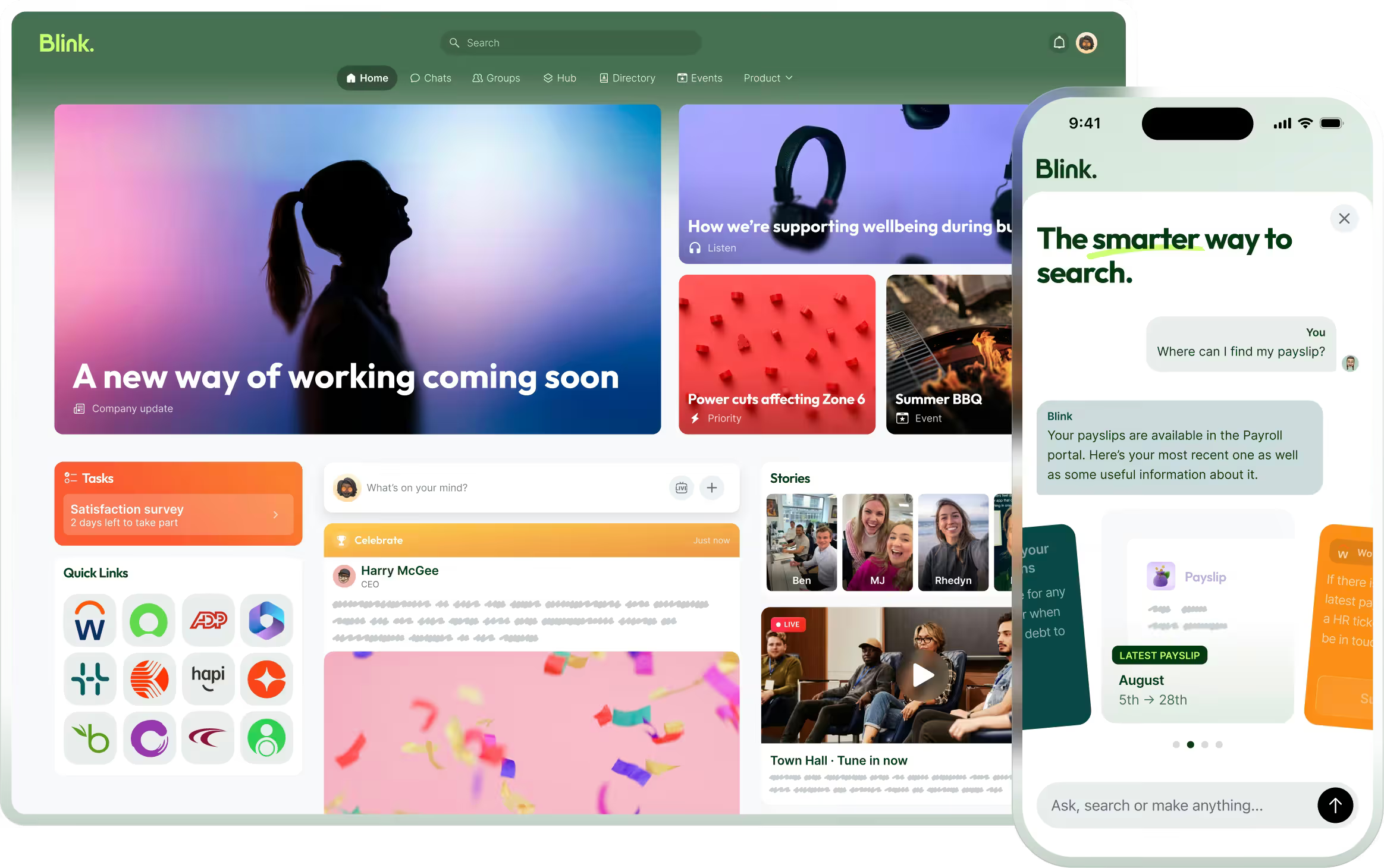
Blink, for instance, can help you communicate administrative and benefits information, but is also a platform for collaboration, a place to store and search for data, a way to solicit feedback (including anonymous feedback), and a social hub for employees to share with one another.
It lets internal comms teams curate messaging so employees stay on the same page without getting overwhelmed by emails, meetings, memos, and Slack chatter.
Up-to-date internal comms tools like Blink’s employee app are even more important for businesses with a lot of frontline workers—especially now that nontraditional employees like remote workers and long-term contract workers make up such a large percentage of the workforce.
By automating paper-based processes, microapps like this help increase productivity overall.
How effective internal communications will change your business for the better
Curious about what effective internal communication can really do for your bottom line? Here are some statistics that might surprise you:
Companies that communicate effectively are 50% more likely to report below average turnover levels.
69% of employees say they’d work harder if their contributions were recognized and praised.
Knowing what you know now, we also want to offer you a quick list of steps you can take right away to gauge how your internal comms is currently working and to enhance your internal comms strategy.
Assess your current strategy — Assuming you have one, that is. If not, you’ll want to make one. But if you do, take the time to consider your internal communications objectives, who has ownership of comms, if the tools you are using are effective, and whether your current strategies are really getting the job done.
Poll your employees — Do they feel like they have a voice in your company? If they have an idea, can they easily share it? When they have questions, can they find answers quickly and easily? Does dealing with administrative tasks take up way too much time? Do they like your communications tech? Let workers answer anonymously and adjust your comms strategy accordingly.
Put everything in one place — Make this the year you finally commit to storing your company data in one place so tracking down a file is never again a half-day affair. When you use Blink to store the information your employees need—from HR docs to project guidelines—they can easily find it all.
Stop sending so many emails — Lengthy, reply-all type email threads are frustrating and, frankly, easy to ignore. Worse, they interrupt the flow of work and often contain irrelevant information leaving workers feeling resentful instead of informed.
Send information to the right people — Use a comms platform like Blink that lets you send information to specific employees and teams instead of the entire company. You can even label posts priority and check to make sure that your messages were received and read by recipients.
The bottom line is that employees at every level of your company will be happier, more productive, and more passionate about their work if they feel informed.
The internal communications strategy you put into place now will not only make it easier for your employees to do their jobs, but will also make your company more profitable in the long run.
Blink makes it easier to overcome the most common organizational communication tool challenges in organizations. Are you ready to tackle the challenges facing internal communications at your company?

The most common communication challenges in organizations from big enterprise businesses to small startups are so widespread that dealing with them can start to feel normal.
It’s easy to forget that internal communications issues can have a big impact. Don’t make the mistake of thinking you can safely back burner internal comms because communication challenges and barriers are so widespread.
The fact is that poor internal communications can seriously harm your business. It’s a domino effect of frustrating communication, poor morale, lower productivity, higher absenteeism leading to higher employee turnover, and finally, higher costs and smaller profits.
Of course, when you’re in the thick of things, the relationship between poor internal comms and your bottom line might not be very clear. After all, it wasn’t that long ago that communication was thought of as a nice but not necessary soft skill.
We put together this article to lay out some of the ways communication challenges and barriers can sap a company’s resources along with strategies for making your internal comms more effective (also see the best way to improve internal communications).
The deep impact of communications challenges in organizations
The idea that internal communications problems can make a business less profitable can seem overblown.
The statistics, however, show that having a weak internal comms strategy (or having no strategy at all) can have a detrimental impact on everything from employee engagement to your business's bottom line.
Here’s how communications challenges in organizations affect success.
Communication challenges and barriers lead to increased employee turnover
Studies looking into the real cost of employee turnover often show different results.
Some studies show it costs employers 33% of a worker's annual salary to hire a replacement while other research suggests that it costs three times that salary.
What all of the data has in common is that employee turnover definitely costs companies big bucks.
Relationships suffer when communication is a problem
Two heads are better than one, but whole teams of heads are necessary for long-term success.
When people can’t communicate with one another effectively because of technical barriers or, worse, can communicate but feel uncomfortable doing so because there’s not a culture of openness at a company, collaboration may slow or even stop.
That means innovation can’t happen and problems languish with no solutions. Your employees just can’t be as productive when relationships with colleagues are strained and everyone feels like they’re working in isolation.
Less productivity means less profit.
Customer service suffers when there are communication challenges
Internal communications and external communications are inexorably linked.
Employees need access to information to answer customer queries, respond to sales inquiries, or help customers get what they need.
When they can’t get that information easily, they’re apt to feel a strong sense of disengagement that can actually lead to everyone—workers and customers alike—feeling frustrated and dissatisfied during encounters.
Dissatisfied employees leave, and as we’ve shown above, that costs money. And dissatisfied customers take their business elsewhere, costing you even more.
Poor communication = stress = higher healthcare costs
This might seem like a stretch, but stress costs the United States $300 billion every year—a figure that includes costs shouldered by businesses that provide insurance to their employees.
While there’s no way to show a hard and fast causal link between frustrations caused by comms issues and increased healthcare costs, it’s worth mulling over the idea that the communications challenges in organizations that stress workers out may also be contributing to expensive physical and mental health issues in those same employees.
Healthcare is expensive, after all, and effective internal comms is cheap in comparison.
Internal communication problems can be a motivation killer
Workers who don’t feel like they have an important role to play, who don’t understand what is expected of them, and who feel like they don’t have a voice literally can’t give their all.
Time that would otherwise go toward productive (and profitable) work is instead spent trying to navigate a confusing company culture or to figure out what that company’s priorities are. There’s no passion among employees because they feel totally disengaged from their tasks and their teams.
The Gallup State of the American Workplace report put it succinctly: “Actively disengaged employees aren’t just unhappy at work—they are resentful that their needs aren’t being met and are acting out their unhappiness. Every day, these workers potentially undermine what their engaged coworkers accomplish.”
Communications challenges in organizations lead to mistakes
Workers who have access to the information they need to really contribute to a company make fewer mistakes because they feel comfortable concentrating on the work in front of them.
Employees who are focused on trying to figure out what their priorities should be or simple emotional management are more prone to error.
In a retail environment, the result of this kind of disengagement may be fewer sales. In industries like healthcare, however, mistakes can lead to hugely expensive regulatory issues or even injury and death.
Poor internal communication makes boosting employee satisfaction impossible
You can’t boost your workers’ overall satisfaction if you don’t have a clear idea of what employees like and don’t like about their day to day.
At companies with strong internal communications strategies, managers regularly touch base with employees to get a sense of what’s working and what isn’t. When comms just isn’t a priority, chances are slim to none that workers will open up about what changes could make your business better.
Absenteeism rates are higher when communications is an issue
Employees who can’t jump ship at the moment may show their communications-related dissatisfaction by simply not showing up.
A Gallup study conducted in the UK showed that disengaged workers miss 10 more working days each year compared to peers who feel a strong connection to the company vision and are clear on what’s expected of them.
The biggest challenges facing internal communications teams
The factors that have contributed to the biggest communications challenges in organizations are well documented at this point. Lack of clarity, platform. and targeted messaging.
The main problem that companies have faced has always been how to address those factors effectively and economically. Email and Dropbox alone are outdated.
Just having a clear vision doesn’t necessarily mean it is easy to share and then reinforce that vision. A company intranet portal that provides a platform for internal comms may not actually facilitate good communication. And getting the right information into the hands of the right people has always been tough.
Luckily, solving the big communications challenges in organizations has become easier with tech tools like an internal communications tool. Intranets have evolved over time from simple information repositories to a kind of mobile base of operations where business happens from anywhere.
Blink, for instance, can help you communicate administrative and benefits information, but is also a platform for collaboration, a place to store and search for data, a way to solicit feedback (including anonymous feedback), and a social hub for employees to share with one another.
It lets internal comms teams curate messaging so employees stay on the same page without getting overwhelmed by emails, meetings, memos, and Slack chatter.
Up-to-date internal comms tools like Blink’s employee app are even more important for businesses with a lot of frontline workers—especially now that nontraditional employees like remote workers and long-term contract workers make up such a large percentage of the workforce.
By automating paper-based processes, microapps like this help increase productivity overall.
How effective internal communications will change your business for the better
Curious about what effective internal communication can really do for your bottom line? Here are some statistics that might surprise you:
Companies that communicate effectively are 50% more likely to report below average turnover levels.
69% of employees say they’d work harder if their contributions were recognized and praised.
Knowing what you know now, we also want to offer you a quick list of steps you can take right away to gauge how your internal comms is currently working and to enhance your internal comms strategy.
Assess your current strategy — Assuming you have one, that is. If not, you’ll want to make one. But if you do, take the time to consider your internal communications objectives, who has ownership of comms, if the tools you are using are effective, and whether your current strategies are really getting the job done.
Poll your employees — Do they feel like they have a voice in your company? If they have an idea, can they easily share it? When they have questions, can they find answers quickly and easily? Does dealing with administrative tasks take up way too much time? Do they like your communications tech? Let workers answer anonymously and adjust your comms strategy accordingly.
Put everything in one place — Make this the year you finally commit to storing your company data in one place so tracking down a file is never again a half-day affair. When you use Blink to store the information your employees need—from HR docs to project guidelines—they can easily find it all.
Stop sending so many emails — Lengthy, reply-all type email threads are frustrating and, frankly, easy to ignore. Worse, they interrupt the flow of work and often contain irrelevant information leaving workers feeling resentful instead of informed.
Send information to the right people — Use a comms platform like Blink that lets you send information to specific employees and teams instead of the entire company. You can even label posts priority and check to make sure that your messages were received and read by recipients.
The bottom line is that employees at every level of your company will be happier, more productive, and more passionate about their work if they feel informed.
The internal communications strategy you put into place now will not only make it easier for your employees to do their jobs, but will also make your company more profitable in the long run.
Blink makes it easier to overcome the most common organizational communication tool challenges in organizations. Are you ready to tackle the challenges facing internal communications at your company?

What we'll cover
Start your free trial today
See how Blink helps frontline teams stay connected, informed, and engaged.
Bad communication isn’t just an inconvenience — it’s a business risk.
In a hybrid, fast-changing workplace, outdated internal comms strategies can lead to disengagement, confusion, and missed opportunities.
It’s time to rethink your approach and measure what truly drives success.
Thanks to evolving internal communications software, comms team leaders increasingly have the tools they need to deliver a modern internal communications plan. They can share important company news, boost workforce resilience, and create a strong company culture.
They can also measure the impact of your internal communication strategies, proving ROI and finding meaningful ways to improve internal comms and achieve your communication goals going forward.
Let’s look at the hard (quantitative) and soft (qualitative) metrics you should be looking at to get a holistic view of your comms performance.
Key metrics for a modern internal communications plan
Hard metrics
Hard metrics are quantitative. They’re objective measures that don’t rely on opinion or perception. This means they’re easy to measure and track — and they provide clear benchmarks for performance.
Here are the key qualitative metrics you should be using to assess the success of your modern internal communication strategies.
#1. Read and response rates
This metric shows you how often employees open and respond to internal communications. You can gather these metrics via the analytics dashboard on your company intranet.
High read and response rates signal that:
Your internal key messages are relevant to their target audience
Your messages contain clear, actionable information
Employees know where to find internal messages on your internal communications channels
Low read and response rates suggest that employees aren’t engaging with your internal messages — and there are several reasons this could be the case.
Perhaps you aren’t personalizing content to employees in different roles, locations, and departments. As a result, employees receive too many irrelevant messages and have decided — out of overwhelm or frustration — to switch off from employee communications.
Message timing (particularly if you have employees who work shifts), complicated communication channels, and a lack of clarity could also be to blame.
{{future-of-internal-comms-2025="/callous"}}
#2. Platform adoption rates
This metric shows you what proportion of employees are using your internal communication platform. High platform adoption rates signal that:
Your communications platform is accessible to all employees
Your platform is user-friendly
Low platform adoption rates indicate that:
Employees are having difficulty accessing your comms platform. This could be because you have a desktop-based intranet that your frontline employees can’t access easily. Or because it’s difficult for employees to remember the login details for multiple internal communication tools.
Employees don’t like using your comms platform. Perhaps your platform isn’t intuitive to use. Or employees aren’t aware of all the useful communication tools it provides. Or it doesn’t offer the levels of engagement and gamification they’re getting from shadow IT solutions.
#3. Employee engagement metrics
You can track employee engagement by looking at a variety of data, including the following:
Survey participation
Attendance at company events
How often employees interact with your intranet
Interactions by target audience, team, and location
Low levels of employee engagement are a cause for concern — especially when engaged employees are more likely to be more productive and stay at their company for longer. So this metric is a useful warning sign that your employee experience — both on and off your internal communication channels — could use some work.
#4. User-generated content (UGC) metrics
UGC is a key part of any modern internal communication plan. It’s also a useful way to judge the effectiveness of your employee comms. With Blink analytics, you can see which employees post most regularly — and identify those who rarely interact with your news feed.
You can also track useful metrics like these:
Number of user-generated posts
Number of likes, shares, and comments on news feed posts
Number of unique contributors
There’s a correlation between high levels of UGC and a thriving workplace culture. So if these metrics are low, consider what you can do to build a strong company culture and foster a sense of togetherness.
{{mobile-stories="/image"}}
Soft metrics
Soft metrics capture the emotional and cultural impact of your employee communications. They uncover the opinions and feelings of your employees, revealing the “why” behind the numbers provided by hard metrics.
You can measure employee sentiment with the help of focus groups and employee surveys. Include employees from across your organization and ask open-ended questions like:
What one thing would improve the internal communication function at [your organization]?
Which communication channels work best for you and why?
What could managers do differently to improve two-way communication with their teams?
You can then analyze answers — ideally with the help of analytics software — assessing whether employee sentiment is largely negative or positive and identifying recurring themes. Consider deploying pulse surveys in addition to long-form annual engagement surveys to benefit from more frequent and real-time responses.
#6. Observations of employee behavior
Another way to gather soft metrics is by observing employee behavior.
Perhaps there’s been an uptick in cross-departmental collaboration and engagement. Or maybe there’s been a shift in tone and participation during meetings. It could be that employees are now more likely to reference company values and organizational strategy in their online and offline contributions.
Tracking these changes — across all business units, teams, and locations — gives you insight into how your employee communications contribute to a strong company culture.
#7. Quality of feedback and suggestions
Any modern internal communication plan should encourage employee feedback. So the quality of that feedback is another soft metric you can track.
Alongside qualitative data — like the number of survey responses and the number of questions completed — you can analyze the depth and constructiveness of the employee feedback you receive.
Assess whether suggestions are feasible and aligned with organizational goals — and whether suggestions are coming from all parts of the organization.
If employee feedback isn’t useful, you could try:
Rewording your survey questions
Reassuring employees of survey anonymity
Ensuring surveys are easy to complete, via each employee’s communication channel of choice (this is especially important for frontline workers!)
Also, be sure to close the feedback loop. Inform employees of your survey findings and proposed actions so they retain faith in the feedback process.
{{mobile-survey="/image"}}
Bridging the gap: Use hard and soft metrics to assess your internal communications strategy.
When tackling your internal communications planning, combine both hard and soft metrics. This gives you a holistic view of what’s happening within your organization.
Use hard data to validate qualitative observations — and use soft data to provide context for your qualitative findings. Then, break down your data by department, role, and location to identify patterns.
Be sure to make use of advanced analytics software, too. It helps you make quick and easy sense of your data. And you can use it to tie metrics to bigger business goals — like employee engagement levels, productivity, employee retention, and business revenue.
Together, hard and soft metrics give you a deeper understanding of comms performance — and help you make targeted and effective improvements to meet your communication goals.
Amelia has spent the last two years bringing energy, creativity, and a spark of marketing magic to Blink’s Boston office. As a Senior Marketing Associate, she’s helped shape our presence at events across the US, from high-profile conferences to intimate dinners — and even found time to turn our beloved mascot, Blinkie, into plush toys and Legos.
We sat down with Amelia to talk about what brought her to Blink, the milestones she’s proud of, and what makes the culture in Boston so special.
1. What is your role at Blink?
I am the Senior Marketing Associate at Blink and am based out of the Boston office. I have been here a little over two years.
2. What initially attracted you to join Blink?
I’ve always been drawn to the fast-paced, creative energy of tech startups, and when my former colleague Courtney Hayes joined Blink, she couldn’t stop talking about the mission, the buzz around the product, and how great the team was. That instantly piqued my interest.
At the time, I was still early in my career and looking for a place where I could grow — and Blink offered that in a really exciting way. It felt like a no-brainer. Once I learned more about the technology and how it was solving real problems for frontline teams, I knew I wanted to be part of it.
3. What's a project you are proud of during your time at Blink?
Because I run our events in the US, no two days ever look the same. Every event — whether it’s a major conference, a global webinar, or an intimate dinner — comes with its own unique set of challenges and rewards, so it’s hard to pick just one project. But I’m incredibly proud of how we’ve grown our event presence over the last couple of years. People now expect to see Blink at major industry shows, and they expect us to bring a level of excitement and creativity — and we’ve been delivering on that. From how we look to the quality of conversations we’re having, it’s been a huge leap forward.
On another note, I also somehow became a toy manufacturer on the side! Over the past year, I’ve worked with third-party partners to bring our mascot Blinkie to life as both plush toys and Legos. It’s been a long but fun process, from design to production, and now that they’re in our hands, it’s incredibly rewarding. They’re playful and memorable, and they bring so much joy to our customers, prospects, and the whole Blink team.
4. How would you describe the company culture at Blink in three words?
Supportive, upbeat, and collaborative.
The Boston office has such a special vibe. Everyone genuinely supports one another, no matter their title or role. We help each other grow, hold one another to high standards, and always find ways to bring energy and fun into the day. That kind of culture makes it easy to stay motivated and feel confident in the work you’re doing.
5. What's one thing you're excited about for the future of Blink?
Definitely our global growth. It’s exciting to see new customers coming on board — whether they’re small teams or massive enterprises. Even in just the few years we’ve been in the US market, we’ve seen incredible momentum. Every new logo is a reminder that there’s a real need for what we’re building.
I’m especially excited to see where we go in industries like EMS and retail. We’ve already made an impact, and I think there’s still so much opportunity. Some of the brands we’ve signed recently weren’t even on my radar when I first joined — and now they’re some of our biggest wins. It makes the next few years feel full of possibility.
6. Can you tell us about a recent initiative or program launched at Blink that you found particularly exciting?
I’m really excited about the new voice and video feature we launched. I’m someone who sends voice notes all the time and prefers face-to-face conversations, so this update felt like it was made for people like me. It’s not just convenient, it adds a whole new dimension to how people communicate on Blink. Sometimes a message just doesn’t capture tone or emotion the right way, and this makes interactions feel more human and real. I think it’s going to be a game-changer for our customers.
7. Why do you work for Blink?
The product, the mission, and the people. Blink is solving a real need connecting frontline workers who have been left out of digital transformation. That in itself is meaningful work. But what makes it special is the people behind it. Everyone here is passionate about the mission and genuinely wants to make a difference.
There was actually a moment early on in my first year, during an all-hands meeting. Sean gave a really inspiring update about our progress, and I remember looking around the Boston office and seeing how proud people were. That was when it really hit me that I was part of something important.
In 2020, digital transformation in the manufacturing industry was valued at $263.9 billion USD. This figure is anticipated to reach $767.8 billion USD by 2026. As business leaders in manufacturing, you probably already know all about how DX on your production line can improve your machinery, drive your production rates and refine your overall output.
But what about your day-to-day, run-the-biz systems? How can digital transformation in manufacturing also benefit your wider company operations and employee performance? How can you utilize DX in manufacturing to craft a more meaningful and engaging employee experience, and what other bonuses may you discover along the way?
At Blink, we know a thing or two about transforming the employee experience through the right digital tools and technologies. So with this guide, we are providing you with a comprehensive introduction to the key benefits of digital transformation in manufacturing and why it's essential for your organization right now, with a core focus on the digital employee experience and how you can transform it in your business.
What is digital transformation (DX) in manufacturing?
Digital transformation (DX) in manufacturing is the process of implementing new digital technologies to improve and refine processes in a manufacturing organization. This typically involves a range of procedures, from improving communication and collaboration to adopting new manufacturing methods, or automating tasks.
A digital transformation strategy works to improve the overall efficiency, productivity and profitability of a manufacturing organization by integrating new digital technologies – such as employee engagement tools, Industry 4.0, big data analytics, cloud computing, Internet of Things (IoT), artificial intelligence (AI) and augmented reality (AR) – into company processes.
And while we all know that production machinery and tech makes up a huge part of your company processes, it’s important to see the wider picture, too. DX can actually have a significant impact on the behind the scenes operations of your business, including how you communicate and engage with employees, distribute knowledge and connect teams, recruit new talent, and even support the wider community.
By undergoing DX in all areas of your business and integrating stronger digital employee experience strategies for your workforce, you can in fact unlock a range of surprising benefits for your organization.
Main goals of manufacturing digital transformation
"It's not possible to pick just a short list of technologies and declare them to be the next big thing. Any innovation project is always a combination of different technologies and thoroughly designed processes aiming to achieve business goals."
Max Ivannikov
But what are some of the main goals that manufacturers are focusing on for their digital transformation initiatives? As this industry whitepaper discusses, the main goals of manufacturing digital transformation can be segregated into four broader areas:
Cost reduction: Leveraging digital technologies to reduce costs in areas such as supply chain management, employee performance, production planning and inventory control.
Competitive advantage: Utilizing digital technologies to gain a competitive edge in the market, such as through improved customer/employee experience, product customization and data-driven decision making.
Agility: Increasing flexibility and adaptability in the face of changing market demands, such as through improved supply chain visibility, predictive maintenance and agile business processes.
New business models: This could include refreshing manufacturing processes, investing in digital technology to improve processes company-wide, and otherwise finding new revenue streams through digital transformation initiatives.
Common roadblocks to DX in manufacturing
Some common challenges organizations see when undertaking DX in manufacturing include:
Competitive market: In a highly competitive market, your current digital capabilities and processes may not be enough to stay ahead. And with the swift upturn in DX investments in the market, it can be difficult to keep up with competitors who are already rapidly integrating new digital technologies. While you might feel on the back foot, it's important to remember that digital transformation is a long-term investment, and there are always opportunities for growth and sustainable improvement.
Distributed workforce: It can be difficult to know where to begin with digital transformation, especially for manufacturers who have a distributed workforce and may not have a clear understanding of the specific needs and pain points of their frontline employees. This can make implementing new processes, rolling out communications and combating employee attrition particularly challenging. We'll dive deeper into how to enable DX by empowering your frontline workers later in this post.
Costs and fees: Adopting new digital technologies and processes can be a costly investment, and there may also be additional fees for training and implementing these changes company-wide. It's important to conduct thorough ROI analysis and carefully weigh the potential long-term benefits against the initial costs.
Resistance to change: Change can be difficult, especially for employees who have been working in a certain way for many years. This is why it's important to have clear communication and a strong employee engagement system in place to help employees transition and adapt to the new digital technologies and processes.
Enabling DX by empowering the frontline
As we mentioned, a distributed workforce and lack of visibility into the specific pain points and needs on the frontline can make DX a challenge for manufacturing organizations. But by focusing on empowering your frontline workers, you can not only improve their experience and enable better communication, but also gather valuable insights to inform your digital transformation efforts.
One way to do this is through a mobile-first approach, providing frontline employees with devices and applications that allow them to easily access the information and communication they need, wherever they are on the factory floor. This not only improves productivity, but also allows for better data collection and analysis to inform DX initiatives.
Another key aspect is giving your frontline employees a voice in the digital transformation process, through tactics like regular check-ins and surveys, as well as dedicated onboarding and training programs. By actively seeking their input and understanding their specific needs, they will feel more engaged and empowered in the DX journey.
Frontline specific tech like Blink's employee app allows for better communication, feedback and overall engagement with your frontline workers. This helps to address common DX challenges such as unclear frontline needs and resistance to change, while also improving productivity and efficiency on the manufacturing floor.
With real-time employee engagement analytics, manufacturers can also track the impact, employee satisfaction and ROI of their digital transformation initiatives, supporting cost reduction efforts and decision making.
One great example to illustrate this is our work with JFE. When Canadian manufacturing company JFE approached us, their frontline workforce was disconnected due to outdated technology and communications, and they were facing large shortages in the labor market.
We overhauled their current technology and communications processes with a real-time communication solution by offering channels to funnel information, the ability to communicate with their operating teams through chats and a central hub to give employees access to company information in one place.
As a result, JFE was able to improve their recruitment processes, employee engagement, satisfaction and, crucially, its workers’ safety. With our help, they took the company from 300 to over 450 employees, and were able to promote initiatives in both recruiting and retaining staff to make them a more attractive employer to staff and new recruits.
https://www.youtube.com/embed/z0kAQOx9Ik8"
Interested in seeing how Blink's employee app can support your manufacturing digital transformation efforts? Schedule a free demo today.
6 unforeseen benefits of DX in manufacturing
So, you already know the production benefits of implementing DX in your business, but what about the benefits of DX solutions for the back of house? Here are 6 key benefits of DX in manufacturing that you just might have overlooked in the past.
1. Reduce staff turnover & recruit the right talent
More than 90% of manufacturing leaders believe that DX is important for their success, IDC states. They go on to predict that global DX spend among companies in discrete or process manufacturing industries will total more than $816 billion in 2025.
Hiring and retaining the right people in a competitive market can be a challenge for manufacturers, but DX can help. And with the IDC statistics above, it's more important than ever for manufacturers to keep up with digital transformation efforts in order to stay competitive in the recruitment market and attract top talent.
Adopting new technologies can make a company more attractive to potential employees and improve employee satisfaction and retention. It allows you to modernize, stay competitive and attract the right employees even when competitors are vying for the same pool of skilled workers with high DX spend.
In addition, frontline-specific tech can boost your employer value proposition as a manufacturer. You listen to how the frontline thinks and feels, allowing you to build trust with the entire workforce and reduce churn.
2. Improve worker health & safety
According to the Workplace Safety Index 2020, workplace injuries are a key driver of loss for U.S. businesses, costing more than $1 billion per week and $59 billion annually.
As we mentioned before, the rise of Industry 4.0 in the manufacturing industry has seen various manufacturers investing in new digital technologies to automate, modernize and enhance the entire process.
And with losses like these reported in the WSI, the key aspect of this modernization in the manufacturing industry is safety. By improving traditional manufacturing processes, boosting direct communication and implementing predictive maintenance, manufacturers can improve worker health and safety at the workplace.
With a frontline app like Blink, manufacturers can also gather direct employee feedback on safety concerns and act on them quickly, as well as offer training materials, policies, procedures and updates to ensure a safe work environment.
Additionally, with research showing that engaged workers are more aware of their surroundings and best practices around safety and are more likely to take steps to protect their co-workers, by investing in and driving employee engagement throughout your company, you can improve worker health and safety as a whole.
By promoting a culture where employees feel comfortable to speak up about concerns or risks, actively participate in risk management and adhere to policies and procedures, manufacturers can see a decrease in injury rates and overall improvement in the health and safety of their workforce.
3. Increase your bottom line
The latest data suggests that digital transformation investment for manufacturing companies increases business value. Gartner reports that 36% of manufacturing enterprises realize above-average business value from IT spending in digitalization at a reasonable cost when compared with peers.
Opportunities for driving profit and increasing your bottom line don’t only come from your production line. Keeping the wider picture of DX in mind, you can utilize digital tools to drive business value through improving your run-the-business functions (like finance or human resources)
DX in an organization’s HR function, in particular, have shown increased employee engagement and statistics show that highly engaged organizations benefit from:
18% higher sales
23% difference in profitability
43% difference in turnover.
With employee engagement tools that provide streamlined workflows, real-time frontline communication and intelligence, seamless scheduling and product updates in addition to new production tech like IoT and augmented reality, manufacturers can cut down on extra expenses and improve the overall efficiency of all their operations.
This ultimately drives up profits and revenue and increases business value, with your teams performing at their best by using the latest and greatest technology solutions.
4. Boost Employee Engagement
The digital transformation process can also boost employee engagement. Adopting new, modern technologies can make employees feel more valued and appreciated, improving job satisfaction and retention rates.
Currently, Gallup data notes that industrial manufacturers haven't quite caught up to other industries in terms of adopting digital tools to improve employee engagement, with only 25% of manufacturing employees stating they felt engaged at work.
DX offers new ways for frontline employees to communicate with each other and leadership, improving transparency and overall communication in the workplace – a key component of employee engagement.
With frontline-specific tech designed to engage employees like manufacturers, you can gather key employee feedback and act on it to improve processes and enhance overall employee engagement.
Further, according to the Chron, employee satisfaction is a reliable predictor of employee retention, meaning you can reduce churn and cut recruitment costs at the same time by improving the engagement your employees have with their digital tools.
Simplified, improved communications and streamlined, intuitive workflows means DX can enhance employee satisfaction levels for frontline workers, in turn, boosting their levels of engagement with their new tech and your employee retention rates.
And with the distinct improvement in profitability, sales and turnover that engaged teams provide as we highlighted above, it’s clear that investing in employee engagement initiatives is worth it from an ROI perspective.
5. Improve employee productivity
It’s obvious how traditional digital transformation solutions help improve quality on the production line. But did you know that implementing DX to improve your employees’ engagement can also lead to huge productivity boosts?
In the manufacturing sector, DX is not only about staying competitive or cutting costs – it's also about supporting your current employees; finding innovative ways to drive their motivation and productivity for a better overall business performance.
TechNative tells us that businesses must embrace innovative digital tools to make the employee experience seamless and personalized, creating a stronger emotional connection to the day-to-day experience of work.
Adopting new digital solutions, like frontline intelligence, predictive analytics and real-time communication solutions, allows you to foster connection with your frontline employees and act on their feedback to streamline day-to-day tasks. As such, your employees will feel better supported to be productive and efficient in their roles, and can produce their best work.
These employee technologies also offer product updates that keep everyone aligned with company goals, as well as streamlined workflows and schedules, reducing miscommunications and errors and allowing for maximum productivity.
So, not only does investing in digital transformation for your frontline workforce improve their overall job satisfaction, it also leads to a significant increase in motivation, productivity and output. It’s a win-win!
6. Build a positive brand reputation
In today’s day and age, it’s no secret that a company’s reputation is everything. In fact, the World Economic Forum has stated that a company's reputation can account for a quarter of its market value. Additionally, 87% of executives believe that reputational risks are more pressing than any other strategic risks.
As the digital transformation movement continues to evolve, your reputation as a manufacturing leader hinges on how well you adopt and use technology for success. Investing in new digital solutions for your frontline workforce is not only beneficial for your employees and your bottom line, but also for building a positive brand reputation.
By boosting employee engagement, satisfaction and productivity with technology, you’re not only improving the experience for those within your company, but also for your potential new hires and even your customers. With employees better equipped to provide top-notch service and meet customer demands efficiently, you can create a more positive customer experience and, ultimately, attract new business.
On top of that, adopting digital solutions for your frontline workforce also demonstrates your commitment to innovation and staying ahead of the competition in the manufacturing industry. It shows potential employees, investors, partners and customers that you’re dedicated to improving processes and creating a successful future for your company.
"Business leaders must move away from industry stereotypes, understand technologies, and help firms ride this wave with a competitive advantage by developing a successful transformation roadmap."
A DX roadmap, or digital transformation roadmap, is a plan that outlines the specific steps and timeframes for the adoption of new technologies to achieve your DX goals. This roadmap may be long and contain a number of different steps, but this allows you to stagger your digital transformation initiatives over time, prioritizing the areas that align with your current goals and business requirements.
To create your DX roadmap, you first need to understand the current state of your business. Your KPIs from above will come in handy here. Without knowing your starting point, it is impossible to map out a clear path to your goals. Therefore, knowing where you currently are is essential.
Your DX roadmap should outline key objectives, success metrics, technology investments, roles and responsibilities, and timelines. Begin implementing new technologies, methods, and processes one step at a time, starting with those that will have the biggest impact on your desired goals. And don’t forget to measure and evaluate your progress regularly to ensure you stay on track.
Remember the bigger picture
Remember, digital transformation is a long-term investment, with long-term value. Digital transformation is changing the way people do business.
Great digital leaders sift through the latest technologies to identify which ones will have the biggest impact on their business, and then prioritize those implementations. Keep in mind that digital transformation is not just about adopting new technology, but also about changing processes and culture for maximum efficiency and success.
And even with the relevant new technologies and industry trends to guide your digital transformation, you want to be uniquely positioned from your competitors. So, it's vital that you consider the wider market picture and how your DX transformation fits into it.
Consider your USPs. Can you provide a swift turnaround time based on your unique manufacturing technologies or streamlined business processes? Do you provide a second-to-none customer service journey because your customer-facing employees are always in direct contact with your frontline? You want these to be considered when mapping out your DX journey.
Set, monitor and measure your core transformation goals
To undergo digital transformation in any industry, you need to know your transformation goals. According to Asana, the best way to understand if your digital transformation strategy worked is by monitoring your business success metrics.
For the manufacturing industry, these success metrics might include employee engagement rates, retention of clients or employees, a reduction in accidents and errors, increased efficiency in production, and sustainable business growth.
Make sure to align these goals with your business key performance indicators (KPIs), as this will ensure that the entire company is on the same page about what constitutes success for the digital transformation. Plus, it's important to regularly track and measure your progress towards these goals, adjusting as needed.
To do this, look for DX solutions that allow you to access Frontline Intelligence, providing you with key metrics, analytics and insights into your employee engagement, satisfaction and even retention rates. With handy tools like this included in your DX roadmap, you are set up for success in achieving your core transformation goals.
Communicate well and often
As Mckinsey recommends for those undergoing digital transformation in the manufacturing industry:
“Communicate well and often. Establish an effective engagement plan and regular communication with critical senior stakeholders, site leaders, and a cross-functional core team.”
In short, communication is crucial for the success of your digital transformation. Keep all stakeholders, from top executives to frontline employees, in the loop about your DX roadmap and progress towards goals. This will ensure that everyone knows their role in the transformation and can work together towards success.
And don't forget to communicate with your employees! Driving employee engagement and buy-in for the digital transformation is crucial. They will be the ones driving and implementing these changes, so it's important that they understand the benefits and their role in making them happen.
Effective communication can also help with any potential resistance to change from employees. By keeping them informed and involved with easy-to-use, two-way conversations, you can work towards getting them on board with the transformation.
Accelerate your digital transformation today…
It's clear that leaders in the sector must prioritize DX efforts to ensure they're keeping up with competitors and improving overall satisfaction among their workforce.
From minimizing the time spent switching between apps and logins, to sending real-time communications and vital updates, DX allows manufacturers to improve the employee experience in a modern, digital way, and boost their bottom line in the process.
Designed specifically for industries like the manufacturing industry where workforces don’t have 24/7 access to a computer, or even a company email account, our platform is here to transform how you do business. Our app rethinks outdated frontline tech and offers a modern, digital solution for your frontline employee engagement.
Kerry Schumann is an Occupational Therapist with diverse experience in the healthcare sector. Currently employed at Ross Care since October 2022, Kerry previously held a similar role at Millbrook Healthcare and worked at the Eastern Cape Department of Health from December 2018 to November 2022, where responsibilities included establishing sustainable services as the sole therapist at a district-level hospital.
Kerry always goes above and beyond her role. She will always reach out to help anyone who needs it. She shows great initiative and is proactive in everything she does — and always has a smile around the office. She has always shown amazing rapport with service users and their family. Kerry is just a general delight to work alongside.
How has Blink helped in her role?
Kerry is our Blink Champion for Chandlers Ford.
What does she want to do next?
She wants to keep doing the best she can each and every day and hopes to progress within the clinical.
Blink wins ClearBox Choice award for the second year running
Blink has been named one of the top intranet platforms by ClearBox in the latest update of the 2024 Intranet and Employee Experience Platforms report. Every year, the intranet consultancy takes an in-depth look at the intranet market, comparing available solutions and awarding the best intranet providers.
Here’s a snippet of what ClearBox had to say about Blink:
“The focus Blink places on the deskless audience is among the best we’ve seen in this report and makes a compelling choice for organizations with a frontline-heavy workforce.” — ClearBox Consulting
Let’s take a closer look at the ClearBox report and its review of Blink.
About ClearBox
ClearBox Consulting is an independent intranet consultancy that helps organizations find intranet solutions that meet their needs. It’s a vendor-neutral company that prides itself on giving honest, impartial advice. Previous clients include big names like Unilever, PlayStation, GlaxoSmithKline, and Bayer.
About the report
Every year, ClearBox compares 20 leading intranet vendors and their products, scoring them on eight criteria. It then releases a report to detail its findings. As part of the report, ClearBox highlights standout intranet vendors, giving them a ClearBox Choice Award. In 2024, Blink was among the award-winners for the second year running.
What does the report assess?
ClearBox evaluates every product against eight criteria. Criteria include user experience and visual appeal, community and engagement, publishing and communications management, and mobile and frontline support.
The organization also seeks customer opinions on the product and customer support from the vendor. It looks at information on pricing and each vendor’s development roadmap too.
Blink’s mobile-first intranet: The ClearBox review
ClearBox describes Blink as “a frontline-focused, mobile-first product that understands its target audience perfectly.”
The report praises Blink’s community and engagement features, its approach to integrations, and its ability to support two-way employee communications. ClearBox gives Blink particularly high scores in the following areas:
Mobile and frontline support
User experience and visual appeal
Community and engagement
Here, we look at each of these criteria in more detail.
{{mobile-main="/image"}}
Mobile and frontline support
Blink was the only software provider in the ClearBox report to score maximum points for this criterion. Staffbase comes close. But achieving the same mobile and frontline support as Blink comes at an additional fee for Staffbase customers.
Blink was built with the frontline workforce front of mind. We wanted to create a tool that leveled the playing field, giving deskless workers equal access to internal communications and company resources.
Employees can log onto our mobile-first platform via smartphone — they don’t need a desktop computer or a company email address. Via a user-friendly interface, they can then access everything they need to thrive in their roles. This boosts employee engagement and the frontline employee experience.
User experience and visual appeal
For user experience and visual appeal, Blink gets a near perfect score — and ties with Omnia and Staffbase for its out-of-the-box offering.
ClearBox highlights Blink’s highly effective mobile user experience and straightforward navigation. The report also references Blink’s excellent branding and design options, along with the social-media-style experience it provides for users.
We know that social media provides an excellent user experience. So, with Blink, you get a comprehensive company news feed that you can fill with interactive, multimedia content. Organizations can also share real-time updates and employee-generated content across Blink Stories.
Community and engagement
ClearBox highlights Blink’s focus on community and people. It also praises the wide range of engaging features Blink includes as standard. These include employee surveys, a range of communication channels, and employee recognition tools.
The ClearBox report also talks about Blink Journeys. Admins can create tailored content pathways for employees, triggering the right content at the right time in the employee lifecycle. This ensures relevant and engaging content that is personalized to every user.
Employees can also join Communities — spaces where workers can unite around shared interests — to find like-minded co-workers and develop a deeper sense of belonging.
Some more highlights from the ClearBox report
Here’s what else ClearBox had to say about Blink:
“Blink was designed with the frontline in mind and the focus on a mobile-first experience is clear throughout. Blink is an excellent app product and one of the best we’ve reviewed in this report.”
“[Blink is] easy to use and quick to navigate, making communications, reference materials, and tools easy to find.
“Blink offers organizations alternatives to shadow technology like WhatsApp, while also providing easy access to business tools without the need for employees to download multiple apps.”
And here’s what customers interviewed by ClearBox said about their experience with Blink:
“Blink has drastically improved the way we communicate with our team members. In a recent survey, [employees] already feel more listened to and this is all down to Blink.”
“[Blink] is amazing. They partner with us to complete projects or work through any desired improvements as they are able. Great partner to work with!”
Why choose Blink?
Blink is the leading mobile-first employee experience platform. It gives admins all the tools they need to share critical messages and build a strong company culture. It allows frontline and desk-based workers to join the conversation, build workplace relationships, and find the information they need to do their jobs well.
If you're exploring alternatives to Happeo, you're likely looking for a modern intranet or employee experience platform that better fits your communication, collaboration, or content needs. While Happeo offers a sleek, Google Workspace-friendly intranet solution, it may fall short for organizations that need deeper employee engagement, more robust integrations, or greater frontline accessibility.
Before diving into the best alternatives, here’s what to look for.
What to look for in a Happeo alternative
When evaluating Happeo alternatives, keep these key criteria in mind:
Employee-first UX – Choose a tool that’s intuitive across devices and roles, not just built for office workers.
True mobile parity – Ensure the mobile experience offers full functionality, not just read-only access.
Instant communication features – Look for platforms with video, voice, push alerts, and Q&A—not just static posts.
Plug-and-play integrations – Prioritize tools that connect easily to your existing HRIS, payroll, scheduling, and productivity software.
Dynamic targeting and personalization – Employees should only see content that’s relevant to them, based on role or location.
Built-in governance tools – Features like post approvals, audit trails, and localization ensure compliance at scale.
Insight-driven decisions – Make sure the platform offers analytics that go beyond vanity metrics to show real impact.
The top 10 alternatives to Happeo
#1. Blink (Best all-in-one Happeo alternative)
Gartner Rating: 4.8/5 G2 Rating: 4.7/5 Pricing: Free trial available; custom pricing based on company size and feature needs
Blink is the #1 Happeo alternative for organizations seeking a more dynamic and inclusive employee experience platform. While Happeo is well suited for desk-based teams using Google Workspace, Blink stands out by meeting the needs of every employee — whether they’re on the front line, hybrid, or remote.
{{mobile-desktop-main="/image"}}
Unlike traditional intranets, Blink is mobile-first, meaning employees can access personalized news, resources, and tools wherever they are. Its unified News Feed centralizes top-down comms, peer-to-peer messages, surveys, forms, and file sharing in one place. Features like voice notes, live video streaming, ghostwriting for leaders, and built-in translations make communications faster, more authentic, and accessible across diverse teams.
Blink also includes content governance, user-level targeting, analytics, and native integrations with HRIS, payroll, scheduling, and messaging tools. And while Happeo focuses on static content hubs, Blink offers a real-time digital HQ that drives usage and engagement.
If you’re looking for an intranet alternative that’s secure, flexible, and designed to drive meaningful impact across all teams, Blink is your best bet.
#2. Jostle
G2 Rating: 4.4/5 Gartner Rating: Not listed Pricing: Starts at $4/user/month
Jostle is an intranet alternative focused on clarity and usability. It’s ideal for mid-sized companies looking to simplify internal communications without overwhelming users with complex features. Jostle offers a visually organized structure with dedicated spaces for announcements, discussions, and documents.
Unlike Happeo, which leans into integration with Google Workspace, Jostle is platform-agnostic and easier to implement for Microsoft-based teams. However, it may lack the customization and extensibility needed by enterprise-scale orgs. It's a strong contender for companies prioritizing simplicity over design flexibility.
Simpplr is a sleek and highly customizable intranet solution that focuses on employee engagement and personalized experiences. It includes features such as smart feeds, event planning, video content, and policy management—all wrapped in a modern interface.
For companies looking for more than just a content hub, Simpplr’s AI-based recommendations and analytics offer a smarter way to keep employees informed. While it rivals Happeo in terms of UI and UX, it does require more onboarding and configuration time. It's best suited for enterprises with dedicated internal comms and IT support.
Staffbase caters to internal communications teams at large enterprises, particularly those managing distributed or non-desk employees. Its core strengths include branded employee apps, segmented messaging, newsletters, and editorial planning tools.
Compared to Happeo, Staffbase leans more heavily into comms and content workflows rather than being a digital workplace or document hub. This makes it an excellent alternative if you want to elevate your comms strategy but don’t need native integrations with Google or Microsoft ecosystems.
#5. Unily
G2 Rating: 4.5/5 Gartner Rating: 4.3/5 Pricing: Typically starts at $30,000/year
Unily is an enterprise-grade employee experience platform that delivers polished design, multilingual support, and deep integrations with Microsoft 365. It includes customizable content pages, advanced analytics, and personalization features.
Unlike Happeo, Unily is better equipped for global organizations with complex structures and compliance needs. However, its enterprise pricing and implementation time may be a barrier for smaller teams or those needing a fast rollout.
#6. LumApps
G2 Rating: 4.3/5 Gartner Rating: 4.2/5 Pricing: Starts at $12/user/month
LumApps is a robust intranet platform with strong support for both Microsoft and Google environments. It offers a central hub for personalized news, documents, and collaboration with social features like commenting and reactions.
Compared to Happeo, LumApps goes further in enabling internal branding and knowledge management at scale. Its onboarding can be intensive, but for organizations that want a visually impressive and highly segmented experience, it’s a solid choice.
#7. Firstup
G2 Rating: 4.4/5 Gartner Rating: 4.1/5 Pricing: Custom pricing based on company size
Firstup is built for employee communications at scale, with automation and personalization features that help you deliver the right message at the right time. It excels at campaign planning, content scheduling, and measurement.
While Firstup isn’t a direct replacement for a traditional intranet like Happeo, it’s a powerful alternative for companies focused on messaging, employee activation, and comms ROI. The platform is highly data-driven and ideal for comms teams seeking a more strategic approach.
#8. Haiilo
G2 Rating: 4.5/5 Gartner Rating: Not listed Pricing: Contact sales
Formerly known as Smarp, Haiilo combines employee communications, advocacy, and intranet tools into a single platform. It’s known for its intuitive UX and ability to empower employees to share content externally.
Compared to Happeo, Haiilo emphasizes social amplification and mobile-first communications more than intranet-style documentation. It’s a strong pick for organizations looking to boost brand reach and engagement from within.
#9. Noodle
G2 Rating: 4.2/5 Gartner Rating: Not listed Pricing: Starts at $3/user/month
Noodle is a no-frills intranet platform designed for affordability and simplicity. It covers the basics—document management, employee directories, calendars, and chat—in a clean and easy-to-use interface.
While Happeo has more polish and integrations, Noodle wins on cost and ease of deployment. It’s a practical option for smaller teams or budget-conscious orgs that don’t need advanced features or automation.
#10. Igloo
G2 Rating: 4.2/5 Gartner Rating: 4.1/5 Pricing: Starts at $8/user/month
Igloo offers a modular intranet solution for businesses that want to build a digital workplace tailored to their needs. With features like forums, wikis, task management, and dashboards, it’s more of a knowledge-sharing and collaboration platform than just a content hub.
Unlike Happeo, which is visually streamlined but limited in scope, Igloo supports cross-functional use cases such as project collaboration and onboarding. It requires more setup time but pays off in flexibility.
Final thoughts
Happeo offers a solid intranet experience, particularly for organizations tightly integrated with Google Workspace. But for many teams—especially those with a mix of deskless, remote, and office-based employees—it may not go far enough in enabling real-time communication, personalization, or frontline access.
Whether you need better mobile capabilities, deeper integrations, or more authentic engagement, there are several strong alternatives to consider. Blink rises to the top for its all-in-one approach, modern UX, and inclusive design. Explore your options carefully—and choose a platform that scales with your people, not just your tech stack.