Introducing Journeys from Blink: Elevate your employee experience from day one
Introducing Journeys from Blink: a powerful new way to meet employee attrition and engagement challenges head-on.
Jess DeVore
Published:
September 6, 2023
Last updated:
September 17, 2023
What we'll cover
Blink. And your frontline is set up for success.
Introducing Journeys from Blink: a powerful new way to meet employee attrition and engagement challenges head-on.
Journeys lets you personalize employee interactions at scale.
Did you know that a third of employees quit within their first 90 days? All that time and effort invested in sourcing, recruiting, and onboarding new team members can so quickly go to waste. That's why it's crucial to equip your business with the right tools to keep employees engaged from the day they join.
Foster a personal connection with your employees from day one, and you'll gain control over frontline employee engagement — setting you up in the short term to reduce new starter attrition, and in the long run a happier, more engaged workforce.
What is Journeys?
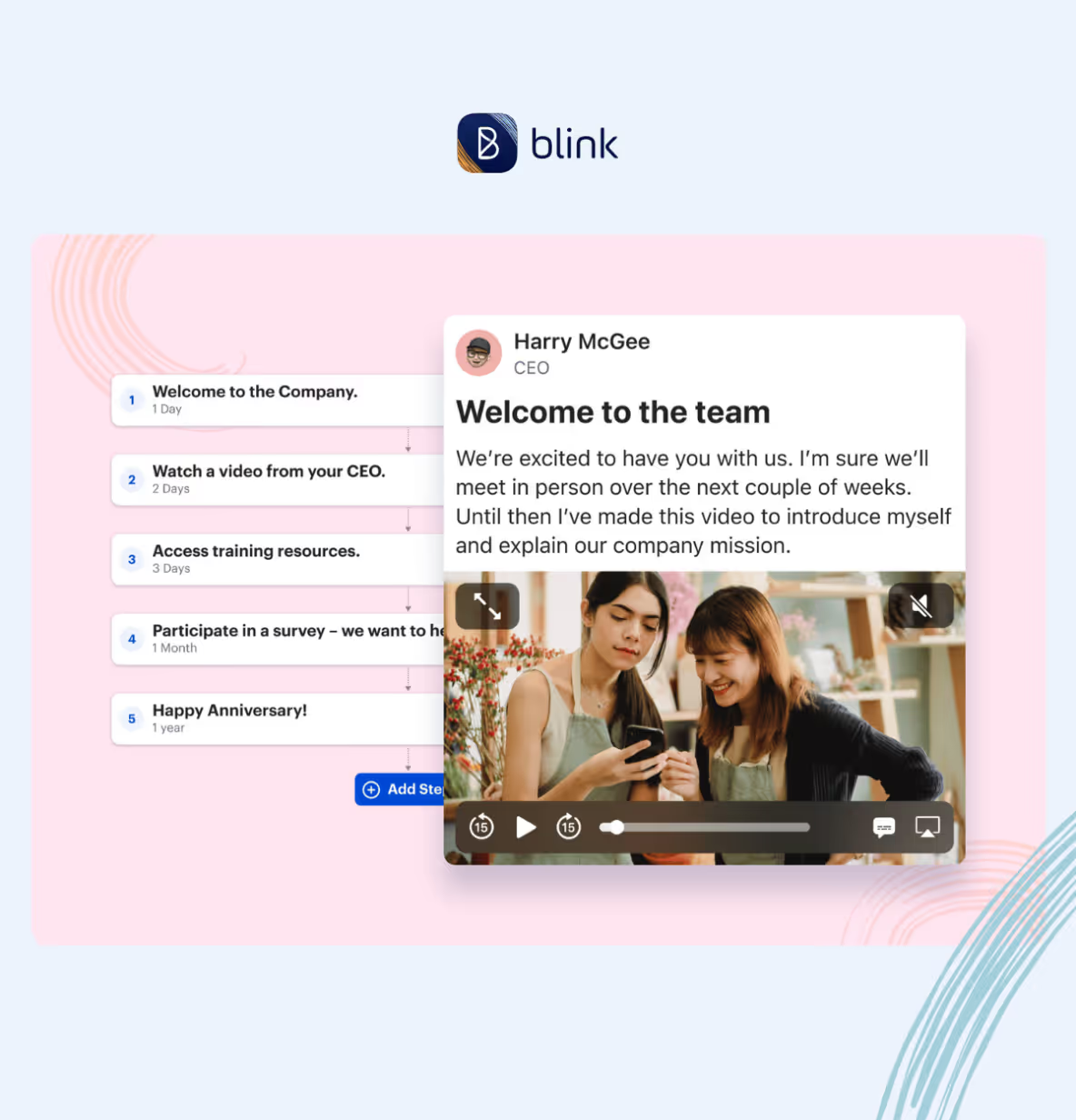
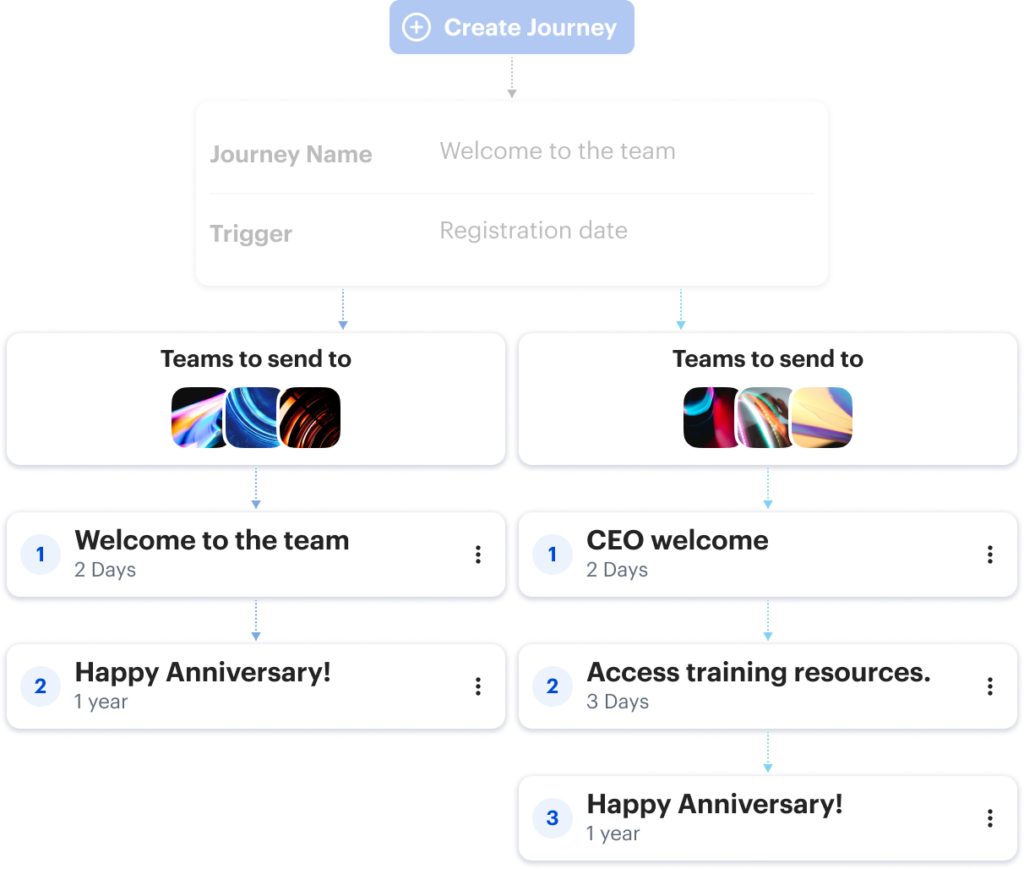
Journeys is a new way to set up personalized content paths for every employee. Each new Journey helps businesses deliver and scale an engaging employee experience.
It's quick and easy to create Journeys that deliver meaningful interactions with your team.
Businesses using Journeys can:
✅ Boost employee happiness and retention by cultivating a sense of belonging and engagement within their workforce
✅ Personalize for the frontline — effortlessly. With Journeys, delivering personalized experiences to every frontline worker is quick and easy
✅ Streamline onboarding: The entire employee onboarding process is simplified by Journeys, saving valuable time and effort while accelerating employee ramp-up time
✅ Create a winning employee experience: In just a few minutes, you'll have created a tailored sequence of posts that align with your employees' needs
"Journeys has been perfect for giving our new team a great onboarding experience, as well as keeping the whole team reminded of key information such as our handbook and safety protocols. But this only scratches the surface: there are a ton of opportunities here."
Katie Palmatier, Operations Manager at Lifeline Ambulance Service
Ways organizations are using Journeys
Onboarding 👋 Effortlessly guide new starters through your induction process, welcoming them to Blink, sharing key onboarding documents and tools, and introducing them to key people who will support them in their roles.
Collecting feedback 💬 Keep your finger on the pulse throughout your employee lifecycle by linking to forms and surveys.
Celebrating work milestones 🎉 Ensure no work anniversary goes overlooked or unrecognized.
Training and compliance 🎓 Distribute key policies and learning and development resources, then send timely reminders for employees to act.
Organizations using Blink Journeys are benefitting from:
Time and effort saved in managing people operations
Improved employee engagement at scale, leading to better productivity and happiness
Reduced new employee churn, thanks to informative and well-timed onboarding communications
Decreased current employee churn through automated touch points and milestones
What's next?
Ready to transform your employee experience with Journeys and Blink? Reach out to us to learn more about Journeys and how it can elevate your employee experience. Get in touch today.
Blink. And your frontline is set up for success.
Introducing Journeys from Blink: a powerful new way to meet employee attrition and engagement challenges head-on.
Journeys lets you personalize employee interactions at scale.
Did you know that a third of employees quit within their first 90 days? All that time and effort invested in sourcing, recruiting, and onboarding new team members can so quickly go to waste. That's why it's crucial to equip your business with the right tools to keep employees engaged from the day they join.
Foster a personal connection with your employees from day one, and you'll gain control over frontline employee engagement — setting you up in the short term to reduce new starter attrition, and in the long run a happier, more engaged workforce.
What is Journeys?
Journeys is a new way to set up personalized content paths for every employee. Each new Journey helps businesses deliver and scale an engaging employee experience.
It's quick and easy to create Journeys that deliver meaningful interactions with your team.
Businesses using Journeys can:
✅ Boost employee happiness and retention by cultivating a sense of belonging and engagement within their workforce
✅ Personalize for the frontline — effortlessly. With Journeys, delivering personalized experiences to every frontline worker is quick and easy
✅ Streamline onboarding: The entire employee onboarding process is simplified by Journeys, saving valuable time and effort while accelerating employee ramp-up time
✅ Create a winning employee experience: In just a few minutes, you'll have created a tailored sequence of posts that align with your employees' needs
"Journeys has been perfect for giving our new team a great onboarding experience, as well as keeping the whole team reminded of key information such as our handbook and safety protocols. But this only scratches the surface: there are a ton of opportunities here."
Katie Palmatier, Operations Manager at Lifeline Ambulance Service
Ways organizations are using Journeys
Onboarding 👋 Effortlessly guide new starters through your induction process, welcoming them to Blink, sharing key onboarding documents and tools, and introducing them to key people who will support them in their roles.
Collecting feedback 💬 Keep your finger on the pulse throughout your employee lifecycle by linking to forms and surveys.
Celebrating work milestones 🎉 Ensure no work anniversary goes overlooked or unrecognized.
Training and compliance 🎓 Distribute key policies and learning and development resources, then send timely reminders for employees to act.
Organizations using Blink Journeys are benefitting from:
Time and effort saved in managing people operations
Improved employee engagement at scale, leading to better productivity and happiness
Reduced new employee churn, thanks to informative and well-timed onboarding communications
Decreased current employee churn through automated touch points and milestones
What's next?
Ready to transform your employee experience with Journeys and Blink? Reach out to us to learn more about Journeys and how it can elevate your employee experience. Get in touch today.
What we'll cover
Start your free trial today
See how Blink helps frontline teams stay connected, informed, and engaged.
Employee appreciation ideas aren’t just a nice thing to do. They’re common business sense.
71% of highly engaged organizations recognize employees for a job well done, but only 41% of less engaged organizations do the same. Meanwhile, Gartner suggests that a well-designed employee recognition program can lead to an increase in average employee performance.
The numbers don’t lie – employee recognition is vital, now more than ever. You don’t need to spend a lot on employee appreciation ideas for them to be effective either, and some of the best employee recognition strategies are completely free.
Here’s how to start showing your employees how much you appreciate them, and some staff appreciation ideas to get you started.
Why are employee appreciation ideas so important?
Everyone likes to be recognized for the work they put in. For staff appreciation, ‘thank you’ is everything.
In fact, feeling underappreciated at work is one of the most common reasons why employees leave a role. A recent study of UK and US workers by Workhuman found that employees who had been thanked for their work in the last month are:
Half as likely to look for a new job (24% vs 48%)
More than twice as likely to be engaged in their work (48% vs 21%)
More than three times as likely to see a path to grow in the organization (59% vs 19%)
All that, just from two short but meaningful words! Imagine the boost more developed employee appreciation ideas could achieve.
And, with the Great Resignation in full swing, the power of ‘thank you’ has never been more apparent, or commercially essential. Around 4.5 million Americans quit their job in March 2022, enticed by rising wages and more flexible working options.
Appreciating your employees for all the hard work they put in is vital in encouraging them to stay put. The great news is that this isn’t a difficult task at all! All it takes is the willingness to listen and some creative thinking on your part.
How to start recognizing your employees’ achievements
Employee recognition isn’t just a top-down thing.
Sure, your senior execs can and should take the lead in calling out great performance – it makes it much easier for everyone else to follow. The issue is that senior managers can only be in so many places at once. They can’t recognize everything worthy of being recognized.
Instead, it’s all about building a culture of continuous recognition from the ground upwards, encompassing both informal and formal recognition methods. This could include:
An employee app that lets managers share great performance with the wider organization
A quarterly awards ceremony to recognize employees who have gone above and beyond
Peer to peer recognition apps to encourage colleagues to support each other
Training all of your employees in how to recognize their peers
That last point is important. In a recent survey, two thirds of businesses said that they trained their managers in employee recognition but only one third offered employees training in colleague recognition. To build a positive culture, it’s important that everyone knows how to offer praise, and its impact on creating an engaged workplace. Don’t leave it to chance.
It’s also essential to build employee preferences into this process. Some people might love receiving an award in front of all their colleagues; for others, this might seem more like a punishment! Ask your teams (or ensure your line managers do) what their ideal way of being thanked looks like. It's an employee engagement best practice worth following.
6 great staff appreciation ideas
1. Salary rise
Almost two-thirds of U.S. private sector payroll workers work in industries where the average weekly wage in the second quarter of 2021 was at least 5% higher than it was in the second quarter of 2020, according to the Bureau of Labor Statistics.
If your rates of pay haven’t budged since pre-pandemic, they’re likely no longer competitive. Show your staff you're serious about your long-term relationship by bringing them up to market rate – or higher! Costs of living are rising rapidly right now, and your team will appreciate it.
2. Public shoutouts
Use your employee app or intranet to shout about individual and team successes. As well as the warmth of public recognition, this helps your employees build their networks in your organization and get noticed by those who could help them progress. .
3. Fun benefits and perks
There’s nothing wrong with offering your employees a little treat every now and then. It won’t make or break employee engagement (a decent salary and day-to-day appreciation are far more important considerations), but it’s definitely a great addition.
Spa days, vouchers for department stores, team days out, gym memberships and personal development funds are all great ways to do this – you might have some ideas of your own.
4. Identify and celebrate key milestones
What we don’t mean: only celebrating 10-year milestones and giving your employees a watch on retirement. Things have moved on since the 1950s.
What we do mean: finding milestones that are meaningful to your business and celebrating little and often. Passing probation, completing advanced training, promotions and getting that first landmark sale are all worthy of celebration. Identify some that are meaningful to your workforce.
5. Individual and team specific
On some level, you’ll have to rely on your line managers to ensure employees feel appreciated on a day-to-day basis. Train them to express their appreciation frequently, and give them a budget for treats like team socials and post-project meals out. It’ll make all the difference.
6. Employee Appreciation Day
Dedicate a day to saying thank you to your employees! In the US, the official Employee Appreciation Day is celebrated on the first Friday of March, but you could hold your own staff appreciation day whenever suits you best.
Employee Appreciation Day ideas include running an awards ceremony to recognize all the effort your employees have put in over the year, followed by a few hours of fun to celebrate these achievements. Fire up the grill (or hire a food truck), plan some fun activities and let everyone have a great time.
On a budget?
It’s not all about the fancy extras. Some of the most effective employee appreciation ideas are free:
Creating a ‘wall of fame’ for great achievements
Celebrating employees’ birthdays, marriages and other life events
Putting effort into feedback, so that employees can develop their skills
Providing opportunities that will help build experience, such as shadowing other roles
Working remotely?
This doesn’t need to stop you! Try using an employee app that will allow you to share your appreciation virtually. You could also try the following employee appreciation ideas:
Early finish Fridays, especially in summer
Celebrations and awards ceremonies via Zoom or similar
Constant engagement and feedback via Slack or your other messaging channels
Treats (food, vouchers, care packages) via post. Everyone loves surprise mail!
Staff appreciation quotes
What you say and how you say it matters! Use these ideas as templates so that you really get the message across.
Every day: “Thank you”
Often, it doesn’t have to get much more complicated than this.
“Thank you for getting that report to me so promptly.”
“Thank you for stepping in last minute – we were really short.”
“Thank you for all your hard work this week – it’s been a long one.”
For small, day-to-day actions that have made everyone’s working lives a little easier, there’s no better alternative.
Recognizing consistently good performance: “I’ve noticed that…”
All too often, it’s large, one-off actions that get noticed rather than consistently good performance that keeps the organization running. Avoid this trap with the “I’ve noticed…” approach.
“I’ve noticed that you always make sure the shop’s tidy before locking up, even though that’s not your role.”
“I’ve noticed that you always hit deadlines without fuss, and it makes it so much easier for everyone else.”
“I’ve noticed that you always take the early shift to make life easier for colleagues with kids.”
Follow up with thanks, by passing on this info to higher ups in the business and potentially with a token of your appreciation – lunch on the company, an early finish this weekend or a large box of baked goods can all work, depending on the situation.
One-off actions: “That really made a difference”
For those times where an employee knocks it out the park, it’s always worth emphasizing the impact of their actions. Employees want their work to be meaningful, and this lets them know
“That report gave senior management a real insight into some of the issues we’re facing, and really made a difference in how we’re going to approach them.”
“That big deal you landed made a huge difference in us meeting our quarterlies. You should be very proud.”
“The new processes you suggested save us so much time. They’ve really made a difference to employee wellbeing.”
Again, follow up with an appropriate reward for maximum impact, whether that’s an award, a bonus or something similar.
Employee appreciation ideas: final thoughts
People like to feel appreciated, so a quick ‘thank you’ here and there works wonders for employee retention.
And, now that your employees can walk out of the job and be reasonably certain of finding another one pretty quickly, ‘thank you’ is a must. If your employees don’t feel appreciated, they will leave.
It’s all about the basics here. A fair wage, regular appreciation and long-term support will go further than doling out a few Amazon Prime vouchers once every quarter. Employee recognition should be a constant process that’s built into the heart of your business.
That’s not to say additional treats aren’t motivating. Rewards and bonuses of all kinds can be fantastic tactics as part of an employee engagement strategy, and they will make your staff feel appreciated. They are, essentially, the cherry on the top of your rewards program. Get the foundations right first for best results.
Blink helps you show employees the appreciation they deserve. Get your free demo today.
HR and employee engagement conferences are more than educational forums for people management insights (although that’s absolutely one of the benefits of attending these events). They are also a gateway to exciting, lucrative networking opportunities — it’s no wonder that huge businesses are built on running conferences for HR and people leaders.
Which employee engagement and HR conferences are best for you to attend in 2023? We’ve put together a list of the events worth your time and the speakers you should be lining up to hear from.
The importance of employee engagement conferences
Every organization strives to engage its workforce, making employee engagement investments and running employee engagement programs. And yet, the latest surveys illustrate that 79% of employees don't feel engaged at work meaning that we’ve still got work to do.
Disengagement is widespread — particularly when it comes to frontline employee engagement — and every business can take bold steps to improve.
Employee engagement is about inspiring your staff to be the best version of themselves. It requires a proactive attitude, one that picks employees up and motivates them to find their feet and climb higher.
But the opportunity to engage employees can only be achieved by seeking out the tried and tested advice of experts. And that’s where employee engagement conferences come in.
What's the link between employee experience and employee engagement?
This is a topic we see come up a lot, but there’s an easy way to remember where employee engagement fits within employee experience.
Employee engagement is the target you're trying to hit and employee experience is the means to get you there.
Employee experience covers everything an individual sees, hears, feels, and believes while at work. It’s made up of countless interactions (or ‘moments that matter’) across the employee lifecycle, from the initial onboarding process to daily tools and responsibilities. Employee engagement, on the other hand, is how demonstrably committed a worker is to their role and your organization.
What are the 4 Cs and 3 Es of employee engagement?
Driving employee engagement is easier when you have a simple guide to follow. Here are the seven key points that will take center stage at employee engagement conferences in 2023:
Contribution - employees need to feel they have an active role to play in your company and that their work is making a notable impact
Connection - whether working remotely, on-site, or on the frontline, it's important to avoid working in silos by forging meaningful relationships with co-workers
Communication - having a management team that’s accessible and approachable offers employees the means by which to speak up and take part
Confidence - members of staff need certainty in their role, to allow them to perform to the highest of their abilities, without worrying about the health of the company or if their job is at risk
Empowerment - instilling employees with a sense of trust and authority gives them the motivation to go that extra mile
Enablement - in order to improve productivity, every employee needs to have the right tool for the job, so ensure their technology needs are met
The challenges and benefits of frontline employee engagement
Frontline employee engagement challenges
When it comes to frontline employees, there are several unique challenges to consider. And all too often courses, articles, and guides don't feel as relevant or relatable — as if they've been written with one (office-based) employee model in mind.
Frontline workers feel disengagement more acutely than most other professions. For one, there’s the disconnection inherent in their line of work, separating them from their co-workers and the wider organization. This deals a heavy blow to morale and productivity in the process.
The trick is to find an employee engagement solution that suits the frontline’s needs and requirements. It should speak to their inconsistent sense of belonging with the company and offer clear development to help employees build careers with your organization, rather than ‘just jobs’.
This goes beyond empty investments and initiatives. Frontline employees want to feel listened to, recognized, and included in strategies that directly affect them, rather than being an afterthought.
Frontline employee engagement benefits
The truth is, we all know the benefits of an increase in engagement. Employees that are committed, motivated, and engaged at work deliver more and perform better — and that means your bottom line improves across each and every level of your organization.
Absenteeism and health and safety incidents fall significantly and employee turnover plummets as staff engagement soars. With this, your competitiveness in the industry and attractiveness to prospective new hires is solidified. For CHROs, this is what makes the job feel great and it's understandable to see why employee engagement conferences are so appealing.
Learn more about how frontline organizations can improve employee experience and engagement through Blink’s customer case studies.
11 must-see HR and employee engagement conferences for 2023
Priding themselves on securing top industry names, you can expect to see representatives from Amazon, Deloitte, Capital One, UPS, Microsoft, and many others, all sharing their invaluable talent management insights.
With a strong focus on HR tech, UNLEASH is the ideal opportunity to explore how technology is changing the future of work across all industries — and the investments you can make to elevate efficiency. It's a must for those in HR and employee engagement.
This convention is not to be missed. One of the biggest of its kind, the CIPD Festival of Work boasts an impressive roster of guests. Organizations with frontline workers will be particularly interested in hearing from Danny Mortimer, CEO of NHS Employers, Tunde Agoro, Head of ESG at Hydrock, Fiona Brunskill, Chief People Officer of Transport for London, and Toby Culshaw, Global Head of Talent Intelligence at Amazon.
And for that specific focus on employee engagement, CIPD has two keynotes lined up: ‘Maintaining engagement through periods of change’ and ‘Employee listening — the key to retention and employee engagement’.
Energetic, vibrant, and fun — SHRM's annual conferences are well-known in the HR world. SHRM’s mission is to offer the widest possible reach with its events, covering ways to improve every facet of working life.
This gathering of industry professionals from all walks of life guarantees that every organization has something to gain from the expansive four-day HR conference.
HR Summit is the UK’s home for HR networking. Understanding that your time is precious, their goal is to pair you up with professionals that can answer the burning questions you have and provide the solutions you need.
They achieve this by organizing pre-arranged, face-to-face meetings between delegates and key industry suppliers. The event also features an array of cutting-edge technology, as well as HR products and services, all presented without a pushy hard sell.
Technology is a main talking point at many HR conferences. The tools we use to manage staff and improve business practices are growing exponentially — and HR Vision dives into the tech that’ll revolutionize your workflows.
The aim of this HR conference is to empower your workforce with the right HR technology and connect People leaders to an impressive set of speakers. Look out for Brady Pyle, Deputy Chief Human Capital Officer at NASA, Stephen Pierce, Deputy MD and CHRO of Hitachi Europe, and Cath Possamai, CEO of Recruiting Group, British Army, and other big names on the HR Vision agenda.
The idea of a sprawling event can feel overwhelming for those new to the employee engagement conference scene. Thankfully, there are more intimate options, such as Canada's Western Cities HR Conference 2023.
This event is made up of personal interactions with like-minded professionals and is designed to help managers gain a better understanding of their employees’ challenges. And with a focus on improving employee experience to drive employee engagement, this year's Western Cities HR Conference may be the best option for those looking to dip their toe into the HR conference experience.
Delivering the best HR tech on the market is what a lot of HR conferences pride themselves on. But for companies looking ahead to the horizon, they want to know what the next leap is, several years down the line — and how they can get in on the action early.
For those businesses, HR Technology Conference & Expo is where it's at. The organizers certainly know that having your finger on the pulse and investing in HR technology is a reliable way to improve your company’s HR standing.
Gartner ReimagineHR Conference
Date: September 11-12, 2023, October 23-25, 2023, and December 4-5, 2023
Location: London, UK, Orlando, USA, and Sydney, Australia
While still too far away for an agenda to have been published, we’re expecting more top-quality content from Gartner’s ReimagineHR Conference in 2023. Attendees of this employee engagement conference will learn how to tackle pressing issues within talent management, such as attrition, while keeping one eye on what’s coming further down the line.
What's more, this is a great opportunity to explore leadership development, culture building, and improved strategic decision-making — all to help your business operate at its highest possible level.
Date: September 26-29, 2023 and November 14-16, 2023
Location: San Francisco, USA and Barcelona, Spain
Ticket price: TBD
Workday’s online employee engagement content was available until April 2023 and it’s bringing the in-person experience to San Francisco and Barcelo towards the end of the year.
With a rallying cry of “It’s time to rise”, Workday Rising’s conference content is always inspiring — and helps deliver more than a few of those employee engagement 4 Cs and 3 Es. It’s energizing and empowering, designed to enable People leaders to excel in their roles. You’ll also connect with fellow leaders and gain greater confidence in the work that you do.
How to get the most from an employee engagement conference
With so many options in mind, having a clear game plan will result in the best takeaways and ROI from your experience. Here's what you should focus on:
Research and planning
What are the particular challenges your organization is facing? Will improving retention have the most impact or do you need to create a culture of communication? Understanding where you’re at today and where you want to be in the future is a great way to prepare for employee engagement conference season.
While it might not look like it on the surface, each HR conference will have its own niche angle. Research the speakers, investigate the talking points, and read reviews of how engaging and effective their output is. What you want to see are the success stories, so you can become one too.
Organize your time
HR conferences are designed to wow you. There are multiple stands, panels, and events that will draw your attention, but having a clear itinerary will keep you on track. Keep the exact timings and locations of must-see sessions marked down to avoid disappointment. But don't overload yourself either. Make sure you schedule breaks and allow for chance encounters, too.
Network before, during, and after
Speaking of encounters… The best thing about employee engagement conferences is that you’re with like-minded professionals. Hunt down the group chats or hashtags on sites like LinkedIn to build those connections in advance, then make time in your schedule to introduce yourself in person.
And, perhaps most importantly, keep the fire burning. Maintain momentum and keep in touch to convert that conference acquaintance into a strong business connection.
This is particularly important for HR leaders from frontline organizations. As we know, there are very few conferences that cater specifically to the frontline employee engagement challenges, so use the events listed above to find your allies. You can support each other from there!
Meet Blink at an employee engagement conference near you
Here at Blink, we don't just talk about HR conferences — we attend them too. Take a look at the exciting employee engagement conferences we'll be attending this year. And whether this is your first time or you're a seasoned pro, come and say hello.
You can buy a tool that looks amazing in a pitch meeting. Then watch it gather digital dust a few months later because it doesn’t actually work for your company.
Asking the right questions up front avoids that frustration and a ton of wasted budget. It helps you find a solution that supports both employee communication and engagement — and fits seamlessly within your tech ecosystem.
Doing some software shopping? To find the right employee communication app for your organization, here are the 10 questions you should be asking.
Choosing an employee communication app: A 10-question checklist
1. Will every employee actually use this?
Okay, so priority number one is finding an app that your employees will embrace. Because if a good chunk of your workforce fails to get on board with your new software tool, you’re not getting good ROI.
The right app is:
Intuitive. Employees can pick it up and start using it without having to trawl through a manual first.
Accessible. It should be easy for every employee to log in, even on older phones or with patchy internet connection.
Free from friction. Everything just works — whether that’s search functions, voice calling, or integrations with other tools.
When assessing an app, keep your least tech-savvy employee in mind. If you think they’d use (and maybe even actually grow to love) this app, you can be confident it’ll work for the rest of your team.
2. Does it work for frontline teams?
A major benefit of an employee communication app is that it’s available on smartphones. So you can land messages with your hardest-to-reach employees — those who don’t sit at a desk all day.
To find the best solution, look for tools that understand and accommodate the realities of frontline work, including:
Shifts and staggered schedules. The best apps support both real-time and asynchronous communication so employees can check in at a time that works for them.
Busy schedules. With search, personalization, critical reads, and bite-sized content, the best apps let you share vital information in a format that’s quick and easy to digest.
Frontline access requirements. Deskless staff don’t always have a corporate email address or access to a shared portal. They should be able to log in easily from their smartphones.
Frontline vs. desk-based experience. Don’t accept one experience for office-based staff and another for frontline employees. Your app should have the same features and functionality across both desktop and mobile apps.
Ultimately, any frontline communication app has to be mobile-first and secure but accessible on personal smartphones. It also needs to provide an exceptional digital employee experience across all devices.
{{mobile-shifts="/image"}}
3. Can it replace multiple tools?
If you’re relying on a patchwork of communication tools, your staff are probably feeling the strain. They’re spending nearly 4 hours each week — and 1,200 clicks per day! — toggling between apps. Or bugging IT because they forgot one of many sets of login details (again!).
The best of the best go even further. They act as an all-in-one employee experience app and intranet platform, with personalized content pathways, employee recognition, and easy access to other workplace systems.
Think about the tools you’re currently using and how many of them your shortlisted apps could replace. Because the fewer tools you use, the easier and more streamlined work becomes.
4. How easy is it to manage and govern?
The front-end of an app can work like a dream. But what’s going on behind the scenes? You need to look beyond the glossy exterior to the nuts and bolts of the admin experience.
When an app is complex to manage and govern, the comms team ends up calling on IT. This creates a bottleneck. And it leads to stale content, clunky processes, and frustrated employees.
To ensure the best user experience and continued engagement with your employee communication app, you need clear permissions and content controls. You also need tools that make it easy to add, update, and personalize communication content.
{{mobile-hub="/image"}}
5. Is it secure and compliant?
Security is another top consideration when choosing an employee communication or employee experience app. You want a solution that meets enterprise-grade security standards, with security built in, not bolted on.
So look for things like:
End-to-end encryption, in transit and at rest
Secondary biometric authentication
Function fencing, so workers only have access to the tools and controls they need
Automated user provisioning, so it’s easy to add, manage, and remove users as necessary
If you work in a particularly regulated industry, like healthcare, you should also look for compliance with industry-specific security laws.
But bear in mind: heavy-handed security can harm the user experience, pushing your employees toward makeshift solutions, like WhatsApp.
So it’s all about getting the right balance. A good software provider should help you find that balance, achieving the best possible security while also ensuring a simple and streamlined experience for users.
6. Does it support two-way communication?
Internal communication is most effective when it goes both ways. The C-suite and managers speak to employees. But employees have the opportunity to respond.
A good employee communication app gives your organization the tools it needs to maintain a dynamic conversation:
Instant messaging tools, for 1-to-1 and group chat
A news feed where employees can react with comments, emojis, and GIFs
Employee surveys and quick-fire polls
Video and voice calling
Interactive live streaming
Choose tools that support two-way internal communication, and you give employees a voice. That means stronger workplace connections, better collaboration, and employees who feel seen and heard.
{{mobile-hub="/image"}}
7. How quickly can we launch?
Time-to-value is important. The right app should be quick to deploy and easy to scale across multiple teams.
If you’re considering building your own comms app, know that this often requires months (or even years) of developing, testing, and iteration. So buying a ready-to-go tool is often the quickest solution.
Today, prebuilt doesn’t mean compromising on the end result. You can incorporate custom branding and tailor app features and functionality to the needs of your organization. You get speed, scalability, and best-in-class technology.
Ask providers about timescales so you have a clear idea of the setup and launch process. Here at Blink, most of our clients go live within 6 to 12 weeks.
8. Will it integrate with our existing systems?
A great employee communication app isn’t just a one-stop shop for internal conversations. It can also act as a digital hub, reducing friction and making life easier for employees in the process.
That requires strong integrations with the existing software you use. And single sign-on technology to give employees access to that software from one unified dashboard.
When you integrate an app into your digital ecosystem, employees can use it to tackle tasks like:
Swapping shifts with coworkers
Checking their paystubs
Clicking a news feed post to go straight to online compliance training
Completing a safety report on the go
Submitting a time-off request
Viewing customer details via your CRM
The result? Your employee communication app becomes a comprehensive employee intranet. A place where staff can catch up with the latest company news — of course.
But also a place where they can learn, receive recognition, give feedback, and access all the tools they need to do their jobs well.
{{mobile-voice-video="/image"}}
9. Can we measure impact and ROI?
To get the most from your mobile-first employee app, you need to know what’s working and what isn’t. And to do that, you need analytics.
Find out what analytics and reporting features come with your shortlisted apps. Consider the internal comms metrics they allow you to track.
And expect more than just the basics. A good app won’t just provide data on platform usage and message read rates.
It’ll show you how internal comms KPIs relate to employee engagement, sentiment, and turnover. It’ll allow you to segment data by team, department, and manager. And it’ll present data in a way that’s super easy to understand and act on.
The final question to ask before choosing an employee communication app. Does this app feel familiar and fun? Or is it cold and corporate?
Employees are more likely to use your app when it offers the same consumer-grade experience they enjoy on apps away from work. If it lets them communicate in ways they’re used to (and in ways they enjoy).
Give people a modern social experience, where they can show up as their real selves, and engagement is sure to follow.
{{mobile-stories="/image"}}
The right employee app makes all the difference
Choosing an employee communication or employee experience app isn’t just about features or fancy demos. It’s about finding a tool your team will actually use — one that fits your workflow, feels intuitive, and makes work more connected, engaging, and human.
Ask the right questions up front. Consider the full scope of the app — the more functions it performs, the more value it brings to your team. Look beyond shiny user interfaces to the day-to-day employee experience.
When you do, you don’t just add another tool to your tech collection.
You get a solution that supports company culture, employee productivity, engagement, and retention. You build a space where employees can easily access the information they need and the connection they crave.
Unily is a powerful platform—but for many organizations, it’s overly complex, difficult to manage, and time-consuming to implement. From rigid intranet structures to costly customizations, it often demands heavy IT involvement just to get the basics right.
If you're looking for something easier to use, faster to roll out, and more engaging for employees, you're not alone.
In this guide, we cover the top 10 Unily alternatives—platforms that deliver the same core benefits (communication, connection, and culture) without the complications. Whether you're in HR, Comms, or IT, these options are worth considering for a modern employee experience.
Blink is the employee experience platform designed to eliminate the friction that comes with legacy intranets like Unily. Where Unily often requires months of setup and technical oversight, Blink delivers immediate impact with a consumer-grade UX, built-in tools, and zero learning curve.
Why Blink is the smarter choice:
No IT bottlenecks: Blink is designed for self-serve teams—get started in weeks, not quarters.
Mobile and desktop ready: Unlike Unily’s more rigid intranet framework, Blink works wherever your employees do.
One simple platform: Comms, chat, surveys, document sharing, and app integrations—all in one place.
Instant engagement: Push updates, target messages, and track results in real time without needing an admin army.
Pros:
Rapid deployment and intuitive for any user
Eliminates the complexity and silos of traditional intranets
Higher adoption and engagement rates
Streamlined pricing and low total cost of ownership
Cons:
Fewer deep customization options compared to Unily (by design)
{{watch-video="/callouts"}}
#2. Staffbase
Staffbase offers an employee communications platform designed for corporate messaging and internal branding. It supports newsletter creation, a mobile app, and intranet functionality.
Pros:
Strong employee app for internal comms
Designed for global organizations
Supports multiple languages
Cons:
Requires training and onboarding time
Some advanced features locked behind higher-tier pricing
#3. Firstup
Firstup is focused on employee journeys and automated campaigns. It’s especially suited for organizations with complex audience segments and large enterprise needs.
Pros:
Advanced audience segmentation and targeting
Automation capabilities for content delivery
Cons:
May require dedicated resources to manage campaigns
Less intuitive for smaller or mid-size companies
#4. Simpplr
Simpplr positions itself as a modern intranet platform with a clean design and AI-powered search. It’s focused on streamlining communication and enabling a sense of belonging.
Pros:
Strong content discovery and search tools
Integrated org charts and people directories
Cons:
Pricing can be steep for growing teams
Limited mobile functionality compared to other platforms
#5. Workvivo
Designed to blend communication with culture, Workvivo gives employees a platform to share stories, celebrate wins, and stay informed. It supports both leadership updates and peer-to-peer engagement. The interface feels familiar to social media, driving higher adoption.
Pros:
Social-media-style interface
Culture and engagement features built-in
Cons:
Collaboration and productivity tools are limited
Can feel more like an engagement layer than a full intranet
#6. Interact
Interact offers a feature-rich intranet solution with a strong focus on content governance and compliance. It’s ideal for organizations with strict security or industry regulations.
Pros:
Rich permissions and content management controls
Good for highly regulated industries
Cons:
Can be complex to configure
Slower time-to-value compared to more modern platforms
#7. Haiilo
Formerly Smarp, Haiilo is a social intranet and advocacy platform. It focuses on content sharing, social collaboration, and employee voice.
Pros:
Social interaction features
Integrates with Microsoft 365
Cons:
Not a full digital workplace platform
Focus is heavier on communication than productivity
#8. Microsoft SharePoint + Viva
If you're deeply invested in the Microsoft ecosystem, SharePoint paired with Viva can be turned into a digital employee experience platform—though it often requires heavy customization.
Pros:
Seamless with Microsoft 365 apps
Highly customizable with IT support
Cons:
Often needs consultants or developers to manage
User experience can feel clunky without Viva add-ons
#9. Jive (Aurea)
Jive is a legacy enterprise social platform with collaboration, communities, and knowledge-sharing tools. It remains a viable choice for large, complex organizations.
Pros:
Good for internal communities and knowledge bases
Mature platform with years of enterprise use
Cons:
Outdated user experience
Less support for mobile and modern UI
#10. LumApps
LumApps integrates directly with Google Workspace and Microsoft 365, offering a centralized hub for company knowledge, news, and social collaboration.
Pros:
Strong integrations with cloud suites
Personalization and targeting features
Cons:
Requires IT involvement for deployment
Learning curve for admins and content creators
Final thoughts
Unily has long been a popular choice for enterprise intranets, but today’s workforce needs faster, more flexible, and engaging tools. If you’re rethinking your digital employee experience, platforms like Blink offer a modern alternative that’s easier to deploy, simpler to manage, and proven to engage employees across the board.
News broke recently that Meta would be discontinuing Workplace, the decade-old enterprise communications platform built on a version of Facebook. The platform will work until September 2025 and remain read-only until May 2026.
In their statement, Meta announced that it would be focusing on “building AI and metaverse technologies” that they believe “will fundamentally reshape the way we work.”
Though there is over a year until Workplace is no longer usable, sadly the disruption for many companies has already begun. The news left thousands of companies scrambling to find a long-term solution to the critical challenge of frontline communications for 7 million workers. Frontline workers already have difficult jobs and high turnover rates; frontline managers, HR leaders, and Communications teams should be gearing up to solve this challenge sooner, rather than later, and working to minimize the impact on frontline workers.
Undoubtedly, the question on many people’s minds right now is: what’s next for employee communications? Our CEO, Sean Nolan, shared his thoughts on the future of digital employee experience after Meta’s announcement, including his empathy for affected workers and his optimism that leaders will take the opportunity to upgrade to a modern employee app that will “make the experience of being employed a simple and fulfilling one.”
If you’re one of the many people frustrated with Meta forcing you to make such a big, unexpected change this year, we hope you’ll also be excited to explore how employee communications technology has developed beyond Workplace’s platform. You can start by checking out some alternatives to Workvivo and a side-by-side comparison of Blink and Workvivo.
Maybe it’s been a while since you’ve evaluated your options and you’d like to hear how other companies are approaching their employee communications’ needs. In one of those weird, cosmic coincidences, Meta’s announcement happened at the same time that we hosted a webinar with our customer, Dee Set, who shared how they evaluated their employees’ needs by comparing email, Workplace, and Blink as the long-term communications solution.
Dee Set is one of the UK’s leading retail suppliers. In 2019, Dee Set recognized that they were spending a lot of money on email without much to show for it.
Email was especially challenging as the primary communication tool for frontline workers. Some of the challenges included:
Communication was transactional and one-way
It was hard to build engagement and culture through email
The tech infrastructure to support it was complex
Little insight into the impact of emails
Analog channels like word of mouth and digital signage did a lot of heavy lifting
Email was so ineffectual that they made the decision to cut off support for email within 3 weeks—without having the next solution nailed down even. (Spoiler alert: they chose and deployed Blink in that time.)
What they learned during the Workplace trial
One solution Peers and Hayter helped evaluate for Dee Set was Meta’s Workplace. Right away, they ran into issues getting all of the company onto the social platform. As they dug deeper, the lack of two-way communications was surprisingly lacking, considering how vital it is to engaging on Facebook. The final straw was that Workplace required a workplace email—which would be a huge step backward in their effort to improve communications and cut down on wasteful spending on underutilized email accounts.
While their limited pilot of Workplace didn’t work out long term, the experience did surface some key insights that would help them make their ultimate choice. In particular, Dee Set liked the idea of a “digital front door” that provided a single place for everyone to communicate and find everything they needed. They also realized that they wanted a solution that was ready out of the box and simple for even the least-tech savvy worker to use on their own phone.
Even though Workplace provided more value than email as a frontline communications solution, Dee Set wanted to deliver an even better experience for their remote workforce.
Maximizing—and simplifying—the tech infrastructure for frontline workers
As the Group Information Security Officer, Hayter recognized the challenge that a complicated tech infrastructure presented to frontline workers. Their frontline workers weren’t just relying on their personal smartphones and email as the main communication channel—they had to manage logins for HR systems, timesheets, learning platforms, and communication tools to retrieve documents. It was complex, costly, and frustrating for frontline workers and the IT team.
Blink’s “digital front door” approach transformed this process thanks to deep integrations with so many systems. By giving access to HR, payroll, and other systems directly within Blink, Dee Set was able to maximize the usage of their tech infrastructure among frontline workers.
What happened when Dee Set started with Blink
After a rapid deployment while email was being shut down, Dee Set’s frontline employees quickly took to the Blink app. In fact, according to Peers, they were a victim of their own success in those initial months.
There were large employee chat groups and lots of content being shared in the News Feed—while the engagement was exciting and new, Dee Set’s leaders had to educate people on communication best practices to improve the experience. They also used the flexibility of Blink to create refined groups and roles, which made it easier to target communications.
After those initial hiccups, Dee Set has continued to make Blink into the best solution for their unique workforce. As a result, they’ve seen a huge rise in engagement in frontline workers.
With more engaged frontline workers, new hire turnover has gone down, productivity has gone up, and helped create a community amongst the remote workforce thanks to secure chat groups.
There’s so much more to hear from Peers and Hayter we haven’t covered here. For the full story, be sure to check out the webinar and hear more about how Blink helped them navigate the challenges of the pandemic, how they rolled out the platform so fast, how they created a better onboarding experience for new starters, and more frontline communications and IT best practices they’ve adopted with Blink.
Learn more about Blink for your frontline communications
Whether you’re looking to move away from email or exploring alternatives to Workplace and Workvivo for frontline communications, it’s a great time to check out Blink’s employee super app.
If you want to see what a mobile-first, all-in-one solution can do for your organization, book a demo to chat with an expert today.
From fairy tales to blockbuster movies to conversations with family and friends, we’re surrounded by stories — and have been since we were tiny babies. Stories are how we learn and make sense of the world.
Stories also have a powerful impact on the brain. Neuroscience shows that stories awaken our senses, help us remember information, and create a sense of human connection.
Using storytelling for business is, therefore, a really effective way to engage employees with your messaging. It’s also a great way to convey information quickly and effectively to time-poor frontline workers.
We know not everyone is a creative writer. But we also believe that with the right approach, you can make business storytelling an integral part of your organization.
So in this article, we’ll walk you through some of our best tips for using company storytelling for your internal communications. Let’s start by looking at some common storytelling structures.
Some popular storytelling structures
Storytelling has existed since the development of language itself. As Yuva Noah Harari explains in his book Sapiens:
“It is the distinctive ability to believe in stories that separate sapiens from other creatures. You could never convince a monkey to give you a banana by promising him limitless bananas after death in monkey heaven.”
Storytelling is one of the foundational pillars of society. It’s shaped our understanding of right and wrong for generations. From 30,000-year-old cave drawings in France to Aesop’s fables to the urban legends teenagers share today, all cultures in history have told stories.
And despite there being stories about every topic and every character imaginable, stories tend to fall into a surprisingly small number of categories. Knowing these categories can help when you’re creating your own corporate stories.
The seven basic plots
Some people argue that you can put every single story ever created into one of these seven categories.
Rags to riches. A character finds power, money, or love, loses it, and then wins it back. Example: Cinderella.
The quest. The main character has to reach a location or fulfill an objective, conquering obstacles along the way. Example: The Lord of the Rings.
Rebirth. A character changes their ways and becomes a better person. Example: A Christmas Carol.
Overcoming the monster. A hero has to overcome an evil force. Example: Any James Bond movie.
Comedy. A story designed to make people laugh by subverting expectations and mixing the familiar with the absurd. Example: Bridget Jones’ Diary.
Tragedy. The main character makes a big mistake or demonstrates a character flaw which leads to their undoing. Example: Bonnie and Clyde.
Voyage and return. A character goes to a strange land, overcomes the challenges there, and returns home with newfound experience or knowledge. Example: Gulliver’s Travels.
The hero’s journey
The hero’s journey is another popular story structure. A hero is living happily in their comfort zone when something unexpected happens and they’re forced into an adventure.
Here are some examples:
Harry Potter lives with the Dursleys. Hagrid comes to take him to Hogwarts.
Frodo Baggins lives with Bilbo in Hobbiton. Bilbo sets off on a journey leaving the ring to Frodo.
Barbie lives in Barbieland. But when she starts behaving strangely, Weird Barbie sends her to the real world.
This same basic template can be found across countless books, movies, and TV shows — and it tends to follow the same 12 steps.
A hero is called to an adventure. They experience tests, allies, and enemies. They reach a low point before finding a solution and returning back to their original lives as a hero.
How these popular story structures can support business storytelling
We’re not suggesting that you go and write a whole novel or screenplay about your organization. But there are a few things we can learn from these storytelling structures.
First, storytelling is not just a talent people are born with or without. There are structures you can follow and techniques you can learn. It’s perfectly possible for your internal communications team to tell compelling corporate stories.
Second, structures like the hero’s journey lend themselves beautifully to storytelling in corporate communications. Challenges intrigue your audience and get them to empathize with the hero. But the hero always achieves their goal. So success is another important and inspiring part of the story.
By incorporating key story elements — compelling characters, emotional ups and downs, and a popular story structure — into your internal communications, you can create messages that engage your employees. You make your messages more memorable and create a sense of connection between employees and your organizational values.
How to supercharge engagement with internal communication storytelling
There are lots of ways to boost employee engagement with your internal communications.
You can give employees a voice with communication tools that support bottom-up communication. You can celebrate achievements and recognize hard work.
Simply giving employees the right information improves their motivation and morale. Employees who receive enough information to do their jobs well are 2.8 times more likely to feel engaged in their work.
Business storytelling is another strategy to add to your list. And however you choose to use storytelling for business, here are some tips that will help you make your stories more engaging for employees.
1. Make it easy
Many organizations use outdated internal communication software that makes it hard to share stories. Some are still using email newsletters or paper memos as their only channels of internal communication. So storytellers find it hard to get their stories seen.
You can make it easy for everyone to tell corporate stories by assessing your internal communication tech and — if it isn’t streamlined and user-friendly — consider other internal communication software providers.
2. Share corporate stories as they happen
The more relevant a story, the more impact it tends to have. Workers like to see authentic stories that are happening in real-time, not stories about an event or accomplishment that happened weeks ago.
Share corporate stories as they happen and employees are more inclined to respond to them in the moment. They’ll then amplify the story by sharing or commenting on it.
3. Mix it up
When storytelling for internal communications, you can get creative. You can use stories to convey all sorts of information. Here are a few ideas.
Share a customer success story. Share a case study explaining a customer pain point, describing how a frontline team member supported the customer, and the outcome your customer achieved. Use quotes from the customer and a video or photos, so employees can put a face to the name.
Share the story of your organization. Tell the story of how your company came to be. This type of story works really well during the onboarding process. Be authentic. Share the challenges founders faced, how they overcame them, and what their plans are for the future.
Paint a picture. The characters in your stories don’t have to be real. You can use imagined characters to paint a picture for employees. For example, when explaining how a new process will benefit customers, create a customer character — let’s call her Sarah — and describe the process from her point of view.
Celebrate an employee milestone. Rather than simply recognizing an employee for their hard work, describe the journey they’ve taken within the company. Start with their nervous first days and lead on to their current successes.
There are countless ways to weave stories into your internal communications. So don’t be afraid to mix it up and try new things.
4. Bring stories to town hall meetings
Whether you conduct town hall meetings in person — or involve remote and frontline workers by live streaming — starting with a story is a great way to build rapport.
When leaders tell stories — any stories — they come across as more human. This makes it easier for employees to trust the organization’s leadership and makes them more likely to contribute to the meeting with their own questions and comments.
According to Ally Bunin, Global Head of Internal Communications Stories at Russell Reynolds Associates:
“Starting with a story is the best way to open a town hall. We encourage our team to share a personal story, even if it's not related to the topic of the town hall meeting. A story makes them more relatable, and it's so important to be a human first.”
5. Be authentic
Stories are compelling because — sometimes — things go wrong for the hero. So don’t gloss over the failures or challenges involved in your stories, even those that come from senior leaders.
Stories told with honesty and authenticity are much more engaging for employees. Therefore, leaders should aim to tell their own stories, rather than relying on polished scripts.
Even if the business is struggling right now and you’re sharing bad news, you’ll make a better impact with a sincere story than with an airbrushed version of events.
The more open you are in your storytelling for internal communications, the more inclined your workers are to believe in what you say. And they’ll not shy away from lending their support.
6. Avoid information overload
When marketing to customers, a company takes steps to ensure that its messages are relevant to each segment of the audience. You should try to do the same for employees.
Corporate stories only resonate with employees when they’re relevant to them and their roles. So —as part of your internal communications strategy — be sure to segment your audience and personalize messages for each sector of your workforce.
This helps to avoid information overload. And because employees come to expect relevant internal communication messages, they’re less likely to switch off from your communication channels.
7. Use the power of repetition
While you want to avoid information overload, you need to make your most important stories stand out and sink in.
Stories tied to your mission, brand, values, and identity should stick in the hearts and minds of employees. To achieve this, you need to repeat those stories often.
Take inspiration from Howard Schultz, the former CEO of Starbucks. Schultz often recited an anecdote about his travels to Milan. It was in Italy that he discovered brewed espresso for the first time and became convinced that coffee shops could be big business in the US.
Schultz shared this story at many different times, events, and locations. He did this to inspire workers, to show his human side, and to emphasize that the Starbucks brand is about more than just selling coffee. It’s about delivering an experience.
Search for Howard Schultz and his name is now synonymous with this story. Repetition has helped him to create a company legend that has engaged and motivated Starbucks employees for years.
Internal communication storytelling for your organization
Company storytelling is a powerful way to improve your internal communications.
Company stories are engaging. They prompt emotion in employees, which makes them feel more bonded to your organization. And while the corporate world tends towards numbers and charts, there’s scientific proof that stories live longer in the memory than even the most impressive stats.
These storytelling benefits can help you achieve your internal communication goals. You can encourage more employees to use your intranet or employee app. You can get more employees to read and engage with your content. You can ensure that important messages are being read and remembered.
In today’s modern workplace — with the help of internal communication tech tools, like Blink — it’s easier than ever to use storytelling for business. You don’t have to rely on edited corporate announcements that receive little engagement.
Instead, you can create and curate stories from across the organization. You can tell stories using engaging multimedia content, like video or live stream. Employees can comment on news feed stories — and create their own content, too.
What’s more, because Blink is a mobile-first employee app, you can put business stories at the fingertips of every employee, whether they work in the office or on the frontline of your organization.








.avif)