
All you need to know to get started with employee recognition programs, including recognition ideas, strategy and the best software tools to support you
Employee recognition programs can be one of your top tools in the war for talent. Done right, they increase employee retention, build workplace morale and have a major impact on productivity.
If you’re new to employee recognition, don’t worry – the principles are simple. Ultimately, your employees like to be thanked for all the work they put in. If you do this, they will be happier and work more productively.
You might have some form of employee recognition in place already, such as bonus schemes. Right now, however, it pays to go a little deeper with your employee recognition processes. Here’s what you need to know about recognition and rewards in the workplace.
Employee recognition programs: what are they?
There are quite a few definitions of ‘employee recognition’ floating around right now. We like Perkbox’s for its simplicity:
“Employee recognition is when a company acknowledges its staff for great work.”
It’s that easy. An employee recognition program is any set of processes you have in place to facilitate this. This could be:
Peer to peer gifting schemes
Employee award ceremonies
Formalized career pathways and regular salary review schemes
Target-based financial bonus schemes
Why do you need employee recognition programs?
‘Underappreciation’ has always been a key driver of high employee turnover and low employee engagement. If you take your employees for granted, they are more likely to leave and less likely to perform well at work.
On the other hand, a simple ‘thank you’ just once per month to your employees doubles employee engagement, halves risk of them leaving and triples the likelihood of them sticking with you in the long term.
And if that’s the impact of one ‘thank you’, imagine how much positivity a fully thought-out employee recognition program can do!
When you make the effort to thank your employees for their hard work, you:
Create a positive work environment where everyone feels valued
Incentivize staff to go the extra mile and boost their performance
Reduce absenteeism – and, just as importantly, reduce presenteeism
Increase employee engagement, job satisfaction and productivity
Why employee recognition programs are so important now
Recognizing your employees keeps them with you. And that’s more important than ever.
‘Lack of appreciation’ has consistently been named as a major reason behind so many people quitting their jobs right now. In fact, a recent survey found it to be the second most popular reason for quitting, behind inadequate pay.
With a record number of open vacancies in the US right now and major competition to fill them, you can’t afford to be letting talent go – particularly when employee recognition programs are so effective for relatively little input.
It’s the small things that make a difference, now more than ever.
Ideas for employee recognition programs
Different types of recognition are appropriate for different occasions. Only recognizing employees at key workplace milestones (e.g. anniversaries, promotions) isn’t enough.
Instead, aim to create a staff recognition program that works as well for everyday acts of recognition as it does for those big occasions. You could try:
Monetary rewards: this doesn’t have to be a big end of year bonus or salary increase! Smaller, more everyday options include extra days of PTO and meals on the company or a personalized t-shirt with your logo design.
Public recognition: shout outs on the company app, wall of fame, on social media or at a company award ceremony are all good options here
Private recognition: creating a peer to peer gifting system builds camaraderie and good feeling. Keep a stock of vouchers, chocolates and bottles of wine that employees can send to their colleagues to thank them
Celebration of lifetime events: show you care about your employees as people by celebrating their life milestones – cakes and collections for weddings, birthdays and new family additions are always appreciated
Use these ideas as a foundation to build on. Add in the big work milestones – the salary increases, the bonuses, the promotions – and you’ve got a program that makes your employees feel appreciated every day, not just on special occasions.
How to create an employee recognition program
According to Gartner, a well designed employee recognition program can increase productivity by around 11%.
To achieve this, it’s worth spending a little time establishing what your (and your employees’) needs are here. Gathering requirements early will help ensure the effort you spend on your employee recognition program pays off in the long term. Flawed requirements trigger 70% of project failures, so it’s worth spending the time here.
Here’s a quick five step plan for doing this:
1. Survey your employees
Different things work best for different workforces. For example, a stable, long-term workforce might appreciate recognition of birthdays, marriages and kids, but a workforce made up of short-term contractors might be less invested. Create a survey to gauge opinion on how your employees want to be recognized.
2. Find the tools that would work for you
For remote and mobile workforces, an employee app with recognition features might hold the key to success. Take that survey info on how your employees want to be recognized, and get started on figuring out which tools you need to do that in your specific environment.
3. Identify your stakeholders
This shouldn’t be difficult – every department in your organization has an interest in retaining top talent and improving productivity. Put together a committee with representatives from each of these groups to guide the implementation, perhaps headed by your HR/People Team experts.
4. Define your budget for employee recognition
In an ideal world, you’d have an infinite amount of cash to show your employees just how brilliant they are – an HR manager can dream, eh?
Unfortunately, we live in the real world and this might not be – no, definitely won’t be – achievable. Resources are finite, so you really need to make your case — finding a senior sponsor will help you maximize your chances of a decent budget. Remember: senior execs are broadly numbers people. Show them the real, tangible difference employee recognition programs have on productivity, retention and engagement for best results.
5. Identify your metrics for success
Once implemented, how can you tell your employee recognition program is working?
Identify some changes you’d like to see, and set some progress targets around these. You might want to see fewer people leave, for example, or fewer ‘lack of appreciation’ answers on those all important exit interviews. Keep tabs on your progress towards these and tweak your approach as necessary.
The best employee recognition apps
Here are some of the best employee reward and recognition apps out there right now.
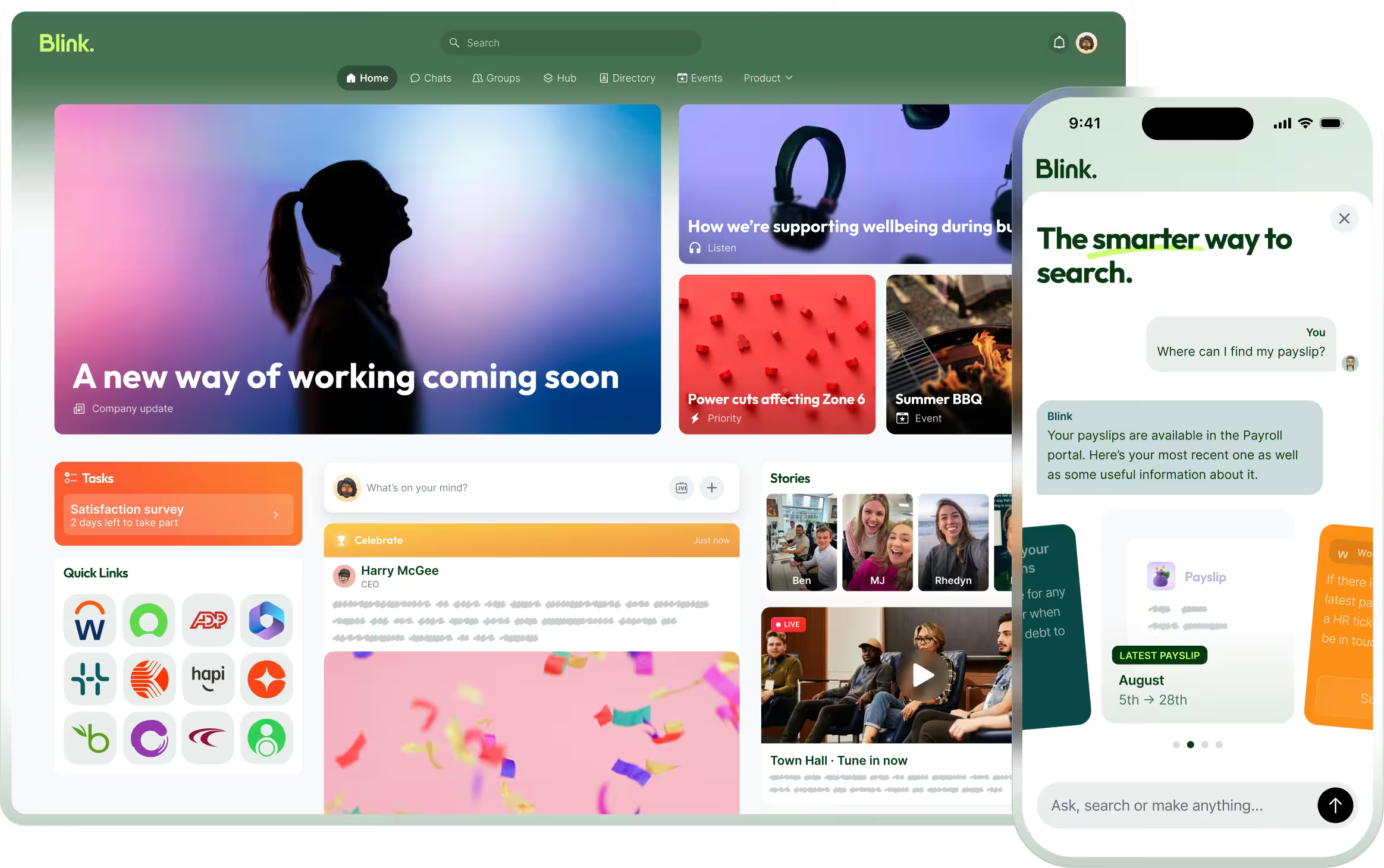
Our Colleague Recognition feature is an easy way to make your employees feel valued in a meaningful, personalized way. Anything worth remembering, recognizing or celebrating can be posted to your company news feed in seconds!
Nectar
Nectar is an all-in-one employee rewards platform that incorporates social recognition, awards, challenges, milestones, discounts, and other kinds of perks.
Reward Gateway
Reward Gateway’s employee recognition features are part of a wider employee engagement suite. With a focus on continuous recognition and celebrating daily success, there’s plenty of scope to build out your program.
Bonusly
Bonusly is simple. You give out points for good performance. Your employees can redeem these for a reward of their choosing – or hard cash, if that’s what they prefer.
Motivosity
Motivosity’s ‘Thanks Matters’ card is an innovative way of rewarding employees. Like Bonusly, you assign points for great performance. These points directly translate into cash, which employees can access via a special Visa debit card.
Kazoo
Kazoo’s employee recognition features sit nicely with the app’s overall employee engagement focus, and emphasizes a diverse rewards scheme that works for each employee – choose from experiences, custom swag, gift cards, charity donations and more.
Final thoughts on employee recognition programs
‘Recognition all day every day’ should be your goal here. It’s about the atmosphere it creates as much as the award certificate or gift voucher your employees go home with at the end of the day.
Keep your employee reward recognition program simple, meaningful and relevant. It’s not always about the big gestures. Remembering a birthday, putting in a good word with the boss or simply taking the team out for dinner after a difficult deadline can have a huge effect on morale – don’t dismiss their importance.
Employee recognition programs can be one of your top tools in the war for talent. Done right, they increase employee retention, build workplace morale and have a major impact on productivity.
If you’re new to employee recognition, don’t worry – the principles are simple. Ultimately, your employees like to be thanked for all the work they put in. If you do this, they will be happier and work more productively.
You might have some form of employee recognition in place already, such as bonus schemes. Right now, however, it pays to go a little deeper with your employee recognition processes. Here’s what you need to know about recognition and rewards in the workplace.
Employee recognition programs: what are they?
There are quite a few definitions of ‘employee recognition’ floating around right now. We like Perkbox’s for its simplicity:
“Employee recognition is when a company acknowledges its staff for great work.”
It’s that easy. An employee recognition program is any set of processes you have in place to facilitate this. This could be:
Peer to peer gifting schemes
Employee award ceremonies
Formalized career pathways and regular salary review schemes
Target-based financial bonus schemes
Why do you need employee recognition programs?
‘Underappreciation’ has always been a key driver of high employee turnover and low employee engagement. If you take your employees for granted, they are more likely to leave and less likely to perform well at work.
On the other hand, a simple ‘thank you’ just once per month to your employees doubles employee engagement, halves risk of them leaving and triples the likelihood of them sticking with you in the long term.
And if that’s the impact of one ‘thank you’, imagine how much positivity a fully thought-out employee recognition program can do!
When you make the effort to thank your employees for their hard work, you:
Create a positive work environment where everyone feels valued
Incentivize staff to go the extra mile and boost their performance
Reduce absenteeism – and, just as importantly, reduce presenteeism
Increase employee engagement, job satisfaction and productivity
Why employee recognition programs are so important now
Recognizing your employees keeps them with you. And that’s more important than ever.
‘Lack of appreciation’ has consistently been named as a major reason behind so many people quitting their jobs right now. In fact, a recent survey found it to be the second most popular reason for quitting, behind inadequate pay.
With a record number of open vacancies in the US right now and major competition to fill them, you can’t afford to be letting talent go – particularly when employee recognition programs are so effective for relatively little input.
It’s the small things that make a difference, now more than ever.
Ideas for employee recognition programs
Different types of recognition are appropriate for different occasions. Only recognizing employees at key workplace milestones (e.g. anniversaries, promotions) isn’t enough.
Instead, aim to create a staff recognition program that works as well for everyday acts of recognition as it does for those big occasions. You could try:
Monetary rewards: this doesn’t have to be a big end of year bonus or salary increase! Smaller, more everyday options include extra days of PTO and meals on the company or a personalized t-shirt with your logo design.
Public recognition: shout outs on the company app, wall of fame, on social media or at a company award ceremony are all good options here
Private recognition: creating a peer to peer gifting system builds camaraderie and good feeling. Keep a stock of vouchers, chocolates and bottles of wine that employees can send to their colleagues to thank them
Celebration of lifetime events: show you care about your employees as people by celebrating their life milestones – cakes and collections for weddings, birthdays and new family additions are always appreciated
Use these ideas as a foundation to build on. Add in the big work milestones – the salary increases, the bonuses, the promotions – and you’ve got a program that makes your employees feel appreciated every day, not just on special occasions.
How to create an employee recognition program
According to Gartner, a well designed employee recognition program can increase productivity by around 11%.
To achieve this, it’s worth spending a little time establishing what your (and your employees’) needs are here. Gathering requirements early will help ensure the effort you spend on your employee recognition program pays off in the long term. Flawed requirements trigger 70% of project failures, so it’s worth spending the time here.
Here’s a quick five step plan for doing this:
1. Survey your employees
Different things work best for different workforces. For example, a stable, long-term workforce might appreciate recognition of birthdays, marriages and kids, but a workforce made up of short-term contractors might be less invested. Create a survey to gauge opinion on how your employees want to be recognized.
2. Find the tools that would work for you
For remote and mobile workforces, an employee app with recognition features might hold the key to success. Take that survey info on how your employees want to be recognized, and get started on figuring out which tools you need to do that in your specific environment.
3. Identify your stakeholders
This shouldn’t be difficult – every department in your organization has an interest in retaining top talent and improving productivity. Put together a committee with representatives from each of these groups to guide the implementation, perhaps headed by your HR/People Team experts.
4. Define your budget for employee recognition
In an ideal world, you’d have an infinite amount of cash to show your employees just how brilliant they are – an HR manager can dream, eh?
Unfortunately, we live in the real world and this might not be – no, definitely won’t be – achievable. Resources are finite, so you really need to make your case — finding a senior sponsor will help you maximize your chances of a decent budget. Remember: senior execs are broadly numbers people. Show them the real, tangible difference employee recognition programs have on productivity, retention and engagement for best results.
5. Identify your metrics for success
Once implemented, how can you tell your employee recognition program is working?
Identify some changes you’d like to see, and set some progress targets around these. You might want to see fewer people leave, for example, or fewer ‘lack of appreciation’ answers on those all important exit interviews. Keep tabs on your progress towards these and tweak your approach as necessary.
The best employee recognition apps
Here are some of the best employee reward and recognition apps out there right now.
Our Colleague Recognition feature is an easy way to make your employees feel valued in a meaningful, personalized way. Anything worth remembering, recognizing or celebrating can be posted to your company news feed in seconds!
Nectar
Nectar is an all-in-one employee rewards platform that incorporates social recognition, awards, challenges, milestones, discounts, and other kinds of perks.
Reward Gateway
Reward Gateway’s employee recognition features are part of a wider employee engagement suite. With a focus on continuous recognition and celebrating daily success, there’s plenty of scope to build out your program.
Bonusly
Bonusly is simple. You give out points for good performance. Your employees can redeem these for a reward of their choosing – or hard cash, if that’s what they prefer.
Motivosity
Motivosity’s ‘Thanks Matters’ card is an innovative way of rewarding employees. Like Bonusly, you assign points for great performance. These points directly translate into cash, which employees can access via a special Visa debit card.
Kazoo
Kazoo’s employee recognition features sit nicely with the app’s overall employee engagement focus, and emphasizes a diverse rewards scheme that works for each employee – choose from experiences, custom swag, gift cards, charity donations and more.
Final thoughts on employee recognition programs
‘Recognition all day every day’ should be your goal here. It’s about the atmosphere it creates as much as the award certificate or gift voucher your employees go home with at the end of the day.
Keep your employee reward recognition program simple, meaningful and relevant. It’s not always about the big gestures. Remembering a birthday, putting in a good word with the boss or simply taking the team out for dinner after a difficult deadline can have a huge effect on morale – don’t dismiss their importance.
Is your internal comms tech stack bursting at the seams?
Technology should make work easier. The right internal communications tech has the power to transform the employee experience and get everyone pulling in the same direction.
But when your internal comms tech stack is bursting with tools — all pinging, updating, and overlapping — things get messy.
With different tools for communication, collaboration, engagement, and more, employees get a fragmented digital experience.
And for the IT team behind the scenes? It’s a constant juggling act of integrations, logins, security, support tickets, and updates — plus eye-watering costs for all those subscriptions.
Of course, each one of those digital tools serves a purpose. But used together, they can create friction, silos, and a digital employee experience that doesn’t live up to expectations.
Overwhelmed by your tech stack? There’s a better way.
Let’s explore how to consolidate your tools without compromise — and why a single, mobile employee app can simplify your stack, save your budget, and elevate the experience for everyone.
The current state of internal comms tech: A tool for every need
Internal communication teams wear a lot of hats. They’re responsible for amplifying company culture, keeping track of employee sentiment, sharing essential company updates, and boosting employee engagement.
To tick all those boxes, many organizations end up with a patchwork of internal communications platforms. A survey tool here. A chat app there. A weakness in one tool is fixed by bringing another software solution into the mix.
In any given organization, there are often separate tools for:
Real-time chat and collaboration
Social media-style engagement
Critical communications
Employee surveys and feedback
Employee training
Virtual meetings and town halls
AI content support
Employee journeys
Peer recognition
Task management
Before you know it, these tools are fighting for employee attention. They’re adding to the noise and making it harder for comms teams to cut through with vital messages. Maintaining multiple, overlapping solutions is also costly — and it creates a real headache for CIOs and IT teams.
{{mobile-hub="/image"}}
The CIO’s challenge: Complexity, cost, and employee fatigue
If you’re managing a complicated internal comms tech stack, you’re probably experiencing one, if not all, of the following challenges.
IT burden
Managing integrations, security, compliance, and maintenance for multiple tools puts a strain on your IT team. Help desk tickets mount up because users struggle to learn each new platform and remember all those login details. For companies with high employee turnover rates, onboarding and offboarding staff across different platforms takes up a huge amount of time.
Cost overload
A bloated internal comms tech stack eats into your budget. When different tools cover similar ground, you pay multiple times for the same features, many of which aren’t even used by your comms team or employees. Costs mount up, draining resources that could be better used elsewhere.
Employee disengagement
App overload kills engagement. Employees bounce between platforms. They miss messages. Some tune out completely. You get poor usage and adoption rates — and a tech ROI that simply doesn’t add up. Despite (on paper) covering all the bases, your internal communication tools don’t provide the seamless digital experience employees have come to expect.
{{mobile-desktop-main="/image"}}
The solution: An all-in-one employee app
With new and improved internal comms tech tools on the market, it doesn’t have to be this way. You don’t need to make do with a hotchpotch of platforms, each fulfilling a slightly different internal comms function.
Instead, you can consolidate all internal communications andworkplace tech into one software solution. And you can do this without compromising on security, functionality, or the employee experience.
With a unified employee app, you have one platform, one login, and one powerful digital workplace for all your internal communication needs. Here’s what consolidation can do for your organization.
One hub for all communications
The best employee communications apps bring all comms under one digital roof. So everyone can stop toggling between tabs!
Employees can access a news feed, instant messaging, alerts, surveys, and videos from the same dashboard. Comms teams can unify their messaging across integrated communication channels. IT teams have just one comms platform to manage and maintain.
Streamlined integrations with existing enterprise tools
The right employee app acts as a hub for all workplace tech. It offers seamless integrations with tools like Workday, ServiceNow, and Microsoft 365.
Your team doesn’t need to spend time creating and customizing integrations from scratch. And with one command center, it’s easy to maintain, secure, and scale your tech ecosystem.
Improved user adoption and engagement
Fewer internal communication tools means less friction and high levels of user adoption. What’s more, with single sign-on (SSO) and deep integrations, users can access all workplace tools via one central, user-friendly dashboard.
Everything from HRIS tools to L&D programs to pay stubs is right at employee fingertips. So adoption of other workplace tech improves too. And — if you pick a mobile-first solution — you improve uptake among frontline employees, which means better comms engagement across your entire workforce.
Reduced costs and complexity
By eliminating redundant software and establishing a single employee app you reduce costs and complexity. Your budget goes further — and your IT team is less stretched, so they can focus on value-add activities instead of tackling endless support tickets.
{{mobile-main="/image"}}
Why Blink? The all-in-one employee app
Blink was built as an all-in-one workplace solution — everything your workforce needs in one intuitive platform designed for easy use on mobile devices.
Wondering whether our employee app is the answer to a sprawling internal comms tech stack? Take a look at what Blink can bring to your organization.
Real-time chat and collaboration
Blink makes a great alternative to Slack and Microsoft Teams, particularly if your organization has a lot of frontline workers. As a mobile-first solution, Blink gives all employees easy mobile access to secure chat and collaboration tools via both desktop and smartphone apps.
Social-style news feed and engagement
Workplace from Meta will soon be defunct. But your workforce can still enjoy an engaging social-media-style experience with Blink. You get a news feed and other modern social features, like Stories, Communities, live streaming, and user profiles.
Mobile alerts and push notifications
Say goodbye to a tangled web of email and SMS communication (which most employees ignore anyway). With Blink, you can use mobile-first alerts and push notifications to share critical updates with your workforce.
Surveys and pulse checks
Surveys and polls are another built-in Blink feature, so you don’t need a third-party tool to find out what your workforce is thinking and feeling. Your comms team can seek regular feedback from employees and view survey data alongside platform usage stats.
Video and live updates
Blink offers integration with Zoom. But you can also use native tools for video and live updates. Users can video call from within chat. Leaders can use the live stream feature to host company-wide meetings from the news feed, giving employees the option to comment and interact during the event.
AI-powered content
Another big benefit of Blink is its built-in AI functionality. Users don’t have to switch between ChatGPT and your employee communications platform. Instead, they can keep their data safe and sound by getting Blink to create, improve, or summarize content, right within the feed.
A wide range of integrations
Blink’s App Marketplace contains integrations with many of the most popular workplace tools. You can set up integrations with your learning and development, project management, CRM, payroll, HR software, employee scheduling, time tracking, and more. One app, one seamless experience: Get one-click access to what you need, when you need it.
Easy identity management
Another way Blink eases the load of your IT team is with user management tools. Rather than using another external identity management provider like Okta, you can use Blink to automate user administration, assigning permissions based on groups, job roles, location, and more. You can use single sign-on right in the app, reducing the number of accounts and login details you’re responsible for.
Rock-solid security
Blink can handle authentication, including secondary biometric authentication, for you. You can also fence particular functions, controlling the areas that workers can access in integrated tools. Blink gives you everything you need to keep company data safe on employee devices.
{{less-is-more="/callouts"}}
Simplify, save, and strengthen employee experience with an employee app
Lately, the internal comms text stack has become a little… unwieldy. In many organizations, a complex network of tools is harming the employee experience, complicating internal communications, and stretching IT teams to the limit.
But with the help of an employee app, you can fix all that.
Employees get a dynamic digital workplace, where they can access multi-media company news and time-sensitive critical updates. It’s easier than ever for them to connect with co-workers, launch video calls, and respond to surveys.
Your internal comms team has tools to share information and gather feedback on employee experience. They can unify their messaging and keep a close watch on employee engagement figures across all workplace software.
And last but by no means least, an employee app brings benefits for your IT team too. Streamlining your tech stack reduces tickets and software maintenance tasks. It frees up your budget while bringing comms clarity to your entire organization.
Blink. And create a streamlined digital experience for every worker and every team.
With a wealth of other digital tools available, email is no longer the de facto king of workplace comms. And if you have frontline employees working for your organization, there’s no doubt that email is falling short.
A retail assistant, a hospital nurse, a warehouse worker — these employees don’t have time to check their emails regularly. Some deskless workers don’t even have a company email address or corporate device, making them even harder to reach via traditional email communication.
So what’s the solution? Let’s take a closer look at why, in 2025, email can’t be your only internal communications strategy — and what makes for a standout alternative.
The pitfalls of email-only communication
Email-only communication is bad news for your business. Here’s why.
Information overload and inbox fatigue
Employees receive hundreds of emails every day, meaning it’s easy for important messages to get lost in the noise.
Critical updates compete with meeting invites, company newsletters, and automated system messages. There’s no clear message hierarchy and things can get pretty messy, pretty quickly.
The result? Employees end up missing essential communications so it’s hard for internal comms teams to keep everyone on the same page.
Poor engagement
Harsh but true: In a world of social media interactivity, emails are dull and uninspiring.
These text-based messages don’t tend to include eye-catching graphics, images, or videos. And they’re not particularly good at engaging employees.
This means workers have less incentive to check their inbox. And your internal communications do very little to boost employee engagement and the employee experience.
{{mobile-image-first-feed="/image"}}
The frontline connection gap
Frontline employees don’t have regular access to email. They work in hands-on roles that involve limited screen time, if any.
Unlike office-based staff, these workers aren’t sitting at a desktop computer being alerted to the latest inbox arrival. Instead, they rely on mobile devices and personal email accounts to check in with internal communications as and when they can.
This makes email a poor fit for real-time, relevant, on-the-go updates. Emails from HQ are lost among personal messages. Information can be outdated by the time workers see it.
You end up with a frontline connection gap that harms the employee experience and increases the risk of poor communication or miscommunication across your organization.
Delayed and one-way communication
A company-wide email is a monologue. You send it on behalf of senior management and everyone else (hopefully!) reads it. Employees are forced into a passive role — they don’t have the opportunity to reply, share their ideas, or ask questions. It’s the ultimate form of top-down communication.
Even one-to-one emails have their flaws. There’s often a delay between receipt of an email and a reply, which can make collaboration with remote workers challenging.
In a world that thrives on instant responses, interactivity, and two-way communication, email feels increasingly outdated. And it’s failing to deliver the employee engagement and culture-building benefits offered by modern internal communication tools.
{{mobile-chat="/image"}}
No analytics, no insights
When sending messages via email, you’re in the dark. There’s no way to track if employees have read or engaged with key messages. So it’s hard to know if emails serve as effective communications or if there's a better channel to use.
This makes it challenging to gauge employee feedback and make improvements. If you don’t know how your messages are landing, how can you make meaningful changes to your internal communication strategy?
The multigenerational workforce has different communication needs
Email was once a logical first choice for company communications. But times have changed.
Millennial and Gen Z workers — who now account for over 50% of the workforce — prefer mobile-first, instant communication. Think WhatsApp, Slack, and social media-style updates.
Gen X and Boomers may still be comfortable with email. They didn’t grow up with social media and the internet in the same way as younger generations.
But now that they too use social media apps in their personal lives, they’ve grown accustomed to the instant messaging experience — and they appreciate fast, direct access to critical information, just like their younger coworkers.
When looking at alternatives to email, you need to pick an internal communication tool that is accessible, engaging, and inclusive for all generations within the workforce. A mobile-first employee app can help you cover all the bases.
A mobile-first employee experience platform brings internal communications to every employee smartphone. In just a couple of taps, they can access the latest company news, chat with coworkers, sign up for shifts, and track down that policy doc they’ve been meaning to reread.
Over email, news about the latest company event, critical safety updates, and messages from coworkers are jumbled together.
You can flag important messages or write URGENT in dreaded capital letters. But as new messages still push emails down an employee’s inbox, there’s a good chance things will be missed.
An employee experience platform gives you defined internal communication channels. Depending on the needs of your company, this might include:
Essential updates that have to be acknowledged by employees before they disappear from the dashboard
A news feed, where employees can find company updates, culture, and connection
A content hub, where you can keep documents like policies, FAQs, and safety guidelines
Digital forms that make it easy for employees to contact HR about their next vacation or their shift availability
Communities, where like-minded coworkers can connect over projects, interests, and hobbies
By putting everything in its place via a multi-channel approach, it’s easier for employees to see essential messages and find the information they need.
{{mobile-main="/image"}}
Instant, real-time communication
Instant messaging tools are a standard feature of employee experience platforms. These social tools support real-time, remote conversations. And they can be used to replace emails and the unauthorized shadow IT, like WhatsApp, that frontline teams often resort to using.
In addition to real time chat, you can share fresh and relevant updates over the news feed, segmenting employees so they only see news that relates to them. You can also use push notifications to highlight time-sensitive information and ensure nothing is missed.
Better reach and accessibility
Employees can log into an employee experience platform without a company email address. This — along with the fact that the app is available via smartphone and doesn’t require a desktop computer — means that all employees, even those working on your frontline, have access to vital employee communications.
Sharing critical messages — think crisis communications, or timely updates to business goals — with everyone gets easier. But there are other benefits to improving internal communications for frontline workers. You also improve frontline employee engagement, boosting satisfaction and loyalty among a traditionally hard-to-reach, hard-to-retain group of workers.
More interactivity and engagement
Employee apps are built to offer an interactive experience. You can launch polls and employee surveys. Employees can comment or leave emoji reactions on news feed posts. With your permission, workers can even post their own content. Peer communication has never been easier.
Multimedia content is also a must, meaning you can move beyond text-based email communication to embrace Insta-worthy internal comms. You can use infographics, videos, and photos to distill complex messages into digestible, engaging content.
Easy-to-access analytics
Over email, it’s hard to keep track of who has read and responded to your messages. And it’s near impossible to understand how you’re doing in terms of employee engagement.
With an employee experience platform, you get access to the effective tools you need to make meaningful changes to your internal communications strategy and the wider workplace experience.
You can use analytics to understand how employees use your app and consume internal comms. You can track engagement trends and drill down into the data to find teams or locations where messages just don’t seem to land.
Armed with this insight, you can identify areas for improvement, setting internal communication KPIs and using data to make more informed decisions regarding your internal communication plan.
{{analytics="/image"}}
Is it time your organization moved beyond email?
Email alone is no longer enough to drive an informed and engaged workforce. For a truly successful internal communication strategy, you need an internal comms tool that is:
Instant. Everyone gets messages when they matter most.
Interactive. Employees can engage, react, and be part of the conversation.
Inclusive. Deskless and office-based workers should get equal access to internal comms.
Insightful. Analytics help you understand what’s working and what isn’t.
The best employee apps support a strong company culture of connection and are built on bottom-up communication. They help you keep pace with the latest internal comms trends and put all the internal communications tools you need in one place.
By relegating email and elevating an employee experience platform, you create a single source of truth, where everyone can instantly access company news, share peer-to-peer communication, and collaborate with each other — right from their smartphone.
Blink. And replace outdated email comms with a modern employee experience platform.
Employee engagement is a critical focus for People teams— or any other business leader. Learn what it is, why it’s important, and how to improve it in our complete guide.
Employee engagement is the difference between soaring productivity rates and a sense of stagnation. It’s fifty people applying for a single vacancy, rather than fifty vacancies and one applicant.
Yet for all its importance, companies frequently misunderstand what employee engagement is and what it looks like. That's why we’re here to help.
Whether you're looking to better understand the definition and importance of employee engagement, drive employee engagement in your organization, or simply understand examples of employee engagement, this complete guide to employee engagement has something for you.
What is employee engagement? A simple definition
Employee engagement is the ongoing process of ensuring your workforce feels satisfied with their job, aligned with your organization’s values, and supported enough to give 100% during work hours.
Research by SHRM defines the term employee engagement as relating to the level of an employee's commitment and connection to an organization, while Investopedia defines employee engagement as describing the level of enthusiasm and dedication a worker feels toward their job.
At Blink, we believe true employee engagement is a combination of two equally important parts:
Attitude - the commitment a worker feels toward the company
Behavior - the effort that an employee is willing to invest in their job
Whichever way you look at it, maintaining employee engagement is a key factor in determining how successful an organization will be. It also provides key insights into employee satisfaction and sentiment, which can help identify areas that may need improvement.
To better illustrate what employee engagement looks like, here are some of the key attitudes and behaviors of engaged vs disengaged employees:
What is employee engagement for employers?
HR is all about people. So it makes sense that, if that is your role, you want the best for your co-workers.
Still, there’s more to it than that.
Employee engagement is important because it affects the performance of your company. Think back to a job you’ve not enjoyed in the past — did you give as much to that role as you did to the ones you loved?
Now extrapolate this out across an entire company of unhappy, unmotivated workers. In toxic environments, productivity nosedives. Depending on the type of organization you work for, this could mean a lower output rate, poor customer service, an increase in safety incidents, reduced patient satisfaction, missed deadlines, or any other number of issues.
What is employee engagement for employees?
For employees themselves, engagement isn't so much a daily activity they schedule time for. It's a natural byproduct of a strong employee experience.
Engagement is directly correlated to a positive work environment; when people feel respected, appreciated, and valued for their work, they are more likely to be an engaged employee. It's about being part of something bigger than just your job title — it’s that sense of satisfaction and fulfillment when you know you are making a difference.
Different groups of employees have different engagement expectations — and when those expectations match the day-to-day experiences of their roles, employees are more likely to be engaged.
Whether it’s your dispersed, frontline teams or your first-line managers, it’s worth getting to know what your employees expect from their engagement experience.
Why is employee engagement important?
Employee engagement efforts don’t need to be expensive, but they do need to be intentional. Issues created by poor employee engagement practices can cost your company thousands.
These include:
Reduced productivity: people don’t work well when they’re unhappy. If teams are consistently falling short of productivity targets you know to be reasonable, there’s a good chance they’re unhappy at work
Absenteeism: unhappy employees stay at home and use more sick days and mental health days than those employees who enjoy their jobs and work environments
Presenteeism: Between May 2021 and November 2022 alone presenteeism rose by 18%. As the cost of presenteeism has historically been found to significantly outweigh the cost of absenteeism, this is one common challenge for engagement leaders to tackle.
High employee turnover: if someone is disengaged, it makes them more likely to leave. Replacing employees is super expensive (think six to nine months’ salary, plus up to 213% of the total annual salary depending on the seniority of the position). Along with being a cost drain, the extra workload will put pressure on your other, potentially unhappy, employees while you find a replacement
Employer brand damage: a stream of employees leaving your organization won’t do your reputation any good. Not only will you end up with a large list of vacancies, but you’ll also struggle to find people to fill them. With more job seekers than ever using online review sites, such as Glassdoor, to screen companies before they apply, a poor reputation for employee engagement has never been so damaging
This creates a cycle that your organization doesn’t want to slip into. Breaking it, or making sure that your company doesn’t start to slip down it, is an essential task that requires time and dedication to tracking — and improving key metrics.
3 core benefits of employee engagement
Gallup provides interesting insights on the benefits of employee engagement. Organizations with highly engaged employees experience:
As you can see in the employee engagement statistics above, there is a vast array of benefits to be gained from increased employee engagement. In the below sections, we’ve found some of the most compelling evidence for three core benefits of employee engagement:
Improved discretionary effort offered by engaged individuals is one huge benefit of employee engagement initiatives.
Those with high engagement levels often perform above expectations and develop meaningful relationships with their peers, contributing to improved outcomes for everyone involved. These efforts are what is known as ‘Discretionary Effort’.
The discretionary effort your employees put in directly impacts the success of your business outcomes, whether it’s your overall employee output rates, your patient safety outcomes and satisfaction levels, or a direct increase to your bottom line.
Improved job satisfaction
Employee engagement has the dual benefit of improving both organizational success and job satisfaction on a personal level.
This is because engagement initiatives themselves provide employees with more development opportunities, better recognition for good work, and better prospects for career growth. When employees reap these benefits offered to them by engagement strategies, they feel like they make a real impact on the success of an organization, and that what they are doing is meaningful.
Don’t underestimate the historic power of meaningful work on your employee satisfaction levels — nine out of ten employees would take a lower salary for more meaningful work.
Increased employee retention
Employees are more likely to stay with the organization when they are more satisfied and engaged.
Research by the IJECM (International Journal of Economics, Commerce & Management) found that job satisfaction is a reliable and relevant predictor of employee retention. Highly engaged employees develop a greater sense of attachment to the organization and become more loyal, resulting in up to a 43% difference in employee turnover according to further employee engagement research.
How to improve employee engagement
There are a number of ways to improve employee engagement, but, at Blink, we like to think of engagement efforts as being split into three key categories:
Delivering on the 10 key drivers of employee engagement
Identifying the employee engagement strategies and tactics that work for your employees
Ensuring the best employee engagement tools and software
Key drivers of employee engagement
In order to improve employee engagement, you must understand what drives it, and focus your efforts there. What coreexperiences and tools do you need to provide to your workforce in order to boost the overall employee experience and drive engagement?
By focusing engagement efforts on enabling these core engagement drivers, you will be much more likely to see significant engagement improvements.
Employee engagement strategies and tactics
An employee engagement strategy is the plan of action you take to bring about an increase in employee engagement levels. On the other hand, tactics are the individual steps and actions that will get you there. In the context of an employee engagement strategy, this means the tactics are the specific engagement actions your teams take to implement the initiatives outlined in the strategy.
Employee engagement strategies combine a number of tactics, such as the use of team-building exercises, offering career growth opportunities, providing more effective recognition for good work and positive behavior changes, or improving your internal communication processes.
In order to effectively craft an engagement strategy, it’s important to have a clear vision of what you want to accomplish, and how you plan to get there.
By having a clearly defined strategy, it is much easier to measure the success or failure of any engagement tactic you try. When you identify which tactics work and which don’t, you can adjust your future strategy accordingly.
Employee engagement tools
Employee engagement tools are products and tech solutions that enable companies to measure, manage, and improve employee engagement levels.
Employee engagement software comes in many forms, from survey software used to collect employee feedback and communication platforms providing a channel for discussion between teams.Engagement analysis tools can also provide insight into how your engagement efforts are faring.
However, if your staff are juggling a number of platforms and tools for different parts of their work, it will be inconvenient and you're not likely to see great engagement results. That's why an all-through-one engagement super-app is the best choice for any business wanting to consolidate engagement efforts.
A super-app brings together all of your employee communications, engagement surveys, recognition programs, and employee rewards into one, central platform.
This will not only make your life easier but will also ensure a more consistent experience for employees while enabling you to get an aggregated view of their engagement levels with just a few clicks.
Examples of employee engagement in action
How Go North West achieved 96% monthly active engagement app users
The challenge
Like many frontline organizations facing a digital inclusion gap, Go North West faced challenges when it came to digitizing processes and communications in their organization. Historically, their internal comms were split across various channels, such as emails, mail to drivers' home addresses, depot noticeboards, and unregulated social media platforms.
With so many paper-based operational processes, Go North West faced high levels of non-adherence and inefficiency. On top of this, they were also facing an industry-wise staff shortage in the wake of the Great Resignation and COVID-19, which made growth for the company more difficult to achieve.
The solution
The first solution to the engagement challenges faced by Go North West lay in using Blink’s Hub — the super-app’s central portal for accessing processes, documents, and tools. Go North West could now use this to share duties,schedule, and running boards for easy access and updating.
After this, the company had to ensure critical information such as route diversions could reach all members of staff quickly and efficiently. This was where the team used the Blink Feed — a company-wide, mobile-first communications channel, supplemented with the use of Chats to fulfill shift swaps and fills and ensure smooth service delivery.
The team at Go North West also needed to streamline how they provided drivers and other members of staff access to critical processes and resources. This was where Blink’s Digital Formsand Custom Apps stepped in to revolutionize how the organization worked.
By moving to digital processes from outdated paper-based processes, drivers were able to:
Request annual leave with a few taps from the app, made easier with functionality such as auto-population and validation
Access their schedules through one-click access to DAS-Web
Submit near-miss reports via a custom app on Blink, allowing them to log incidents quickly and easily, increasing the number of submissions to drive process improvement
The outcome
The outcome of this engagement tech overhaul was a resounding success. Engagement levels, retention, and digitization efforts were all improved.
What did this look like in terms of engagement? Well, alongside achieving 96% monthly active app users, Go North West also saw:
30,000 opens of DAS-Web per month
6,000 Chat messages per month
98,000 opens of Hub content
17 daily app opens per user
186 monthly app opens per user
What a result! Widespread success across the operation, with Go North West achieving its goal of higher engagement.
The use of Blink’s engagement super-app has enabled the team to move into a digital-first future and deliver an efficient service that allows them to better serve their employees — and customers. A win-win for everyone.
It’s not just something you need to focus on when employee morale is down and stop as soon as it reaches manageable levels… it should be a central part of the HR or People team’s day-to-day activities.
So, before implementing any of the below, ask yourself:
How much time should we dedicate to this a week?
Who should be in charge of this area?
Who can manage the on-the-ground responsibilities associated with this?
Are there any tools (e.g. a new employee super-app) that could help us manage this workload?
In terms of exactly what to measure and how to measure it, there are two key areas you need to focus on:
The data that already exists in your company
Data that you actively go out and collect.
Measuring employee engagement using existing data
This is data that your HR team won’t have to set up any new processes for; it (should) already be monitored by various departments. The key here is collating it, as there’s a good chance that inter-departmental silos mean that you won’t necessarily be able to access it right away, let alone see the big picture.
We’re talking about:
Absence rates
Employee turnover
Number of complaints to line managers
Number of complaints to HR
eNPS scores
Customer reviews
Customer retention
Sales
Turnover
Social media engagement
There could be a myriad of reasons why customer satisfaction has dipped, so take a look at it alongside some of the other metrics listed, over an extended period of time.
For example, do eNPS scores dip when employee turnover is highest? Do customers write poorer reviews when absence rates are particularly high? Start to compare ‘result’ metrics (like sales, turnover, customer satisfaction, and customer retention) with employee wellness to see whether you notice any patterns.
From there, measure, measure, measure! Set up dashboards with all your chosen metrics so that you can track and compare them at a glance. You can then monitor employee engagement via its direct consequences — absence rates going down and productivity going up is a sure sign that your efforts are working.
To assess your current data, an engagement analytics tool can help. It will look at the data you already have (like those mentioned above) to identify how engaged your people really are and provide real-time insights into what might need improvement.
All of the above help to paint a picture of where you are with employee engagement, but they aren’t the only weapon in your arsenal. So, once you’ve got those dashboards up and running, move onto…
Measuring employee engagement by collecting new data
What’s the best, most efficient way of understanding your employee engagement levels?
Just ask them.
Regular, anonymous employee engagement surveys are the most efficient way of doing this. You might see these referred to as “pulse” surveys, and they are so much better for measuring engagement than the traditional annual long-answer survey for the following reasons:
Response rates tend to be higher. It’s much easier to encourage employees to complete three quick “rate on a scale” questions with an optional “any further comments” box than three pages of long-answer questions that they don’t have time to do.
You can keep them focused on one single issue each time. This gives your HR team a much better chance of addressing feedback successfully and sharing what they’ve done to address their co-workers’ concerns.
They encourage constructive feedback. The issue with running an annual survey is that employees see it as their single opportunity to get everything off their chests.
It’s difficult to respond to 12 months of input from an entire company in any meaningful way, particularly if the topics covered range from disagreement with the company’s strategic direction or low staff retention to dissatisfaction with the options offered in the cafeteria.
How to use your employee engagement data
Whether you’ve noticed that your absence rates are soaring way above your industry average or carried out a highly targeted pulse survey, you need to take action from this data. Understanding exactly how to use your employee engagement data is therefore crucial.
Align key stakeholders with a plan of action
First, sit down with all relevant stakeholders and agree on a workable course of action. Involving stakeholders here keeps things grounded — it’s tempting to offer your workforce the moon on a stick when they’re unhappy, but this isn’t realistic. Avoid promising things you can’t deliver on — broken promises won’t be taken well by your employees, no matter how ambitious they are.
If, for example, your employees have stated they want better quality break rooms or equipment, it’s wise to take the time to align with the leadership suite on whether they have the resources to help with this before you promise a tech overhaul or new break room to your workforce.
Track improvements in data with KPIs
Second, it’s super important to track these improvements against realistic employee engagement KPIs. Change in organizations is gradual, so make sure your targets reflect this and avoid the temptation to try and go from 0 to 100 in three months.
If none of your employees are having regular one-to-one contact with their line managers, an example target structure could look like this:
3 months in: 20% of all employees having regular catch-ups
6 months in: 40% of employees
9 months in: 60% of employees
12 months in: 80% of employees
You could also consider how you roll this out. It’s much easier to coordinate regular catch-ups for office-based positions, so you could focus on getting a full 100% in the first three months for office-based teams as a quick win. Whilst you do this, you can sort out the infrastructure for deskless and dispersed teams to be able to do this further down the line.
Consider new tech
Finally, think about any tools that might help you meet these targets and/or address employees’ concerns.
There’s now plenty of workplace tech to help with a range of issues, like employee apps to help communication, productivity software to help meet targets, and advanced CRM features that make meeting customer needs much easier for frontline employees.
Check with your leadership team to see what sort of support they could offer here. They’ll be looking for a solid return on investment and plan before giving the green light, so make sure that if you’re making a direct request for new software, you build a solid business case about why you need it.
The golden rule: never assume that your workforce will notice your efforts to improve things without you communicating it.
Your workforce is busy, and meaningful change takes time — so you’re not going to make everything perfect right away. To really show your employees that you’ve taken their feedback on board, you’ll need to be explicit.
Include announcements about your planned improvements into your internal communications strategy. If you’ve conducted a pulse survey, share the results. This is a gesture of transparency that people will really appreciate—and emphasizes that you’re taking employee feedback seriously.
When announcing any improvement plans, consider:
The channel that would work best: would more people see it via email, on a noticeboard, or via a mobile-first employee app?
The frequency of your communication: how frequently should you update your employees on the progress you’re making towards these goals
You could also consider providing updates in person at company meetings, as this adds a welcome personal touch.
Remember the small things alongside big things
Big, organizational changes take time, but there are smaller things you can do for your workforce in the meantime.
Reworking the employee journey so there are more obvious routes for internal promotion takes time. Easier things like upgrading the coffee machine, setting up a couple of lunchtime clubs, or getting a pool table for the break room does not.
Implementing a couple of easy-to-manage changes (either that your workforce has specifically asked for, or just off your own back) emphasizes your commitment to improvement while you’re working towards the more structural stuff. It’s not a substitute, but it is a good reminder to your workforce about what you’re trying to do.
Blink. And your employee engagement strategy takes shape.
Blink is the all-through-one engagement super-app that your business needs to make sure employee engagement isn’t an extra task on your list, but part of a holistic approach to people management.
Our platform includes all the tools you need for effective employee engagement, from surveys and feedback loops to recognition programs and rewards. We also provide comprehensive reporting dashboards and insights to monitor progress, track performance, identify problem areas and create actionable plans.
When it comes to employee engagement, Blink is the perfect solution for businesses of all sizes.
No matter where you are in your engagement journey, we’re here to help you create the best possible experience for your employees and drive maximum success for your business.
Blink wins ClearBox Choice award for the second year running
Blink has been named one of the top intranet platforms by ClearBox in the latest update of the 2024 Intranet and Employee Experience Platforms report. Every year, the intranet consultancy takes an in-depth look at the intranet market, comparing available solutions and awarding the best intranet providers.
Here’s a snippet of what ClearBox had to say about Blink:
“The focus Blink places on the deskless audience is among the best we’ve seen in this report and makes a compelling choice for organizations with a frontline-heavy workforce.” — ClearBox Consulting
Let’s take a closer look at the ClearBox report and its review of Blink.
About ClearBox
ClearBox Consulting is an independent intranet consultancy that helps organizations find intranet solutions that meet their needs. It’s a vendor-neutral company that prides itself on giving honest, impartial advice. Previous clients include big names like Unilever, PlayStation, GlaxoSmithKline, and Bayer.
About the report
Every year, ClearBox compares 20 leading intranet vendors and their products, scoring them on eight criteria. It then releases a report to detail its findings. As part of the report, ClearBox highlights standout intranet vendors, giving them a ClearBox Choice Award. In 2024, Blink was among the award-winners for the second year running.
What does the report assess?
ClearBox evaluates every product against eight criteria. Criteria include user experience and visual appeal, community and engagement, publishing and communications management, and mobile and frontline support.
The organization also seeks customer opinions on the product and customer support from the vendor. It looks at information on pricing and each vendor’s development roadmap too.
Blink’s mobile-first intranet: The ClearBox review
ClearBox describes Blink as “a frontline-focused, mobile-first product that understands its target audience perfectly.”
The report praises Blink’s community and engagement features, its approach to integrations, and its ability to support two-way employee communications. ClearBox gives Blink particularly high scores in the following areas:
Mobile and frontline support
User experience and visual appeal
Community and engagement
Here, we look at each of these criteria in more detail.
{{mobile-main="/image"}}
Mobile and frontline support
Blink was the only software provider in the ClearBox report to score maximum points for this criterion. Staffbase comes close. But achieving the same mobile and frontline support as Blink comes at an additional fee for Staffbase customers.
Blink was built with the frontline workforce front of mind. We wanted to create a tool that leveled the playing field, giving deskless workers equal access to internal communications and company resources.
Employees can log onto our mobile-first platform via smartphone — they don’t need a desktop computer or a company email address. Via a user-friendly interface, they can then access everything they need to thrive in their roles. This boosts employee engagement and the frontline employee experience.
User experience and visual appeal
For user experience and visual appeal, Blink gets a near perfect score — and ties with Omnia and Staffbase for its out-of-the-box offering.
ClearBox highlights Blink’s highly effective mobile user experience and straightforward navigation. The report also references Blink’s excellent branding and design options, along with the social-media-style experience it provides for users.
We know that social media provides an excellent user experience. So, with Blink, you get a comprehensive company news feed that you can fill with interactive, multimedia content. Organizations can also share real-time updates and employee-generated content across Blink Stories.
Community and engagement
ClearBox highlights Blink’s focus on community and people. It also praises the wide range of engaging features Blink includes as standard. These include employee surveys, a range of communication channels, and employee recognition tools.
The ClearBox report also talks about Blink Journeys. Admins can create tailored content pathways for employees, triggering the right content at the right time in the employee lifecycle. This ensures relevant and engaging content that is personalized to every user.
Employees can also join Communities — spaces where workers can unite around shared interests — to find like-minded co-workers and develop a deeper sense of belonging.
Some more highlights from the ClearBox report
Here’s what else ClearBox had to say about Blink:
“Blink was designed with the frontline in mind and the focus on a mobile-first experience is clear throughout. Blink is an excellent app product and one of the best we’ve reviewed in this report.”
“[Blink is] easy to use and quick to navigate, making communications, reference materials, and tools easy to find.
“Blink offers organizations alternatives to shadow technology like WhatsApp, while also providing easy access to business tools without the need for employees to download multiple apps.”
And here’s what customers interviewed by ClearBox said about their experience with Blink:
“Blink has drastically improved the way we communicate with our team members. In a recent survey, [employees] already feel more listened to and this is all down to Blink.”
“[Blink] is amazing. They partner with us to complete projects or work through any desired improvements as they are able. Great partner to work with!”
Why choose Blink?
Blink is the leading mobile-first employee experience platform. It gives admins all the tools they need to share critical messages and build a strong company culture. It allows frontline and desk-based workers to join the conversation, build workplace relationships, and find the information they need to do their jobs well.
Nowadays, most organizations understand the importance of employee engagement. In fact, 75% of CHROs say that improving the employee experience and organizational culture is a top focus for 2024.
There’s plenty of research out there, outlining the benefits employee engagement brings to your business. Increased employee productivity and retention, better customer satisfaction rates, improved business profitability — and that’s just the tip of the iceberg.
It’s clear. Businesses that prioritize employee engagement tend to be more successful than those that don’t. But one important question remains.
Whose responsibility is employee engagement? Who within an organization is tasked with devising an employee engagement strategy — and putting it into action?
In this guide, we explain who should take ownership of employee engagement. We also look at the vital role HR teams play in establishing the strategies, tools, and behaviors that support better engagement in the workplace.
Why does employee engagement matter?
Engaged employees are happier. They’re more likely to interact with company communications and contribute to company culture.
Engaged employees are also more productive and more innovative. They come up with bright ideas, feel invested in their work, and are committed to your organization.
Increase productivity and profitability: Engaged workers outperform their less engaged peers. Gallup’s extensive research into employee engagement reveals that engaged organizations are 17% more productive. They also experience a 23% increase in profitability.
Boost levels of innovation and creativity: An engaged workforce goes beyond the bare minimum. They’re more likely to collaborate — and more likely to demonstrate creative thinking — which spells greater business innovation.
Improve customer experience: Engaged employees care about the customer experience and inspire customer loyalty. Whether they’re serving customers, manufacturing products, or working at HQ, your team is dedicated to customer satisfaction.
Minimize staff turnover: Higher employee engagement levels are linked to higher employee satisfaction. This boosts employee retention and minimizes turnover. In fact, organizations with high levels of engagement can reduce staff turnover by up to 51%.
Why avoid disengagement?
So, we’ve looked at how employee engagement benefits your business. But why is disengagement such a problem?
Disengaged employees are less productive and invested in your organization. They experience more stress, anger, and health problems than their more engaged co-workers — and are more likely to take time off sick.
These employees are also less loyal. They’re more likely to look for a job elsewhere, increasing your recruitment costs. Those who stick around can cause other problems for your organization.
According to McKinsey, quiet quitters account for between a fifth and two-fifths of an organization’s workforce. These workers fulfill minimum job requirements — but no more. Some also act to demoralize and disrupt other members of your team.
It’s also worth bearing in mind that frontline employees are generally even less engaged than their desk-based peers. They’re more likely to feel burned out, three times more likely not to recommend their organization as a good place to work, and twice as likely to leave.
Whatever form it takes, disengagement is costly. According to Gallup’s estimate, low engagement costs the global economy $8.9 trillion in GDP. So finding ways to engage the whole workforce — including your remote, office-based, and frontline employees — is crucial.
Who is actually responsible for employee engagement?
IIt’s clear that high levels of employee engagement are good for an organization. But who within your organization makes that happen? Who’s responsible for employee engagement?
The most successful employee engagement strategies involve everyone within an organization. It’s simply not possible for HR to improve employee engagement significantly without company-wide buy-in.
You need all of the following parties on board:
Leadership. Leadership is responsible for championing employee engagement. Their attitudes and behaviors filter down through an organization. So without C-suite support, employee engagement initiatives are unlikely to be effective.
Management. Managers also play a crucial role. Because they have direct contact with employees, they’re well-placed to develop and sustain employee engagement, implementing the agreed engagement strategies.
Employees. Workers also play a role in the success of employee engagement. They can help by supporting their teammates and by taking part in two-way dialogue with managers and leaders, providing constructive feedback.
HR. None of the above would be possible without HR. The people team is responsible for empowering the rest of the organization. They put in place the strategies, processes, tools, and coaching needed to build a more engaging and engaged workplace.
The HR team is uniquely positioned to drive employee engagement. As the custodians of talent, it’s HR's responsibility to manage employee recruitment, onboarding, development, and retention. For each of these key points in the employee life cycle, they can devise and implement strategies that ensure employees feel valued and engaged.
They can also support the wider organization so they understand what good engagement looks like — and the best ways to achieve it.
In a nutshell: HR and employee engagement go hand-in-hand. But they need buy-in from leadership and management if they’re to improve employee engagement and reap the associated benefits.
The role of HR in employee engagement: 6 key responsibilities
As well as coaching leaders, managers, and employees to adopt effective employee engagement behaviors, HR is responsible for engagement in all the following ways.
1. Recruitment and onboarding
HR can support employee engagement from the very first contact a potential employee has with your organization.
By developing your employer brand and by crafting job descriptions that showcase this brand, you showcase company culture and attract candidates to apply.
Once a new hire starts work, you can continue to engage them with tailored onboarding experiences. Support workers to find resources and forge relationships from day one and they’ll feel part of company culture more quickly.
2. Communication
Internal communications are critical to employee engagement. Relevant, personalized, and timely communications keep employees informed and engaged.
HR teams can use communication tools to regularly remind employees of workplace benefits, perks, and development opportunities. They can also encourage leaders and managers to send their own engagement-boosting comms.
Regular, two-way communication is also key to maintaining a positive relationship with employees. HR should make an effort to communicate with employees often, whether it be through secure chat, 1-2-1 meetings, or the company news feed. This helps employees to feel valued and connected to the company, boosting overall performance.
3. Recognition
Employees feel more engaged when they feel valued by their employer. So praise from a manager or co-workers, bonuses, and rewards programs should be a regular feature of the employee experience.
While it’s up to team leaders to show their appreciation, HR plays an important role in making recognition an integral part of company culture.
Your HR team can establish recognition and reward systems. They can determine which rewards are most appealing to your workforce. They can also implement user-friendly employee recognition tools, which make it quick and easy for managers to recognize the hard work and milestones of their employees.
4. Retention
Another key responsibility for HR teams is talent retention. With employee surveys and exit interviews, you keep a finger on the pulse of your organization. You learn how employees are feeling and what could be done to improve employee engagement.
This data can then be used to make changes that will improve employee engagement levels and drive employee retention, minimizing staff turnover and its costly consequences.
Development and progression are also key to retention. HR teams can keep employees engaged by clarifying progression opportunities and career goals.
They can also ensure easy, online access to training and development programs — so all employees, whether they work on the frontline or in the office, can make progress in their careers.
5. Wellbeing and safety
Employees are more likely to enjoy high levels of engagement when they feel physically and psychologically safe at work.
HR can support this aspect of employee engagement by ensuring good communication around safety. It should be easy for employees to report safety concerns and hazards. Workers should have access to a content hub that stores essential company policies and safety procedures.
For psychological safety, HR can take the lead, promoting transparent communication and an inclusive company culture across all employee touchpoints.
6. Tools and tech
The right tools and tech make employee engagement much easier. So another responsibility for HR is the implementation of tools — like employee engagement apps — which have the power to engage the workforce and amplify company culture.
Via an employee app, employees can access an engaging news feed, employee surveys, training and development, and a content hub — everything they need to feel connected to their roles, co-workers, and the wider organization.
It’s important that these tools are available to all employees to ensure engagement initiatives reach every sector of the workforce.
So look for tech tools that are accessible via a mobile device and that don’t require a company email address. That way, frontline employees enjoy the same access as their desk-based peers.
Searching for the ultimate employee engagement tool? Here’s a quick intro to the Blink employee app.
What can HR do to improve employee engagement?
HR teams play a critical role in employee engagement — and there’s lots that HR can do to improve employee engagement within their organization.
HR can support managers in understanding the 'baseline' or BAU (business as usual) engagement levels within an organization.
This means assessing and tracking metrics like turnover, productivity, and performance over time, as well as identifying any trends or patterns that may be affecting overall engagement levels.
With this information, HR can work with managers to identify the most suitable employee engagement activities. These are interventions that will improve engagement levels in both the short and the long term.
Some useful metrics include retention rate, absenteeism rate, and employee net promoter score (eNPS). You can also use employee surveys, exit interviews, and your employee intranet analytics to assess engagement levels within your organization.
Here's how we measure engagement at Blink:
Retention: Disengaged employees are more likely to quit their jobs so employee retention is a good indicator of engagement. You need to understand why and when employees choose to leave your organization.
Manager performance: Strong managerial support is a key driver of employee engagement, so it's important to assess and improve the performance of your managers. We drill down into the data to identify low-engagement teams and then provide those managers with extra coaching.
Intranet engagement: What do your intranet engagement metrics tell you? By tracking how employees interact with our employee app, our HR team can identify disengagement and dissatisfaction.
Know how to manage for engagement
Managers account for at least 70% of the variance in team engagement and have a huge influence on employee wellbeing.
Ideally, mid-level management supports engagement by providing constructive feedback, giving recognition and rewards, and acknowledging individual strengths and contributions.
HR can support employee engagement by supporting managers. With the right employee engagement tools and guidance, managers are empowered to build happy and engaged teams.
Employee engagement training can also help managers better understand the important role they play in engaging the workforce.
Look for early signs of disengagement
Employees who are becoming disengaged may start to pull back from their work. They might make fewer contributions to the team, their output may decrease, and they might be less likely to speak up in 1-2-1s and meetings.
This disengagement isn’t always obvious to busy managers, particularly when they’re responsible for a dispersed frontline team. So HR can support them by using employee intranet analytics to identify employees who aren’t engaging with the platform.
By looking out for early signs of disengagement, HR and managers can take action to re-engage employees before they impact team morale or decide to leave the organization.
Talk about more than tasks during 1-2-1s
HR should encourage managers to focus more on fostering strong relationships during 1-2-1s.
Of course, they need to discuss work-related tasks and employee performance. But this is also an opportunity to learn about employees’ personal interests, goals, and challenges.
By creating a supportive and open environment where employees feel comfortable sharing their thoughts and concerns, HR can build the trust and connection that is critical for strong employee engagement.
In summary
Improve employee engagement at your organization and you stand to improve productivity, profitability, and employee retention.
HR teams are responsible for employee engagement throughout the employee life cycle. They play a critical role in devising and implementing employee engagement strategies.
But they can’t go it alone.
For employee engagement initiatives to be a success, you need company-wide buy-in. Leaders, managers, and employees — guided by HR — need to see the value in engagement and demonstrate a commitment to creating an engaging workplace culture together.
In today’s modern workplace, you also need the right tech tools. These tools make it easy for everyone to incorporate engagement activities into their every day.
Blink’s employee app provides all the tools you need to improve engagement within your organization:
A personalized news feed: A place where you can build a welcoming company culture, encourage everyone to take part in two-way communication, and prioritize the most relevant information for each employee.
Recognition tools: Our Kudos tool makes it easy for managers to recognize employee milestones and achievements. It allows co-workers to share in the celebration, too
Employee surveys and analytics: Gather employee feedback and view app analytics to understand, track, and make data-based improvements to employee engagement
An integrated content and resource hub:Employees can access all tech tools and resources via a single, user-friendly interface. Just one set of login details and no company email address necessary.
Whether you're looking for a new way to measure employee satisfaction or simply want to provide a more engaging employee experience, Blink has the tools to support and facilitate your success.
Book a personalized demo today to find out how Blink can support employee engagement at your organization.
Take a wild guess. During a week-long hospital stay, how many different employees is a patient likely to interact with?
When you account for all the doctors, nurses, technicians, consultants, and other people involved, it’s certainly more than a dozen. And depending on the patient’s condition, he may also see more than one type of specialist such as an oncologist, haematologist, radiologist, and so on.
If these many people are responsible for a patient’s care, they better be on the same page regarding the patient’s condition, diagnosis, and treatment. After all, a small mistake can risk his well-being.
Despite that, internal communication is an area where the global healthcare industry hasn’t caught up with the latest tools and best practices available to them. In this post, we’ll walk you through the importance of internal communications in the healthcare industry, its challenges, and what you can do to address them.
Why is communication important in healthcare?
Caring for patients properly takes more than procedures and diagnoses. You also need an effective internal communication system. And not having one in place makes you vulnerable to gaps that can have dire consequences.
In the UK alone, the healthcare communication gap costs over £1 billion in wasted funds and resources per year. Not to mention the risk that it poses to patients’ health.
This shows better internal communication has the potential to benefit both patients and healthcare providers. It helps save costs, protect your patients, and enhance day-to-day efficiency.
Gaps & barriers in healthcare communication
The issues that widen the healthcare gap are multi-faceted. Miscommunication exists between healthcare workers and patients. And it also exists between healthcare workers, technological systems, and more. So let’s take a closer look at the main obstacles getting in the way of effective communication in healthcare.
Outdated communication channels
The global healthcare industry boasts of some of the most advanced technology in the world. From AI to VR-assisted operations, and from 3D printing to robotic surgeries, healthcare has seen some incredible scientific breakthroughs.
Yet, it’s shocking that many medical organizations haven’t adopted the latest communication technologies. Not just that, the whole burden lies with the senior practitioners to plan and send communication materials to patients, mid-level employees, frontline workers, and other caregivers. There is no infrastructure to support streamlined multi-directional communication.
Lack of focus on internal communication
Most organizations focus on improving communication between healthcare professionals and patients, but the gap among the healthcare professionals themselves is usually a blind spot.
Many doctors work alone. Specialist care is often fragmented. And healthcare professionals are not always in contact with each other. This leads to a lower quality of care. This is where a well-thought-out internal communications strategy is vital.
Apathy towards frontline staff
Katie Knight, a pediatric emergency medicine registrar in the NHS, recalls from a roundtable discussion among experienced NHS professionals:
“Those in senior management rarely ask for the opinions or ideas of those in junior positions.”
When decisions are being made that could drastically change the experience of those working on the frontline, it seems strange that those on the frontline are rarely consulted. The result is the formation of unrealistic rules and regulations that can’t be implemented in the real world.
Limited technological aptitude
Gaps in technological ability affect both healthcare workers and patients. A report published by the Good Things Foundation in 2019 found that 55% of over 65s lack at least one essential digital skill.
In fact, over 50% don’t have the basic digital skills they need. This prevents organizations from truly adopting the tools that can streamline internal communication.
High-pressure environment
Healthcare workers tend to be pressed for time. These are professionals with limited resources tasked with an array of responsibilities such as meeting patients, diagnosing conditions, monitoring reports, supervising treatment, and much more. And the ongoing pandemic has added even more to their stress and work pressure.
So unless you make it really easy for them to adopt and use a new communication mechanism or policy, it’s not going to put a dent.
3 ways to improve healthcare communication
Good internal communication practices aren’t easy to adopt, even for experienced healthcare professionals. Here are the steps to foster better internal communication in your healthcare organization.
1. Assess your current situation
Before you zero in on where you need to go and how to get there, you should understand where you are right now. Conduct an internal audit or employee survey to get answers to questions such as:
How do workers communicate most often?
Are there any commonalities or trends in communication mishaps?
How are company news and policies communicated?
This is also your opportunity to solicit feedback and suggestions to address communication problems and enhance internal communication.
Implementing new methods and patterns of communication will require time and effort, but it will pay off in the end.
2. Form an internal communication strategy
Good internal communication involves everyone in the organization, but it starts at the top. It needs support and active participation from senior leadership.
When administrators and managers clearly define and communicate goals, processes, and expectations, along with aligning their own behaviour accordingly, it’s easier for employees to adhere to the same standards.
Now to clearly shape and share guidelines for effective internal communication, you must have a concrete plan. A great internal communication strategy will answer questions such as:
For example, managers can use employee communication software to:
Set up reminders and schedule employee performance reviews and other team meetings.
Share new procedures and policies with everyone in the organization (including frontline staff) with just a few clicks or taps.
Make certain messages mandatory and monitor electronic signatures to check whether employees have read the information.
Store and distribute training materials in multiple formats to make sure workers understand and can refer to the information again as needed.
Most of all, a great communication tool can empower everyone to access and share stories, updates, and suggestions across your organization. This change alone can lead to a significant boost in employee lifecycle and productivity.
Final thoughts
If you’ve ever looked for a job online, we bet you’ve come across the phrase — “candidate must have excellent communication skills.”
Good communication with coworkers is a key ingredient everywhere, but it’s even more important for hospitals and other healthcare facilities. Poor communication can put lives at risk, and cause many day-to-day issues in a hospital, regardless of your profession or department.
So use this guide to analyze the gaps hindering internal communication and start taking steps that take you close to build a company that does right by both its workers and patients.