No items found.

<script type="application/ld+json">
{
 "@context": "https://schema.org",
 "@type": "FAQPage",
 "mainEntity": [
   {
     "@type": "Question",
     "name": "Has Beekeeper been acquired?",
     "acceptedAnswer": {
       "@type": "Answer",
       "text": "Yes. LumApps announced a definitive agreement to acquire Beekeeper in April 2025. The deal closed in July 2025 and values the combined company at more than $1 billion. Source: <a href=\"https://www.lumapps.com/insights/news/lumapps-and-beekeeper-to-join-forces-creating-the-leading-employee-experience-platform-for-the-future-of-work\">LumApps press release</a>."
     }
   },
   {
     "@type": "Question",
     "name": "Will Beekeeper be shut down?",
     "acceptedAnswer": {
       "@type": "Answer",
       "text": "Not in the short term. LumApps has publicly stated there are no short-term sunset plans for either platform during the integration. The combined offering is expected over 12 to 18 months, with a 24-month integration roadmap. Source: <a href=\"https://www.lumapps.com/lumapps-x-beekeeper\">LumApps + Beekeeper hub</a>."
     }
   },
   {
     "@type": "Question",
     "name": "Who owns LumApps and Beekeeper now?",
     "acceptedAnswer": {
       "@type": "Answer",
       "text": "The combined company is backed by Bridgepoint, a European private equity group that acquired a majority stake in LumApps in 2024 and now owns the merged business. Source: <a href=\"https://www.bridgepointgroup.com/about-us/news-and-insights/press-releases/2025/lumapps-and-beekeeper-to-join-forces-creating-the-leadinge-employee-experience-platform-for-the-future-of-work\">Bridgepoint</a>."
     }
   },
   {
     "@type": "Question",
     "name": "How does Blink. compare to Beekeeper on pricing?",
     "acceptedAnswer": {
       "@type": "Answer",
       "text": "Blink. publishes per-user pricing starting at $3.75/user/month on the Core annual plan. Beekeeper does not publish pricing, and third-party sources cite a range of roughly $5 to $15/user/month depending on modules, plus implementation fees. Sources: <a href=\"https://www.joinblink.com/pricing\">Blink. pricing</a>, <a href=\"https://www.capterra.com/p/156917/Beekeeper/pricing/\">Capterra</a>."
     }
   },
   {
     "@type": "Question",
     "name": "Which is better for hospitality?",
     "acceptedAnswer": {
       "@type": "Answer",
       "text": "Beekeeper has deep hospitality vertical experience and native shift scheduling. Blink. is used across hospitality but is stronger when you need a unified knowledge hub and a mixed frontline plus office workforce."
     }
   },
   {
     "@type": "Question",
     "name": "Can I try both?",
     "acceptedAnswer": {
       "@type": "Answer",
       "text": "Yes. Blink. offers a free trial across all tiers. Beekeeper offers a 14-day premium trial and a free plan for up to 30 users."
     }
   }
 ]
}
</script>

10 mins

Beekeeper vs Blink in 2026: the buyer's guide after the LumApps acquisition

Beekeeper was acquired by LumApps in 2025. Here's an honest, current comparison of Beekeeper vs Blink. for frontline teams, with pricing, features, and risks.

Jess DeVore
Published:
September 6, 2023
Last updated:
May 27, 2026
Beekeeper vs Blink in 2026: the buyer's guide after the LumApps acquisition
What we'll cover

If you're comparing Beekeeper and Blink. right now, the most important fact is the one most comparison articles still miss. Beekeeper was acquired by LumApps in July 2025, in a deal valuing the combined company at more than $1 billion. The integration roadmap runs 12 to 24 months. That changes how buyers should weigh this decision.

This guide gives you a current, objective comparison. What each platform actually does, what the LumApps merger means for new Beekeeper buyers, where the two products differ, and how to choose.

The short answer

Pick Blink. if you want a mobile-first frontline platform with an independent product roadmap, transparent per-user pricing, and a single app that combines comms, a searchable knowledge hub, and chat. Blink. starts at $3.75 per user per month.

Pick Beekeeper (now part of LumApps) if you need built-in shift scheduling and inline translation as core day-one features, you want to replace your existing scheduling tool rather than integrate with it, and you're comfortable buying into a platform mid-integration with a larger desk-worker intranet (LumApps).

Both are real options. The right choice depends on your workforce mix and how much integration risk you can absorb.
What changed: the LumApps acquisition explained

In April 2025, LumApps and Beekeeper announced a definitive agreement to merge. The deal closed in July 2025. Here's what's publicly confirmed:

  • The combined company is valued at over $1 billion, backed by private equity group Bridgepoint, which already held a majority stake in LumApps from 2024. (Bridgepoint announcement)
  • The merged business serves around 7 million users across 2,000+ clients, with roughly $150 million in recurring revenue and 600+ employees. (LumApps press release)
  • The combined product is being positioned as an "AI Employee Hub" for both desk-based and frontline workers. (Forrester analysis)
  • A fully integrated platform is expected over 12 to 18 months, with a 24-month integration roadmap covering infrastructure, user provisioning, and mobile apps. (Reworked coverage)
  • LumApps has confirmed there are no short-term sunset plans for either platform during the integration. (LumApps + Beekeeper hub)

This isn't a small bolt-on. LumApps is primarily a desk-worker intranet on Google Workspace and Microsoft 365. Beekeeper is a mobile-first frontline app. Merging them into a single hub is a multi-year engineering and product effort. New Beekeeper buyers should understand they're buying into the start of that journey, not the end of it.

What buyers should ask before signing with Beekeeper today

These are fair questions to ask any Beekeeper sales contact in 2026:

  1. Which Beekeeper modules are on the combined-platform roadmap, and which will be retired or rebuilt on LumApps infrastructure?
  2. If our contract spans the 24-month integration, what's our migration path if functionality moves to a different SKU or pricing tier?
  3. How does pricing change once we're on the combined LumApps + Beekeeper platform?
  4. Which engineering and product leaders from Beekeeper are committed through the integration?

There are no wrong answers here. There are only answers you should hear before you sign.

Comparison point
Blink.
Beekeeper (LumApps Group)
Ownership
Independent, frontline-focused
Acquired by LumApps in July 2025, backed by Bridgepoint
Product roadmap
Single product, frontline-first
Mid-integration with LumApps intranet, 12 to 24 months
Starting price
$3.75/user/month (Core, annual)
Not published, third parties cite $5 to $15/user/month
Free trial
Free trial across all tiers
14-day premium trial, free plan up to 30 users
Best for
Mobile-first frontline teams, mixed office and frontline workforces
Shift-based operations wanting native scheduling and inline translation in one app
Knowledge hub
Unified, searchable Hub in-app
Streams and channels, less unified search
Shift scheduling
Integrates with your existing scheduler
Native built-in scheduling
Chat: delete and forward
Yes
No (per user reviews)
Inline translation
Multi-language publishing on Pro
150+ languages, inline
Integrations
Direct native (Microsoft 365, Salesforce, IdPs)
Mix of native and Zapier-based
Digital signage
Not offered
Yes, break room displays
AI assistant
Included on Pro
Roadmap item under "AI Employee Hub" combined product

Where Beekeeper is genuinely strong

To be fair to Beekeeper, it has real product depth in a few areas:

  • Shift scheduling is native, not an add-on. Built-in scheduling, swaps, and time-off requests. For operators who want comms and scheduling in the same app, that's a meaningful day-one feature.
  • Inline translation across 150+ languages. Useful for multilingual frontline workforces where messages need to land in the worker's language without an extra step.
  • Mature workflow automation. Onboarding flows, chatbots, and operational checklists are well-developed and documented.

If those three features are non-negotiable for your rollout, Beekeeper covers them out of the box.

Where Blink. is genuinely strong

Blink. is built mobile-first for frontline teams and competes head-to-head in the same buying conversations. Where it pulls ahead:

  • Unified Hub. Blink. combines a feed, chat, and a searchable knowledge hub in one app. Documents, policies, and SOPs are all findable in the same place a worker reads comms.
  • Mobile-first content experience. Built for workers who don't have a desk or a corporate email address. Rich post formatting, embeds, and emoji support in the feed.
  • Transparent per-user pricing. $3.75/user/month on the Core annual plan, $5.00/user/month on Pro, with a free trial across all tiers. No quote-only walls for SMB buyers. (Blink. pricing)
  • Independent product roadmap. Blink. is not mid-integration with a larger desk intranet. The roadmap is fully focused on frontline use cases.
  • Direct integrations. Native connections to Microsoft 365, Salesforce, and other workforce systems, rather than relying on third-party connectors for security-sensitive flows.
Pricing: what you actually pay

Blink. publishes pricing on its website. As of May 2026:

  • Core: $3.75/user/month (annual) or $5.60/user/month (monthly). Includes feed, chat, Hub, custom branding.
  • Pro: $5.00/user/month (annual) or $7.00/user/month (monthly). Adds events, live streaming, multi-language publishing, AI assistant, and priority support.
  • Enterprise: custom, with advanced admin, API access, surveys, dedicated CSM, and SLAs.

Free trial available across all tiers. Source: Blink. pricing page.

Beekeeper does not publish pricing. Third-party trackers report a per-user, per-month range of roughly $5 to $15 depending on modules, plus implementation fees that range from around $1,000 for small deployments up to $50,000+ for larger ones. A free plan for up to 30 users and a 14-day premium trial are available. Sources: Capterra pricing tracker, TrustRadius pricing, GetApp listing.

The practical difference: Blink.'s pricing is predictable per seat. Beekeeper's depends on which modules and add-ons you enable and is harder to forecast before a sales conversation.

Feature comparison

Feed and content. Blink.'s feed sits next to a unified Hub where documents, policies, and SOPs are searchable in the same app workers read messages in. Beekeeper organizes content into multiple streams, and user reviews on G2 frequently note that documents are harder to find compared to chat or feed posts. For frontline workers searching one-handed on a shift, that difference compounds every day.

Chat. Blink. supports message deletion, forwarding, and saving in group chats. Beekeeper users on G2 and Capterra have flagged the inability to delete old chats as a long-running frustration. Small detail, daily impact.

Scheduling. Beekeeper replaces your scheduler. Blink. partners with it. If you already run Deputy, When I Work, Quinyx, or a workforce management system, Blink. integrates without forcing a rip-and-replace. That keeps your shift logic, payroll exports, and labor rules where they already work, and puts comms next to them in one app workers actually open.

Integrations and IT load. Blink. ships direct native integrations with Microsoft 365, Salesforce, and the major identity providers (Okta, Azure AD, Google). Beekeeper relies on a mix of native and Zapier-based connectors for many of the same flows. For IT and security teams, that's fewer middleware points to audit and fewer third-party data hops to review.

AI: shipping vs roadmap. Blink.'s AI assistant is live on the Pro tier today, helping admins draft posts, translate, and surface content for workers. Beekeeper's AI features are now tied to the combined "AI Employee Hub" with LumApps, which is on a 12 to 18 month build. If AI is part of your decision, the practical question is whether you want it in your hands now or in the roadmap.

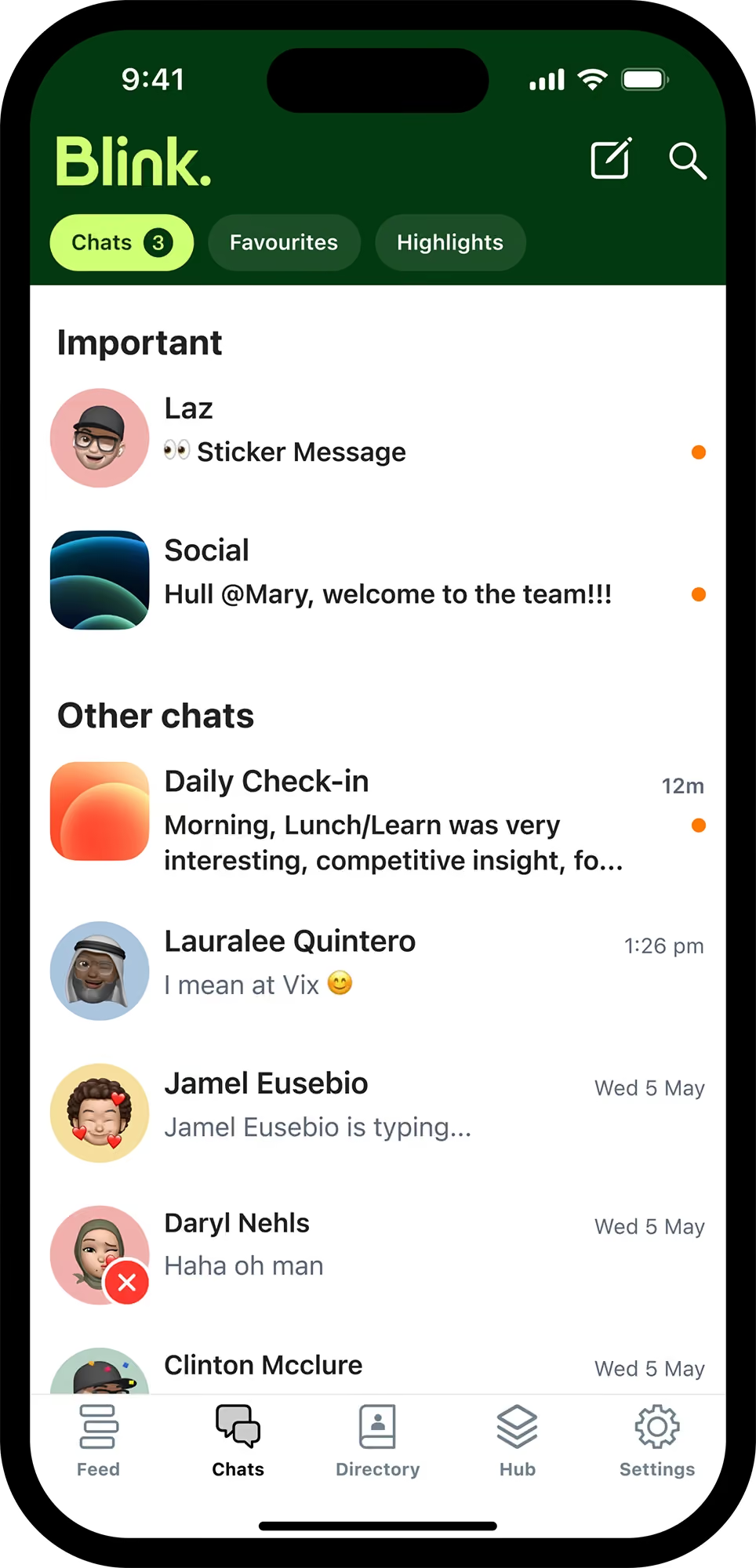
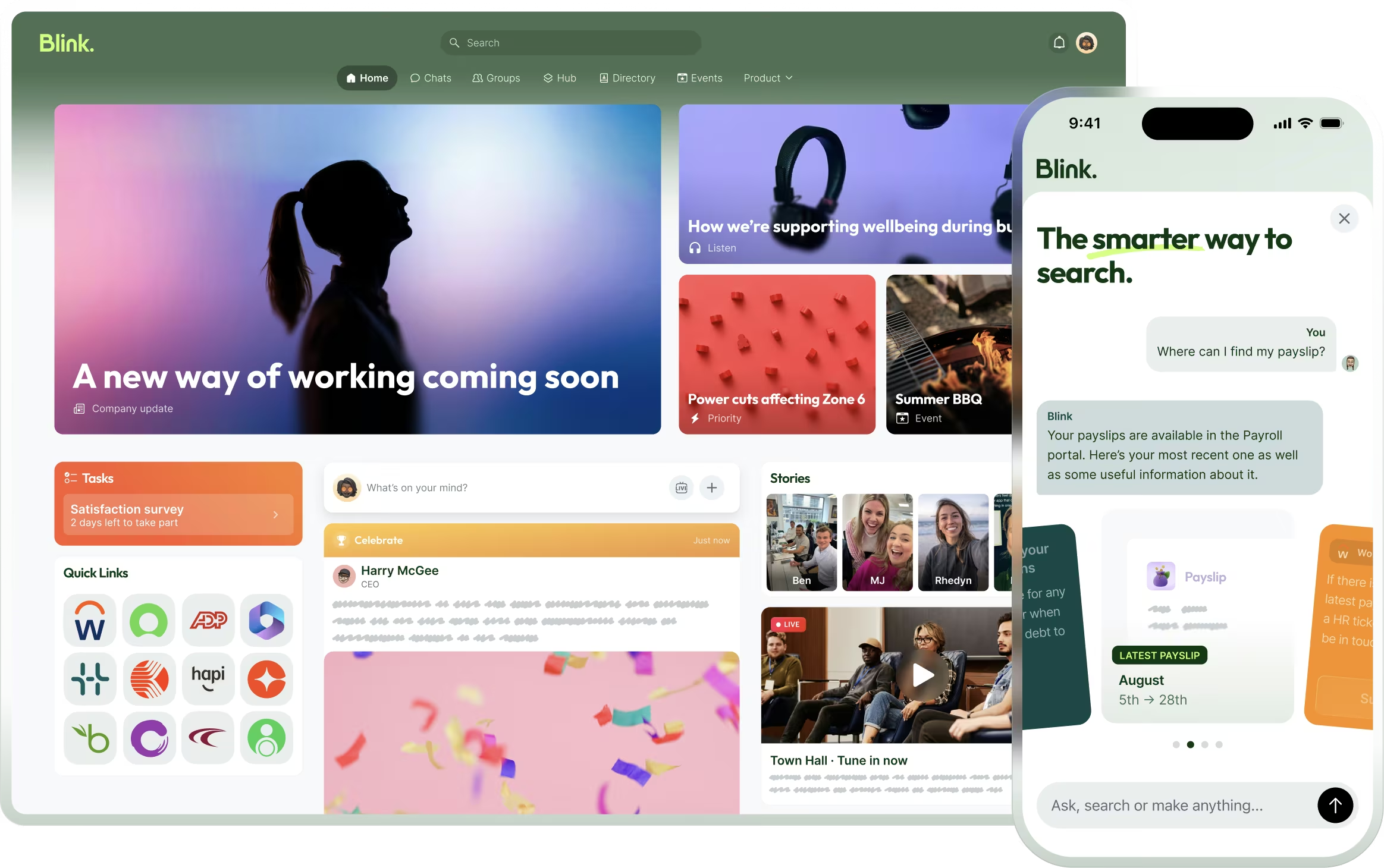
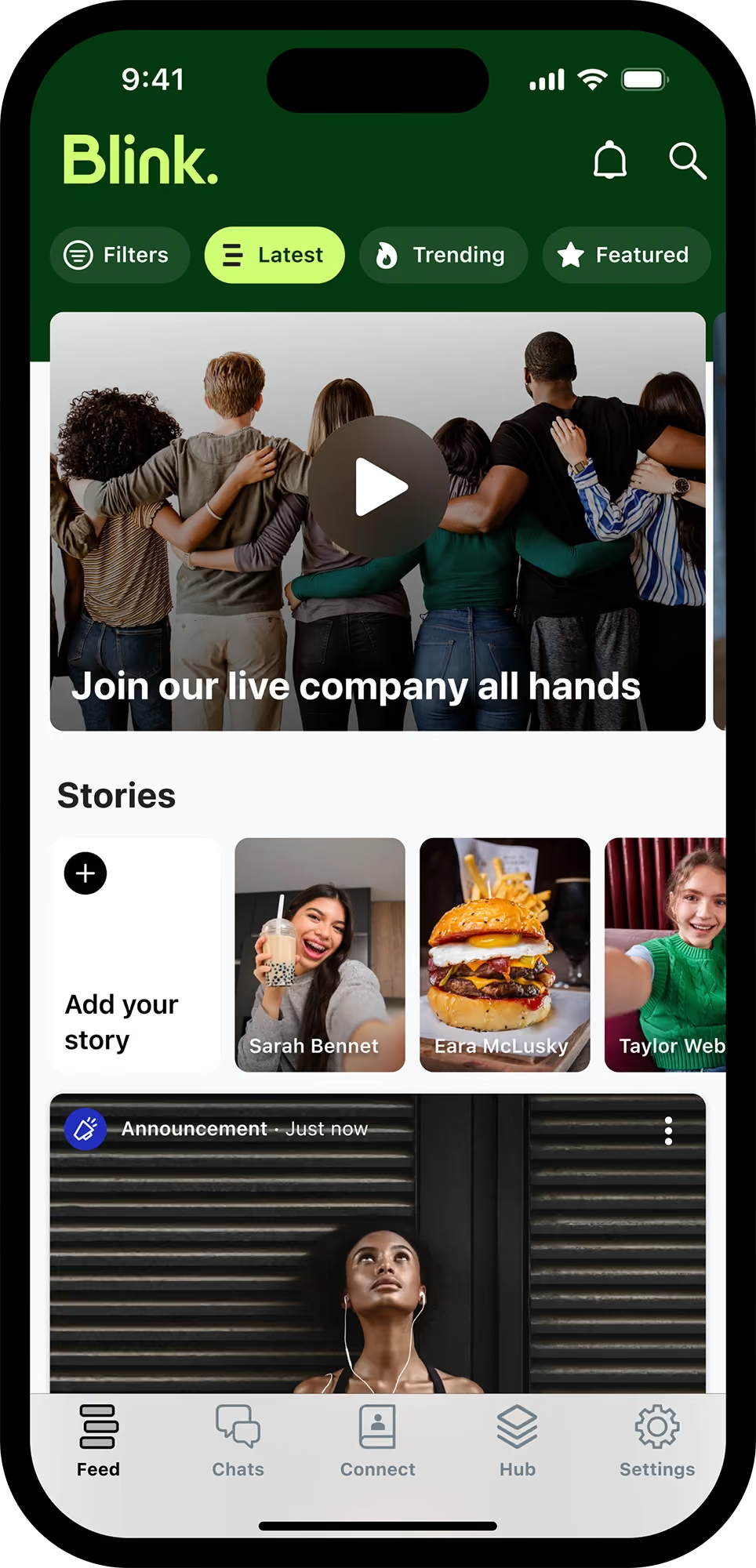
Mobile experience. Both apps work on a phone. The difference is what loads when a worker opens it. Blink. leads with a personalized feed and a searchable Hub. Beekeeper leads with streams and operational workflows. For mixed workforces and engagement-led rollouts, Blink.'s home screen does more on first open.
Mobile experience and frontline adoption

Both products are mobile-first. The honest read on adoption signals:

  • Blink. publishes adoption rates above 90% across customer case studies, with a UI built specifically for workers who only ever use the app on a phone. (Blink. customers)
  • Beekeeper publishes similar high-adoption numbers and has a longer track record in very large hotel and manufacturing deployments.

The differentiator isn't whether either app works on a phone. Both do. It's what the worker sees when they open it. Blink.'s home screen leads with a personalized feed and Hub. Beekeeper's leads with streams and operational workflows.
Migration considerations: moving from Beekeeper to Blink.

If you're a current Beekeeper customer evaluating alternatives because of the LumApps merger, the practical migration questions:

  • Content export. Both platforms support data export. Confirm the format with each vendor.
  • User provisioning. Blink. integrates with the major IdPs (Okta, Azure AD, Google). Most Beekeeper customers can re-provision in days, not weeks.
  • Integrations. Audit which third-party connectors you depend on today. Blink. ships direct integrations with the most common systems, which reduces ongoing Zapier or middleware costs.
  • Timeline. A typical Blink. SMB rollout takes 2 to 6 weeks end-to-end. Larger or multilingual rollouts run 6 to 12 weeks.

The team at Blink. handles migration planning and content import directly. If you want a structured assessment, request one here.

Final word

Beekeeper is a capable product with real strengths, especially around shift scheduling and inline translation.The LumApps acquisition doesn't make it a bad choice. It does make it a different choice than it was 18 months ago. New buyers should know they're signing into a multi-year integration and ask the right questions about roadmap and pricing.

Blink. is built mobile-first for frontline teams, with a unified Hub, transparent pricing, and an independent roadmap focused entirely on this audience. If those things matter to you, start a free trial and put it side-by-side with Beekeeper on your real use cases.

Frequently asked questions

Has Beekeeper been acquired?

Yes. LumApps announced a definitive agreement to acquire Beekeeper in April 2025. The deal closed in July 2025 and values the combined company at more than $1 billion.

Will Beekeeper be shut down?

Not in the short term. LumApps has publicly stated there are no short-term sunset plans for either platform during the integration. The combined offering is expected over 12 to 18 months, with a 24-month integration roadmap.

Who owns LumApps and Beekeeper now?

The combined company is backed by Bridgepoint, a European private equity group that acquired a majority stake in LumApps in 2024 and now owns the merged business.

How does Blink compare to Beekeeper on pricing?

Blink. publishes per-user pricing starting at $3.75/user/month on the Core annual plan. Beekeeper does not publish pricing, and third-party sources cite a range of roughly $5 to $15/user/month depending on modules, plus implementation fees.

Can I try Beekeeper and Blink before buying?

Yes. Blink. offers a free trial across all tiers. Beekeeper offers a 14-day premium trial and a free plan for up to 30 users.

Which is better for a mixed frontline and office workforce?

Blink. is built for mixed workforces where frontline workers and head-office staff need the same app. Beekeeper is primarily frontline-only, and LumApps (its new parent) handles the desk-worker side separately. If you have both audiences and want one platform, Blink. is the more direct fit.

If you're comparing Beekeeper and Blink. right now, the most important fact is the one most comparison articles still miss. Beekeeper was acquired by LumApps in July 2025, in a deal valuing the combined company at more than $1 billion. The integration roadmap runs 12 to 24 months. That changes how buyers should weigh this decision.

This guide gives you a current, objective comparison. What each platform actually does, what the LumApps merger means for new Beekeeper buyers, where the two products differ, and how to choose.

The short answer

Pick Blink. if you want a mobile-first frontline platform with an independent product roadmap, transparent per-user pricing, and a single app that combines comms, a searchable knowledge hub, and chat. Blink. starts at $3.75 per user per month.

Pick Beekeeper (now part of LumApps) if you need built-in shift scheduling and inline translation as core day-one features, you want to replace your existing scheduling tool rather than integrate with it, and you're comfortable buying into a platform mid-integration with a larger desk-worker intranet (LumApps).

Both are real options. The right choice depends on your workforce mix and how much integration risk you can absorb.

What changed: the LumApps acquisition explained

In April 2025, LumApps and Beekeeper announced a definitive agreement to merge. The deal closed in July 2025. Here's what's publicly confirmed:

  • The combined company is valued at over $1 billion, backed by private equity group Bridgepoint, which already held a majority stake in LumApps from 2024. (Bridgepoint announcement)
  • The merged business serves around 7 million users across 2,000+ clients, with roughly $150 million in recurring revenue and 600+ employees. (LumApps press release)
  • The combined product is being positioned as an "AI Employee Hub" for both desk-based and frontline workers. (Forrester analysis)
  • A fully integrated platform is expected over 12 to 18 months, with a 24-month integration roadmap covering infrastructure, user provisioning, and mobile apps. (Reworked coverage)
  • LumApps has confirmed there are no short-term sunset plans for either platform during the integration. (LumApps + Beekeeper hub)

This isn't a small bolt-on. LumApps is primarily a desk-worker intranet on Google Workspace and Microsoft 365. Beekeeper is a mobile-first frontline app. Merging them into a single hub is a multi-year engineering and product effort. New Beekeeper buyers should understand they're buying into the start of that journey, not the end of it.

What buyers should ask before signing with Beekeeper today

These are fair questions to ask any Beekeeper sales contact in 2026:

  1. Which Beekeeper modules are on the combined-platform roadmap, and which will be retired or rebuilt on LumApps infrastructure?
  2. If our contract spans the 24-month integration, what's our migration path if functionality moves to a different SKU or pricing tier?
  3. How does pricing change once we're on the combined LumApps + Beekeeper platform?
  4. Which engineering and product leaders from Beekeeper are committed through the integration?

There are no wrong answers here. There are only answers you should hear before you sign.

Comparison point
Blink.
Beekeeper (LumApps Group)
Ownership
Independent, frontline-focused
Acquired by LumApps in July 2025, backed by Bridgepoint
Product roadmap
Single product, frontline-first
Mid-integration with LumApps intranet, 12 to 24 months
Starting price
$3.75/user/month (Core, annual)
Not published, third parties cite $5 to $15/user/month
Free trial
Free trial across all tiers
14-day premium trial, free plan up to 30 users
Best for
Mobile-first frontline teams, mixed office and frontline workforces
Shift-based operations wanting native scheduling and inline translation in one app
Knowledge hub
Unified, searchable Hub in-app
Streams and channels, less unified search
Shift scheduling
Integrates with your existing scheduler
Native built-in scheduling
Chat: delete and forward
Yes
No (per user reviews)
Inline translation
Multi-language publishing on Pro
150+ languages, inline
Integrations
Direct native (Microsoft 365, Salesforce, IdPs)
Mix of native and Zapier-based
Digital signage
Not offered
Yes, break room displays
AI assistant
Included on Pro
Roadmap item under "AI Employee Hub" combined product

Where Beekeeper is genuinely strong

To be fair to Beekeeper, it has real product depth in a few areas:

  • Shift scheduling is native, not an add-on. Built-in scheduling, swaps, and time-off requests. For operators who want comms and scheduling in the same app, that's a meaningful day-one feature.
  • Inline translation across 150+ languages. Useful for multilingual frontline workforces where messages need to land in the worker's language without an extra step.
  • Mature workflow automation. Onboarding flows, chatbots, and operational checklists are well-developed and documented.

If those three features are non-negotiable for your rollout, Beekeeper covers them out of the box.

Where Blink. is genuinely strong

Blink. is built mobile-first for frontline teams and competes head-to-head in the same buying conversations. Where it pulls ahead:

  • Unified Hub. Blink. combines a feed, chat, and a searchable knowledge hub in one app. Documents, policies, and SOPs are all findable in the same place a worker reads comms.
  • Mobile-first content experience. Built for workers who don't have a desk or a corporate email address. Rich post formatting, embeds, and emoji support in the feed.
  • Transparent per-user pricing. $3.75/user/month on the Core annual plan, $5.00/user/month on Pro, with a free trial across all tiers. No quote-only walls for SMB buyers. (Blink. pricing)
  • Independent product roadmap. Blink. is not mid-integration with a larger desk intranet. The roadmap is fully focused on frontline use cases.
  • Direct integrations. Native connections to Microsoft 365, Salesforce, and other workforce systems, rather than relying on third-party connectors for security-sensitive flows.

Pricing: what you actually pay

Blink. publishes pricing on its website. As of May 2026:

  • Core: $3.75/user/month (annual) or $5.60/user/month (monthly). Includes feed, chat, Hub, custom branding.
  • Pro: $5.00/user/month (annual) or $7.00/user/month (monthly). Adds events, live streaming, multi-language publishing, AI assistant, and priority support.
  • Enterprise: custom, with advanced admin, API access, surveys, dedicated CSM, and SLAs.

Free trial available across all tiers. Source: Blink. pricing page.

Beekeeper does not publish pricing. Third-party trackers report a per-user, per-month range of roughly $5 to $15 depending on modules, plus implementation fees that range from around $1,000 for small deployments up to $50,000+ for larger ones. A free plan for up to 30 users and a 14-day premium trial are available. Sources: Capterra pricing tracker, TrustRadius pricing, GetApp listing.

The practical difference: Blink.'s pricing is predictable per seat. Beekeeper's depends on which modules and add-ons you enable and is harder to forecast before a sales conversation.

Feature comparison

Feed and content. Blink.'s feed sits next to a unified Hub where documents, policies, and SOPs are searchable in the same app workers read messages in. Beekeeper organizes content into multiple streams, and user reviews on G2 frequently note that documents are harder to find compared to chat or feed posts. For frontline workers searching one-handed on a shift, that difference compounds every day.

Chat. Blink. supports message deletion, forwarding, and saving in group chats. Beekeeper users on G2 and Capterra have flagged the inability to delete old chats as a long-running frustration. Small detail, daily impact.

Scheduling. Beekeeper replaces your scheduler. Blink. partners with it. If you already run Deputy, When I Work, Quinyx, or a workforce management system, Blink. integrates without forcing a rip-and-replace. That keeps your shift logic, payroll exports, and labor rules where they already work, and puts comms next to them in one app workers actually open.

Integrations and IT load. Blink. ships direct native integrations with Microsoft 365, Salesforce, and the major identity providers (Okta, Azure AD, Google). Beekeeper relies on a mix of native and Zapier-based connectors for many of the same flows. For IT and security teams, that's fewer middleware points to audit and fewer third-party data hops to review.

AI: shipping vs roadmap. Blink.'s AI assistant is live on the Pro tier today, helping admins draft posts, translate, and surface content for workers. Beekeeper's AI features are now tied to the combined "AI Employee Hub" with LumApps, which is on a 12 to 18 month build. If AI is part of your decision, the practical question is whether you want it in your hands now or in the roadmap.

Mobile experience. Both apps work on a phone. The difference is what loads when a worker opens it. Blink. leads with a personalized feed and a searchable Hub. Beekeeper leads with streams and operational workflows. For mixed workforces and engagement-led rollouts, Blink.'s home screen does more on first open.

Mobile experience and frontline adoption

Both products are mobile-first. The honest read on adoption signals:

  • Blink. publishes adoption rates above 90% across customer case studies, with a UI built specifically for workers who only ever use the app on a phone. (Blink. customers)
  • Beekeeper publishes similar high-adoption numbers and has a longer track record in very large hotel and manufacturing deployments.

The differentiator isn't whether either app works on a phone. Both do. It's what the worker sees when they open it. Blink.'s home screen leads with a personalized feed and Hub. Beekeeper's leads with streams and operational workflows.

Migration considerations: moving from Beekeeper to Blink.

If you're a current Beekeeper customer evaluating alternatives because of the LumApps merger, the practical migration questions:

  • Content export. Both platforms support data export. Confirm the format with each vendor.
  • User provisioning. Blink. integrates with the major IdPs (Okta, Azure AD, Google). Most Beekeeper customers can re-provision in days, not weeks.
  • Integrations. Audit which third-party connectors you depend on today. Blink. ships direct integrations with the most common systems, which reduces ongoing Zapier or middleware costs.
  • Timeline. A typical Blink. SMB rollout takes 2 to 6 weeks end-to-end. Larger or multilingual rollouts run 6 to 12 weeks.

The team at Blink. handles migration planning and content import directly. If you want a structured assessment, request one here.

Final word

Beekeeper is a capable product with real strengths, especially around shift scheduling and inline translation.The LumApps acquisition doesn't make it a bad choice. It does make it a different choice than it was 18 months ago. New buyers should know they're signing into a multi-year integration and ask the right questions about roadmap and pricing.

Blink. is built mobile-first for frontline teams, with a unified Hub, transparent pricing, and an independent roadmap focused entirely on this audience. If those things matter to you, start a free trial and put it side-by-side with Beekeeper on your real use cases.
Frequently asked questions

Has Beekeeper been acquired?

Yes. LumApps announced a definitive agreement to acquire Beekeeper in April 2025. The deal closed in July 2025 and values the combined company at more than $1 billion.

Will Beekeeper be shut down?

Not in the short term. LumApps has publicly stated there are no short-term sunset plans for either platform during the integration. The combined offering is expected over 12 to 18 months, with a 24-month integration roadmap.

Who owns LumApps and Beekeeper now?

The combined company is backed by Bridgepoint, a European private equity group that acquired a majority stake in LumApps in 2024 and now owns the merged business.

How does Blink compare to Beekeeper on pricing?

Blink. publishes per-user pricing starting at $3.75/user/month on the Core annual plan. Beekeeper does not publish pricing, and third-party sources cite a range of roughly $5 to $15/user/month depending on modules, plus implementation fees.

Can I try Beekeeper and Blink before buying?

Yes. Blink. offers a free trial across all tiers. Beekeeper offers a 14-day premium trial and a free plan for up to 30 users.

Which is better for a mixed frontline and office workforce?

Blink. is built for mixed workforces where frontline workers and head-office staff need the same app. Beekeeper is primarily frontline-only, and LumApps (its new parent) handles the desk-worker side separately. If you have both audiences and want one platform, Blink. is the more direct fit.

What we'll cover

Start your free trial today

See how Blink helps frontline teams stay connected, informed, and engaged.

Try Blink

Related Blogs